
 E-Paper



‘Show the terrorists' faces!’: Rahul Gandhi meets Vedant, student at centre of CBSE row, mocks familiar insults
Vedant's Physics answer-sheet scanning mix-up was also acknowledged and corrected by CBSE; but he was abused by several handles on X and otherwise

 Prefer HTon Google


Class 12 student Vedant Shrivastava, whose X post went viral after he got the wrong answer sheet from CBSE as part of its on-screen marking (OSM) system, met Leader of Opposition Rahul Gandhi where they spoke about familiar insults being thrown at them, such as “anti-national” and “deep state agents” or being called Pakistani.
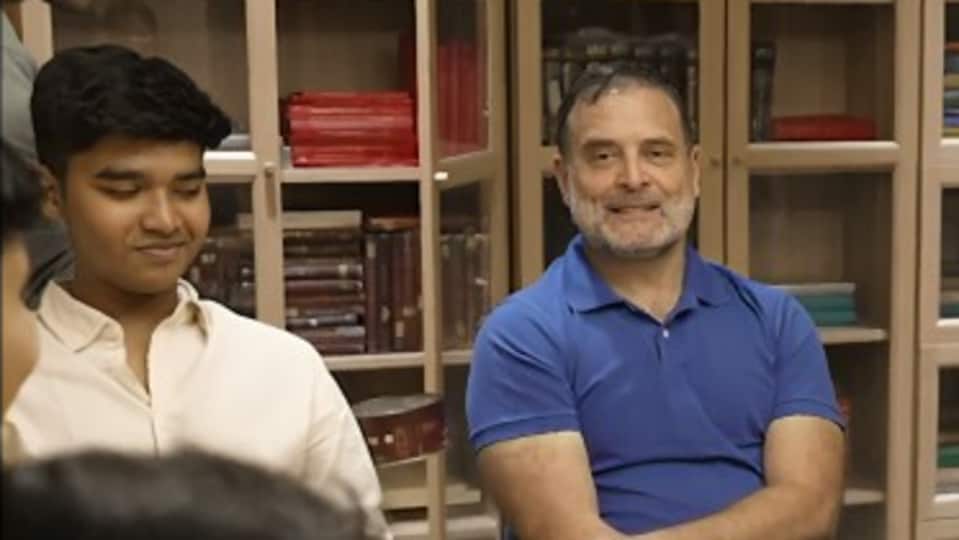
They laughed at also being called “Soros agents”, a reference to Hungarian-American investor and philanthropist George Soros whom the Hindutva right-wing accuses of funding “left-wing agenda” among other things.
"Were you also called ‘terrorists’? Tell me!" Gandhi asks Vedant, his brother and some other students in the 90-second clip from what appears to be a larger video that remained to be released as of Sunday, May 31.
Vedant's elder brother Siddhant Srivastava responds with a smile: “Yes, yes!” He also explains how, after there was public uproar over the CBSE's mistake, “To shut us up… they [said] we are some ‘deep state agents trying to create unrest in India’.”
Also read | What's a Honey Singh song doing in the CBSE row? Teen hacker's mic-drop meme as board 'admits' gaps
Gandhi laughs along, and tells the cameraperson: “Seventeen-year-old ‘deep state agents’! Show their faces... Come on, show the faces of these ‘terrorists’!”
In his X post caption, Gandhi wrote in a mix of this tone, mocking the allegations and raising the CBSE issue.
“A revealing chat with my fellow 'anti-national Soros agents',” he wrote. “Vedant and his friends are brilliant, brave young Indians who asked CBSE and the Modi government simple questions — but got insults instead of answers. They deserve a bright and secure future. We will make sure they get it,” he added.
What is Vedant's case?
Delhi resident Vedant's case became the public face of a wider controversy over CBSE's first-time use of on-screen marking. His X post, which crossed 2.5 million views on X, said he and his family found that the handwriting on the Physics answer sheet supplied by the board did not match his own. He said the Physics sheet differed entirely from his English and Computer Science answer sheets and from his handwritten notes.
The board responded as it blew up, and said to Vedant on X that his concern had been examined, that the correct copy of his answer book had been sent to his registered email, and that his result would be updated as applicable. That was done later.
In between came personal attacks as several X users questioned whether his newly created handle really belonged to a CBSE student.
Some social media accounts saw in it “a plot to destabilise” the Narendra Modi government. A TV anchor's post calling him “Pakistani” went viral in particular, though he later apologised.
Vedant's brother, Siddhant, explained that a new X account for Vedant had been set up only to raise the grievance because they felt there was no clear way to report the problem. Rahul Gandhi was among those who publicly took his side and amplified his post.
Gen-Z blog blew up, meanwhile
The episode fed a broader political fight over how the marking contract was awarded.
At the centre of that, too, landed a 17-year-old student.Sarthak Sidhant, a Class 12 student from Jharkhand, published an investigation into how the OSM system's tender was awarded by the CBSE.
Rahul Gandhi and other leaders shared Sidhant's blog and demanded an independent judicial probe. OSM contractor Coempt Edutech and CBSE have rejected the allegations.
A fall in CBSE pass percentage originally led to questions over the OSM system, and some students reported errors and mix-ups.
While PM Modi has not spoken on it, education minister Dharmendra Pradhan took “full responsibility” and said he would ensure no further issues come up.
The CBSE OSM controversy, in fact, arrived at a fraught moment for the government-run exam system, barely three weeks after the NEET-UG medical entrance examination was cancelled due to a paper leak. The National Testing Agency (NTA) faced more heat on Saturday after a technical glitch delayed the CUET-UG 2026 at several examination centres.


