
 E-Paper



3 of 5 Padma Vibhushan go to Kerala as south gets large share in Republic Day honours; Bengal number goes up too
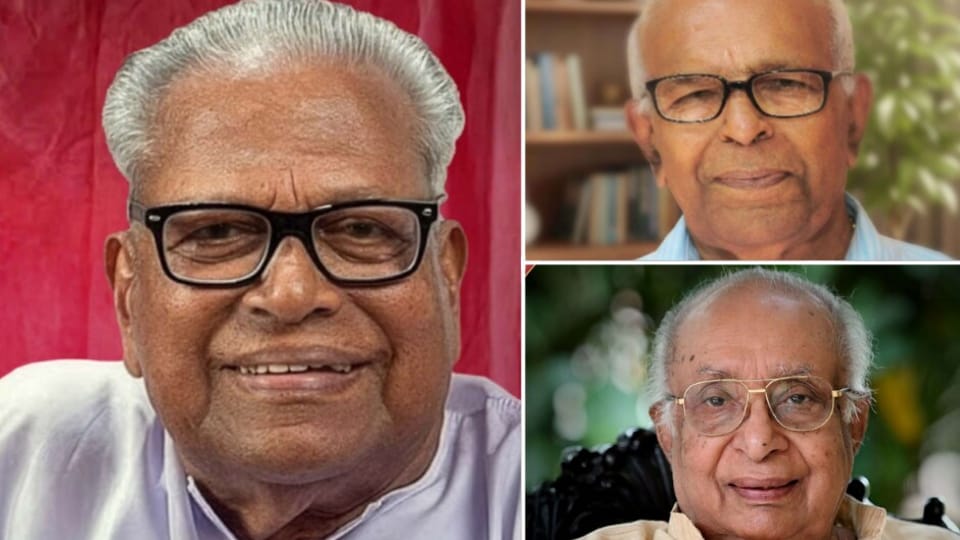
Kerala got eight total awards; three Padma Vibhushan awardees from the state are ex-judge KT Thomas, RSS veteran P Narayanan, and the late ex-CM Achuthanandhan

 Prefer HTon Google


The list of Padma awardees on the eve of Republic Day 2026 had, in terms of regions, robust representation from the southern states, particularly Tamil Nadu and Kerala. An analysis of the lists reveals some region- and state-wise patterns in the distribution of the 131 Padma awards this year.
Here: See full list of Padma awardees 2026
Which state got the most Padma awards?
Maharashtra leads the nation in total awards, with 15 recipients across levels: one Padma Vibhushan (actor Dharmendra Singh Deol), three Padma Bhushan (singer Alka Yagnik, adman Piyush Pandey, businessman Uday Kotak), and 11 Padma Shri awards. It got 14 Padma awards in 2025.
After the Bharat Ratna, Padma Vibhushan is the second highest civilian award in India, followed by Padma Bhushan and Padma Shri.
Tamil Nadu gets 13 awards
Among states, Tamil Nadu comes second on the 2026 list with 13 awards — its total number same as last year — with its presence mostly in the Padma Shri category (11 awards), and two Padma Bhushan recipients (gastroenterologist Kallipatti Ramasamy Palaniswamy and industrialist SKM Maeilanandhan).
Uttar Pradesh and West Bengal have got 11 awards each. Uttar Pradesh’s list includes one Padma Vibhushan (violinist N Rajam) and 10 Padma Shri recipients. West Bengal’s recognition is exclusively in the Padma Shri category.
South gets a big share, Bengal number goes up too
Going by regions, South Indian states collectively account for around 40 of the 131 awards.
Both Kerala and Tamil Nadu in the south are set for high-stakes elections — as are West Bengal and Assam in the east — within months. While Assam has a strong BJP presence, at the other three places the Centre's ruling party led by PM Narendra Modi is hoping to make a mark after decades of attempts.
In 2025, South India (considering Tamil Nadu, Karnataka, Kerala, Telangana, Andhra Pradesh, and Puducherry) received 36 awards. This time, the region's influence expanded by five awards.
West India, counting Maharashtra and Gujarat, saw its total slightly dip from 23 awards in 2025 to 20 in 2026. But Maharashtra saw an increase in higher-level recognition in 2026, receiving four Padma Bhushan awards compared to three in the previous year.
North India (including Uttar Pradesh, Delhi, Punjab, Haryana, Chandigarh, Rajasthan, and others) saw a decrease from 33 awards in 2025 to 27 in 2026. The East and Northeast regions, which held 34 awards in 2025, recorded 30 in 2026.
Here, West Bengal saw its number go up, from eight Padma Shri recipients in 2025 to 11 in 2026. Assam maintained a steady presence with six awards in 2025 and four in 2026. These two states are set for elections soon.
Kerala number goes up, honour level too
Kerala got eight total awards, which is not particularly high as against other states, but more than the five it got last year.
It has got high-level recognition, though, this time — three out of the five Padma Vibhushan awards have gone to people from the state. These include former judge KT Thomas; and the late communist leader VS Achuthanandhan, an ex-CM.
VS Achuthanandan was born on October 20, 1923, in Punnapra in Allapuzha district, and served as Kerala's chief minister from 2006 to 2011.
KT Thomas is a former Supreme Court judge who “contributed to judicial policy, chaired key committees and championed law reforms”, the government communique said.
P Narayanan is a third Malayali who has been awarded the Padma Vibhushan. He is a senior Rashtriya Swayamsevak Sangh (RSS) leader in the state, and has been picked under the literature and education category. The government press release described hims as: “Eminent Malayalam journalist dedicated to social reformation & national reconstruction. Translated 40 books from different languages into Malayalam.”
Among the southern states, Telangana received seven awards, all in the Padma Shri category. Karnataka received eight awards, including one Padma Bhushan for author Shatavadhani R Ganesh.
Of the 131 awardees, 16 have been chosen posthumously.


