E-Paper



5 states hit as fog grips north India; no relief for next 48 hours
Two people were killed and 15 were injured in separate incidents due to low visibility in Uttar Pradesh, as dense fog engulfed several parts of north India for the second consecutive day.


Two people were killed and 15 were injured in separate incidents due to low visibility in Uttar Pradesh, as dense fog engulfed several parts of north India for the second consecutive day.
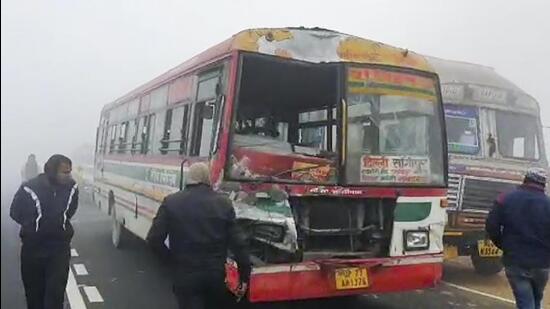
The India Metoerological Department (IMD) issued an advisory and said such conditions are likely to prevail over the Indo-Gangetic plains at least for the next two days.
Dense to very dense fog conditions were seen over most parts of Punjab, Haryana, Chandigarh, Delhi and some parts of Uttar Pradesh.
Cold wave conditions were observed in isolated pockets over Punjab and Himachal Pradesh. The minimum temperature hovered in the range of 3 to 5 degrees Celsius over parts of Punjab and Haryana, and in the range of 6 to 9 degree Celsius over remaining parts of Punjab, Haryana, Chandigarh, New Delhi, Uttar Pradesh and Bihar.
Several trains in the national capital were reported to be running late by a few hours due to poor visibility induced by fog. Flight operations, however, remained unaffected.
In Uttar Pradesh’s Bulandshahr, a truck driver was killed and six people were injured in a pile-up involving several vehicles on Bulandshahr-Aligarh road under Arnia police station area.
The driver of a mini-truck lost control of the vehicle after one of its tyres burst. As a result, a roadways bus, a canter and some other small vehicles behind the mini-truck collided with each other, additional superintendent of police (rural) Bajrang Bali Chaurasia said.
The injured were rushed to the hospital and the damaged vehicles were removed from the road with the help of cranes.
In Kaushambi, a 25-year-old man was travelling with his friend on a motorcycle when their two-wheeler hit a stationary truck near Sayara overbridge on the Prayagraj-Kanpur road around 9am due to low visibility, police said. The man died in the incident and his friend was admitted to a hospital in a critical condition.
In Sitapur, eight people were injured when the van in which they were travelling hit a stationary truck due to low visibility, police said. Six school students were injured when a school van collided with a milk tanker near Pinahat town of Agra rural.
Due to the presence of moisture and light winds at lower tropospheric levels over the Indo-Gangetic plains, dense to very dense fog is likely in some pockets over Punjab, Haryana, Chandigarh, Delhi and Uttar Pradesh for the next two days. Dense fog is also likely over Himachal Pradesh for the next five days and in the Himalayan West Bengal and Sikkim for the next two days, the IMD predicted.
While no significant change is expected in minimum temperatures over northwest India in the next two days, it is likely to fall by 2 degrees Celsius thereafter, the weather body said.
Due to north-north westerly winds from Himalayas, cold wave conditions are likely to continue in isolated pockets of Himachal Pradesh, Punjab, Haryana and north Rajasthan for the next five days. Severe cold wave conditions are likely over Punjab on December 22 and 25, according to the IMD.
No significant change in minimum temperatures is also expected over east India for the two days but a rise by 2-3 degree Celsius thereafter.
“Punjab, Haryana, Uttar Pradesh and Delhi are impacted by dense fog for a second day. The visibility was extremely low in Lucknow, Amritsar, Chandigarh, Delhi, etc, because of which aviation and railways may have been impacted. There is a cold wave in isolated areas over northwest India. Cold, northwesterly winds are impacting the region,” RK Jenamani, senior scientist at IMD, said.
“There was a dense layer of fog and smog over the entire Indo-Gangetic plains region. This could be seen clearly in satellite imagery. Interestingly, there was no western disturbance that led to a drop in temperature. The northern winds are light and there is a slight rise in humidity in the morning hours leading to condensation,” Mahesh Palawat, vice president, climate change and meteorology at Skymet Weather, said.
Western disturbances are cyclonic formations originating in the Mediterranean that bring winter rain and snow to northwest India starting November. Typically, northwest India sees 2-3 moderate to strong western disturbances in November and 2-3 in December. This year it saw none since November 10 , a situation that hasn’t changed thus far in December.
“There was no western disturbance that brought snowfall to the hills. The drop in temperature is due to a seasonal shift towards peak winter conditions,” Jenamani said.
According to IMD, there has been hardly any snow in the upper and lower reaches of Himalayas in December because of the absence of a strong western disturbance, HT reported on December 17. Many Himalayan peaks remain brown at a time when they should have received at least a couple of moderate spells of snowfall.
“We are seeing a build-up of fog and smog because pollutants are also sticking to the cold, humid air. Though there is no major drop in temperatures, the smog layer is obscuring sunshine,” Palawat said.