
 E-Paper



5 tribal villages at epicentre of the unending ethnic conflict
Authorities are convinced the five villages are home to militants who travelled almost 250km to Jiribam.

 Prefer HTon Google


Imphal/Churachandpur Muolvaiphei, Valpakot, Ngurte, Thenmol and Khawpuibing are non -descript Hmar dominated tribal villages in Manipur’s Churachandpur district, nearly 65 km away from the state capital, Imphal.
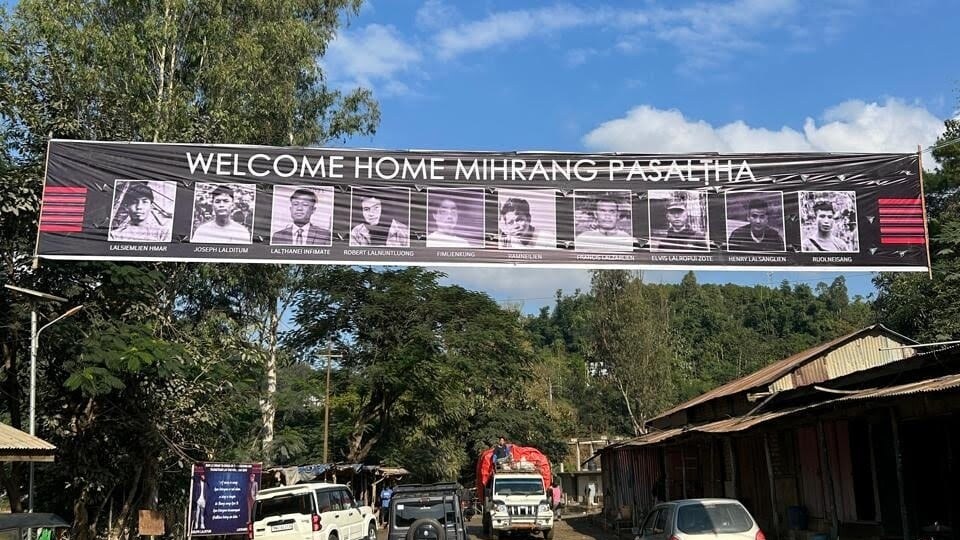
They are also the epicentre of an investigation into a heinous crime and the site of possibly a new fracture in a state which has been wracked by 18 months of ethnic conflict.
The state government and security forces are convinced the five villages are home to militants who travelled almost 250km to Jiribam, a town bordering Manipur-Assam, attacked security forces on November 11, and killed two Meitei elderly residents. It is believed there were 30-40 of them; 10 were killed in an ensuing shoot-out with security forces. The survivors escaped, but with six Meiteis, women and children (the youngest was eight months old) whose bodies were found in various locations in Jiribam and across the border in Assam. Protests that have roiled Imphal over the past week, including the vandalisation of the houses of legislators and ministers, are a sign of public anger at the state’s failure to rescue the women and children.
For the Kuki-Zo-Hmar tribal residents of Manipur, the 10 are heroes and martyrs. The town of Churachandpur is dotted with photographs of the 10 men. There are posters, which read – Welcome Home. Others say, Honour to our fallen heroes.
On November 18 when the bodies were airlifted to Churachandpur by security forces, Kuki-Zo-Hmar legislators, including local MLA LM Khaute, also the former chief of Manipur police between 2016 and 2021, who received the bodies, dismissed allegations of the state government and security forces that the men were militants; their families claimed the men were all civilians, who took up arms to defend their villages in the wake of the ethnic conflict in the state.
Read more: Manipur murders: Autopsy of all six bodies done; families not ready to accept them for last rites
Tinneilam, wife of Lalseiemlin Hmar(34), one of the slain gunmen, said her husband is not a militant but a computer graphic designer. “We have a computer accessories shop in Churachandpur. Last year, he went to the frontline to defend the villages. He is a civilian to who took up arms in this conflict. Until the pandemic in 2020, he was in Delhi and did a computer course there. He is not a militant.”
Ramhmasoum, who is the elder brother of slain gunman, Lalthanei Infinate(23) , the youngest of the 10 alleged militants, said his brother is a painter.
“I refuse to believe that my son and his friends abducted and later murdered the women and children. Before the conflict, he wanted to study and was ready to give his class 10 exam from National Institute of Open Learning,” said Vanthleiphui, mother of Ruolnesiang(22).
At least 250 people have been killed and over 50,000 rendered homeless in the ethnic conflict between the Meiteis and Kuki-Zo-Hmar tribal groups that started on May 3 last year.
The five villages are on the radar of security agencies that believe they hold the key to identity of the men, behind the killing of the six women and children.
“The truth behind the killing of the six women and children is in those villages. These are prominent Hmar villages, so the gunmen are all from here. All the 10 men killed, who are from the Hmar tribe, were from those five villages so one can assume that the 30-40 gunmen who went to Jiribam that afternoon are from there only. If the NIA manages to conduct raids in the villages, the identity of all the other gunmen will become clear,” said a senior police officer posted in Manipur’s Imphal valley.
Following the protests in Imphal, the cases have been transferred to NIA, a federal agency. Images of decomposed bodies such as one showing the headless body of a two-and-half-year-old fanned tension in Imphal, prompting the government to black out the internet.
The five villages are also being closely watched by security forces and intelligence agencies because they have suddenly become a meeting ground for all Kuki-Zo-Tribal leaders.
The leaders have been meeting to discuss the killing of the 10, protest what they term as the slaughter of civilians by the central security forces, ways to encourage young men to stay on the frontline, defending their villages, and counters to the allegation that the Hmar gunmen killed six unarmed women and children.
The Hmar Community has refused to bury the 10 men until they get copies of post-mortem reports from the government. Following the shootout, Kuki-Zo-Hmar tribals were quick to term the 10 men “martrys” and announce that the bodies would be transported road from Silchar(Assam) to Churachandpur for tribals to pay their last respects; in response, security forces airlifted the body directly to Churachandpur fearing a potential breakdown in law and order.
“We believe the men were tortured and killed. This is why we are asking for the postmortem reports. If that is not done, we will not bury the bodies. If they deny us the reports, a second postmortem will be conducted at the Churachandpur district hospital,”said Ramneisang Faiheng, development secretary of the Hmar Students Association (HSA).
Each of the villages in Churachandpur has sent groups of 15-20 to guard the Churachandpur district hospital to ensure that there are people to watch the mortuary.
On a road leading to one of the villages , Mulovaiphei, the road is dotted with black flags and photograph of one of the 10 alleged militants killed, Lalthanei Infimate(22). “We have done this for all villages. They are not militants. They are village volunteers who went to defend our villages because a woman from our community was raped and murdered on November 7 there. Pherzawl district, which is thinly populated and shares its borders with both Churachandpur and Jiribam, became vulnerable to attacks from the Jiribam side so our village volunteers went there defend the Kuki-Zo people,” said a spokesperson from HSA.
The killings of the six women and children may have turned public opinion against the Kukis.
A senior officer from a security force posted in Churachandpur said,” During a peace meeting with the tribal community leaders here, we told them they made a mistake by killing those unarmed women and children. Nobody will forgive them for this crime. There is war going on in the state between these communities but even then, there is a code to be followed. We told them the national press and neutral people are now against them for the horrific killings. If they object to central agencies conducting raids in their village, they will only end up being on wrong side of national public opinion.”
The state government under Biren Singh, which has not tried very hard to hide its allegiance -- Singh is a Meitei himself -- is pressing home what it sees as an advantage. In a resolution dated November 18, the government asked for the militants to be declared as members of terrorist groups. The Centre has already sent over 70 companies of paramilitary forces to the state to ensure that the communities do not cross the buffer zones between valley and hills and attack each other. Most residents in these villages believe this will lead to massive operations by forces. Kuki-Zo-Hmar tribal MLAs, who are against Biren Singh, on Wednesday objected to the resolution calling for mass operations against only one community and instead demanded a dialogue to restore peace. “The Centre and state government must take all necessary steps to restore peace and normalcy in Manipur by way of initiating political dialogue to bring lasting peace in the troubled region,” the statement by the 10 rebel MLAs said.
The mood in Imphal’s streets against the Kuki-Hmar-Zo community is clear. An official from prominent umbrella Meitei group , COCOMI said, “Until the security agencies arrest all militants and smoke them out from their hideouts, the protests will continue. It will intensify further.”
A senior officer from a paramilitary force in Churachandpur, who asked not to be named, said, “Violence in Manipur has happened in waves. In this wave, the Kuki-Zo tribals have lost when it comes to public opinion. Young men and civilians from both sides have picked up arms. TTribal civil society organizations are suddenly hiding behind the age of the gunmen and pushing claims of them being farmers, painters, and innocent civilians. Maybe the village defence volunteers have gone rogue...”
The officer said there are many unanswered questions.
“These men are from five villages of Churachandpur. What were their doing in Jiribam almost 250 km away? It takes 10-12 hours to reach there. Whose villages were they protecting there? Most importantly, how will they explain the seized RPG launcher recovered from them? Where did they get it from?”
He, other security officers, and the state government, all believe the answers can be found in the five villages.
 ABOUT THE AUTHORPrawesh Lama
Prawesh Lama, an Associate Editor at Hindustan Times with nearly two decades of frontline reporting experience across India’s conflict zones, border regions, and disaster-hit areas. He writes on internal security, insurgency, the Northeast, and Left-wing extremism and has reported from India’s hinterland and some of the most sensitive and strategically critical regions.Read More


