
 E-Paper



9 die as seized explosives accidentally go off in J&K
The explosives were part of a larger haul of close to 2,900kg materials seized from Faridabad and transported to J&K, according to officials who said the smaller 360kg portion was brought by road in a pickup truck with the rest ferried by trucks

 Prefer HTon Google


Nine people were killed and 32 were injured when approximately 360 kg of confiscated explosives accidentally detonated during forensics sampling at the Nowgam police station late on Friday, senior officials said on Saturday, even as multiple state and federal police teams hunted for more suspects and clues over the alleged white-collar terror module behind the cache.
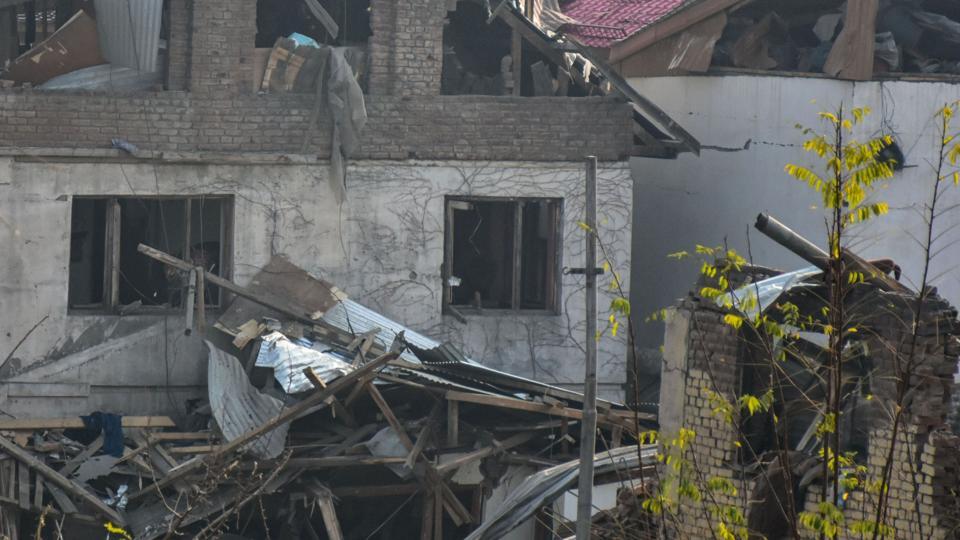
The explosives were part of a larger haul of close to 2,900kg materials seized from Faridabad and transported to Jammu and Kashmir, according to officials who said the smaller 360kg portion — which was highly explosive — was brought by road in a pickup truck with the rest ferried by trucks.
Among the dead were three members of a forensics team that was extracting samples when the explosive mix detonated, claiming also the lives of two revenue department officials, a state police inspector, two police photographers and a tailor working with the team.
“Due to the unstable and sensitive nature of the recovery, the sampling process, the handling was being done with extreme caution, with utmost caution by the forensics team,” Jammu and Kashmir police chief Nalin Prabhat said at a press conference in Srinagar. “However, unfortunately, during this course, last night around 11.20 pm, an accidental explosion took place.”
Prabhat and joint secretary of the Union home ministry Prashant Lokhande read out similar statements before the media in Srinagar and New Delhi, stressing that the incident was an unfortunate accident. Neither officer took questions from reporters.
Among the injured were 27 police personnel, two revenue officials, and three civilians from adjacent areas. All injured are said to be stable.
“Any other speculation into the cause of this incident is unnecessary,” Prabhat said, addressing claims by the Pakistan-based People’s Anti-Fascist Front (PAFF) that it was responsible for the blast.
The blast was heard within a radius of 10 to 15 kilometres and left the entire police station severely damaged, officials said. Dozens of houses in the vicinity were also damaged.
More than 50 people were present in the police station at the time of the explosion, including the Station House Officer who had a narrow escape along with several colleagues, according to officials.
“The officers of SIA, forensic laboratory and revenue officers were collecting samples in the police station, even the services of a local tailor was hired to collect samples in small bags when by accident a big blast took place which engulfed the entire police station in flames,” said an officer who visited the scene after the blast, asking not to be named.
“It took hours for the fire and emergency and SDRF teams to extinguish fire and collect the bodies and retrieve the injured. I have never witnessed such gory scenes in my life.”
According to an official aware of the material, much of the seized explosives and associated material — including chemicals, reagents, electronic circuits, batteries and timers — was destroyed. “Whatever was stored outside was destroyed. But a small quantity was also inside the police station that wasn’t destroyed,” this person added.
MHA official Lokhande, during the briefing in Delhi, said a detailed investigation into the precise trigger behind the blast will be carried out and reiterated appeals for the public to refrain from speculation until the inquiry is complete.
The sampling process had been ongoing for two days as forensic experts collected material from the voluminous cache and placed it in small bags for further forensic and chemical examination, Prabhat said.
In all, the close to 3,000kg haul seized from the alleged terror module included explosives, including in the form of ammonium nitrate, chemicals and reagents that were seized in multiple raids in Faridabad between the end of October and the days until November 10 when a white Hyundai i20 driven Dr Umar un-Nabi exploded outside Red Fort.
Taken to J&K
The material, seized in joint operations between Haryana and Jammu and Kashmir police, were in 12 suitcases, a bucket of semi-prepared chemical, and as 358 kg of ammonium nitrate. These were moved to Srinagar in a white Bolero pickup truck, escorted by armed officers, an official said, asking not to be named.
The rest, including 2,683 kg of ammonium nitrate, was transported through a registered transporter to Jammu and Kashmir Police for examination, the official added. “The explosive material was taken to Srinagar as part of the chain-of-custody requirement since the case is registered in J&K,” said a senior Jammu and Kashmir Police officer, asking not to be named. “All 12 suitcases and chemical samples were stored at Nowgam Police Station for forensic testing.”
A senior Jammu and Kashmir Police official said transporting such high-risk material by road was a massive challenge. “The officers took all safety precautions, but the composition’s volatility was beyond expectation,” the official said.
The ammonium nitrate in the suitcases was already chemically treated and ready for detonation, an investigator added. A Haryana Police officer said they tested one gram of the mixture to determine its power. “The intensity was alarmingly high — it confirmed the chemical composition had been perfected for an attack,” the officer said.
Nowgam station is key
The explosives were being stored and examined at Nowgam police station because that is where the investigation began and where FIR number 162/2025 was registered, making the seized material the station’s case property under chain of custody protocols, officials said.
The chain of events that led to the discovery of the terror module began when Nowgam station officers began investigating Jaish-e-Mohammed posters in the vicinity of Bonpora locality in mid-October.
Investigators now believe the group functioned as a “white-collar terror network” — a sophisticated syndicate of educated individuals using their academic credentials and technical expertise for extremist operations. At least six doctors linked to Al-Falah University are now under the scanner for facilitating logistics, financing, and recruitment.
Forensic experts suspect that the group had completed the mixing process and were preparing to deploy the explosives in multiple locations before being intercepted.
It was part of this terror campaign that Dr un-Nabi, a medical practitioner at Al Falah Medical College, allegedly carried out the Red Fort explosion in his car in busy traffic on November 10 evening. The blast was caused by the same type of material stockpiled in Faridabad, officials said.
Teams from the National Investigation Agency, Jammu and Kashmir Police, and Haryana Police continue to interrogate suspects and cross-verify call records, digital data, and financial trails. Forensic teams are still analysing remnants of the ammonium nitrate from both Faridabad and Srinagar, and examining whether some of the recovered chemicals were imported or locally synthesised.
Jammu and Kashmir Lieutenant Governor Manoj Sinha expressed anguish over the loss of lives and ordered a probe. “Deeply anguished by the loss of precious lives due to extremely tragic accidental blast at Nowgam Police Station in Srinagar. My condolences to the bereaved families. I pray for speedy recovery of the injured,” he said in a post on X.
“The government stands in solidarity with the families, friends, and loved ones of the departed. All possible assistance is being provided to those affected. I have ordered a probe to ascertain the cause of the accidental explosion.”
Jammu and Kashmir chief minister Omar Abdullah said the government will compensate for damages caused to nearby structures by the accidental blast at Nowgam police station.
Speaking to ANI in Srinagar, former J&K CM Farooq Abdullah criticised the manner in which the explosive material was dealt with by local authorities, stressing that those with proper expertise should have been consulted beforehand.
“This is our mistake, those who understand this explosive better, we should have talked to them first about how to deal with it instead of trying to handle it ourselves, you saw the result, nine people lost their lives. So much damage was caused to the houses there,” he said.
(With inputs from Prawesh Lama in New Delhi)


