
 E-Paper



Econ Nobel rewards work linking past, present links between innovation, growth and society
The uniqueness of this year’s award lies in its acknowledgment of diverse methodological approaches

 Prefer HTon Google


The Royal Swedish Academy of Sciences has conferred the 2025 Sveriges Riksbank Prize in Economic Sciences in Memory of Alfred Nobel—commonly referred to as the Nobel Prize in Economics—upon Joel Mokyr, Philippe Aghion, and Peter Howitt. This prestigious accolade has been awarded in recognition of their analysis of the determinants and correlates of long-term economic growth.
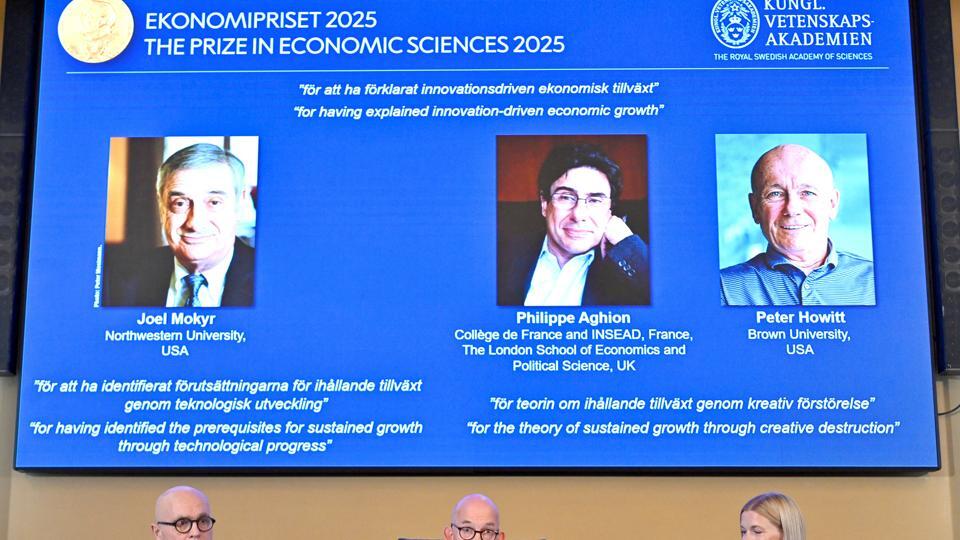
Although their scholarly contributions explore interconnected themes, the uniqueness of this year’s award lies in its acknowledgment of diverse methodological approaches. Joel Mokyr, an esteemed economic historian, examines numerous intricacies and transformations of economic history, while Philippe Aghion and Peter Howitt adopt a more quantitative perspective to understand the process.
The core inquiry driving Joel Mokyr’s research has been the historical patterns of innovation. Mokyr observes that innovation in human history, even prior to the onset of the Industrial Revolution, occurred sporadically, in isolated instances. Various historical eras were characterized by advancements in tools, techniques, and knowledge. However, these brief spurts of innovation tended to diminish over time. With the advent of the Industrial Revolution, the pace of innovation became more sustained and even accelerated.
A crucial distinction between pre- and post-Industrial Revolution innovation lies in the foundational theoretical comprehension. Mokyr explains this by describing a world wherein engineering prevailed without the principles of mechanics, iron production flourished absent the science of metallurgy, agriculture thrived without soil science, mining operations proceeded without geological insights, water-power was harnessed without the knowledge of hydraulics, dye-making occurred without understanding organic chemistry, and medical practice was conducted without the contributions of microbiology and immunology.
Mokyr identifies three essential prerequisites for the sustenance of innovation: the co-evolution of science and technology, a substantial pool of ‘tinkerers’ capable of bridging the gap between theoretical knowledge and practical application, and a society that embraces change.
In fact, instead of science and technology, Mokyr uses the terms propositional and prescriptive knowledge. Propositional knowledge–the knowledge about the physical world–differs from science in that it may include proto-scientific knowledge as well. Mokyr finds the rich interplay between the propositional knowledge and prescriptive knowledge as the first component of sustainable innovation.
The second fundamental requirement in Mokyr’s framework is the individuals–often called “tinkerers,” “tweakers” or “implementers”-- who traverse and bridge the gap between theoretical and applied knowledge. Mokyr finds that highly innovative societies are the ones in which highly educated individuals mingle with the artisans and skilled craftsmen.
Finally, Mokyr points out that innovation is rarely accepted without opposition. The opposition may be due to the fact that there are individuals who are likely to lose from innovation, or it may be due to ideological reasons or it may be sheer force of habit and the fear of the unknown. In each case, successful innovation requires an institutional framework which can be used as a forum for negotiation and compensation. In Mokyr’s view, historically speaking, the emergence of institutions like parliament played this part and muted the resistance against innovation.
It is on this latter point that the contributions of the other two laureates, Philippe Aghion and Peter Howitt, become particularly relevant. Innovation is seldom the neutral, universally beneficial phenomenon it is often presumed to be.
While Joseph Schumpeter famously coined the term ‘creative destruction,’ Aghion and Howitt have advanced this concept by embedding it within more formal, theoretical frameworks. Before Aghion and Howitt, formal models of endogenous growth often predicted a ‘balanced growth path’. Somewhat counter-intuitively, such models emphasized the role of extraction and deployment of surplus by the exercise of monopoly power for innovation as well.
Through their work, Aghion and Howitt challenged some of these conclusions. In Aghion and Howitt’s model, incumbents reap the rewards of innovation only partially, thus having muted incentive to innovate compared to the potential entrants. Additionally, in sharp contrast to Schumpeter’s belief that creative destruction may lead to the demise of the free market economy, they found that the process of creative destruction can indeed be sustained under certain conditions.
This year’s Nobel laureates’ work explains the prerequisite for innovation, albeit in a more nuanced way. In his book, “The Gifts of Athena – Historical Origins of the Knowledge Economy”, Mokyr writes: “Athena’s gifts were many: she gave King Cecrops the olive tree, but she also gave the city of Troy the wooden horse that led to its destruction. Technology makes people more powerful in exploiting nature, but how and for what purpose they do so remains indeterminate. If the twentieth century has shown us anything, it is that the capacity of humans for intolerance, stupidity, and selfishness has not declined as their technological power has increased.”
(Avinash Tripathi is an economics faculty working for the Centre for the Study of Indian Economy, Azim Premji University)


