
 E-Paper



A startling crime cloaked in caste contours, unresolved questions
One loved sewing patterns into slivers of cotton


One loved sewing patterns into slivers of cotton. Another liked hanging around the kitchen, learning to identify vegetables from the aroma wafting from the stove. One spent hours etching byzantine outlines of henna on her palms, hoping to master a craft she adored as a child. Another silently ticked off days in her mind before her family could afford that new salwar suit her heart was set on. Together, they both dared breach that invisible film that preserves the public sphere for men, and binds women to the mud-slapped walls of the courtyard. They went to the temple, the tailor’s, for evening walks and morning strolls. One was 18, another 15. Was.
Loosely enjoined by distant kinship, the two teenagers first met roughly a year ago, when the 15-year-old’s father brought her back from her paternal aunt’s place. Now in an unfamiliar home, the younger girl quickly attached herself to her 18-year-old neighbour, the daughter of her father’s cousin. “Between chores, they would spend all their time together. They found solace in each other’s company,” said her aunt, biting back tears.
In this grimy corner of Uttar Pradesh, a trail from the tarred road leads to their houses – pockmarked brick walls with dabs of cement hiding the crevices used to share stories and rumours, a clump of trees opening up into a field where men and women went to relieve themselves. Here, many households are Jatavs, the most-populous Dalit sub-caste in Uttar Pradesh who have found their ladder for upward mobility made slippery by brute discrimination despite their numbers. Two shops selling soiled packets of chips and the jumble of speckled red plastic chairs outside the sole tea stall on the main road make up the only semblance of a public space, reserved largely for men.
The two girls didn’t bow to this diktat. As the festive air of Janmashtami swept over the village on August 26, the friends decided they’d ask their families for permission to go to the local temple for the grand aarti, the bhog, and skits from the mythical god’s life. They went out, first at 7.30pm, and then again at 9pm, the second time to the pink-and-red painted shrine roughly 50m away. “I told them many times, you have to come back before midnight, but I thought, it’s so close by, what can go wrong,” said the father of the younger girl.
That was the last time anyone saw them alive.
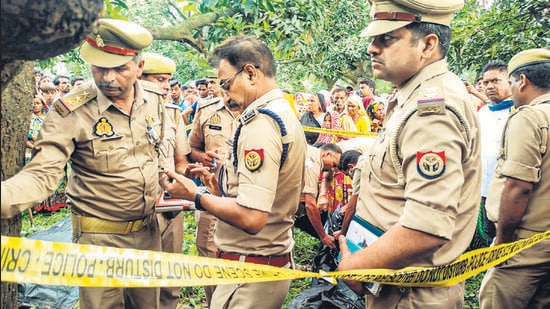
At 5am, the younger girl’s aunt walked into the clearing to relieve herself. “She ran back to the house, screaming that two bodies were hanging from the tree,” said the younger girl’s father. There, tied in two knots by either end of a yellow dupatta were the two friends. “It was unimaginable,” said the older girl’s brother.
The sensational crime sparked immediate outrage. The police now blame two local men from the same community – one a minor and another 22 – for luring the two girls from their homes and then pushing them to suicide. But the family of the two victims aren’t convinced, insisting their daughters were murdered, pointing out inconsistencies in the police theory, and alleging that the authorities are in a hurry to end the investigation. “We are not educated. We couldn’t understand that a game was afoot,” said the father of the elder girl.Hanging over the crime is the spectre of caste, skewing the coverage of the case at a time when outrage over crimes against women is stoking waves of protest across India.
2
Both labourers with small plots of farmland in their name, the two men went to bed early that fateful night. When the screams of his sister woke him up, the younger girl’s father scurried to the field. “The body higher on the tree was my brother’s daughter. I thought maybe I was saved. Then I saw my daughter,” he said.
By then, the elder girl’s father had also reached, dialled the local police station. It was 5.36am. There was no response after six or seven rings, said the father, but the inspector called back. “I told him someone had murdered our daughters,” said the father.
The police came in 10 minutes, and were quick to take down the bodies from the tree. “In 30 minutes, they had packed the bodies, procured a vehicle, and left..no one examined the bodies” said the elder girl’s father.
By 8.30am, the family reached the police station, submitted an initial complaint and were told that the post-mortem procedures were on. At 1.30pm, with 300 people in tow, they reached the medical examiner’s office.
“It is from here that we first started feeling the pressure. We were told that we should wrap this up quickly otherwise rumours could spread,” said the elder girl’s father.
They came back by 6pm; by then, they said that a phalanx of around 400 police personnel had ring-fenced the village. “In the evening, we saw the local news, where the police was saying there were no injuries on the body and only suicide being suspected,” said the elder girl’s father.
They immediately called the police, and said the women of their families had already taken photos of “injuries” and “marks” on the bodies. “We believed them, we told everyone not to agitate,” he said.
Later that evening, at the Ganga ghat, a standoff ensued. “I told them, I won’t cremate my daughter, that we were not happy with the postmortem report and that our daughters didn’t die of suicide,” said the younger girl’s father.
The initial post-mortem report, a copy of which is with HT, notes that there were no external injuries. “In my opinion, cause of death due to asphyxia result of antemortem hanging,” read the report.
But the families weren’t satisfied.
“They kept hurrying us…at one point, I screamed, why can’t you give us 10 minutes?” the father said. After senior officials came and defused the situation, the girls were finally cremated around midnight. “Police said kisi ko batana mat [don’t tell anyone]...quickly finish the rituals,” he added.
Tension simmered the next morning. At the police station, the families spent six hours. “We were repeatedly told to add the possibility of suicide in the complaint…but we knew they were murdered. I got angry when they kept saying the same thing…screamed `Are you deaf?’,” said the younger girl’s father.
3
Somewhere near the afternoon of August 28, the family were shown a sheaf of documents that contained the call data records of the SIM card found near the bodies. The police had narrowed down a number that they said belonged to a local boy, also Dalit. This boy, 17, worked at the local tailoring shop where the two girls would go sometimes, and would talk to the girls along with the master tailor, a man of 22 also from the Dalit community. They would meet clandestinely, say the police.
“The man and the boy had procured a SIM card and a mobile phone to talk to the girls. They would often call and harass the girls,” said Farrukhabad superintendent of police Alok Priyadarshi.
“The two used to force the girls to talk to them...their pressure forced them to commit suicide. They were arrested on the basis of the complaint filed by the family members of the girls and sent to jail. Further investigation is underway,” he added.
They were booked under Section 108 (abetment of suicide) of the Bharatiya Nyaya Sanhita following a complaint from the girls’ family members, said the police, and arrested on August 30. “We were also told that the two have confessed in custody,” said the elder girl’s father.
But now, they’re engulfed with doubt. “If the boy and the man were indeed meeting our girls and wanted to have a relationship, then why would they force both to die by suicide? We didn’t understand the call detail papers properly. We wonder if the confession is genuine,” said the elder girl’s father.
“All we are certain of is that the girls were murdered,” he added.
Similar doubt enveloped the houses of the two accused.
The 17-year-old lives three houses down from the two victims. The families distantly know each other. “Ask anyone if they ever saw him with the girls,” said the boy’s mother.
In the settlement of the 22 year old, there is mounting anger. Under a canopy of blue flags next to a bust of Dr BR Ambedkar, villagers gathered one afternoon in protest. They said that the morning when the two bodies were discovered, the 22-year-old left the house around 7am on motorbike to open the tailoring shop. “If he had pushed the girls to suicide, would he have gone back to the spot to open the shop when police was already there?” asked his mother. “This is why we demand a CBI inquiry,” his father added.
The police have refuted any charges of laxity. “We have repeatedly spoken to the victim’s family, have been completely transparent and made them understand everything. We have also promised them a clear investigation forward, and if something is uncovered, then more stringent charges will be added,” said Priyadarshi.
But there are other unanswered questions – why would the girls suddenly commit suicide? If the two boys were talking to them regularly, why would they suddenly push them to suicide? If the girls killed themselves, how did they use one dupatta to tie both knots? What could have been the motive behind a potential murder? Were the marks mentioned by the family incriminating or just benign? How was the older (and heavier) girl found higher than her younger friend? Did the police do an initial forensic exam at the spot that morning? If not, why? Did they wait for experts to arrive at the scene? Is the family correct in alleging that the authorities were in a hurry? Have the two men confessed? Why was the family’s initial complaint of murder not converted into a first information report?
4
Hanging over the crime is the spectre of caste, a fault line that shapes almost every aspect of life in this part of the world. At its harshest receiving end are Dalit women, who battle the scourge of discrimination in structural (poorer health indices and lower educational achievements) and societal ways (abuse, physical and sexual threats from upper-caste communities, bias in everyday life, and lower pay for the same jobs).
“From their birth, Dalit women are seen as commodities and their characters are questioned. They face physical and mental aggression from a young age – whether studying in the classroom or working in the field,” said Sarita Gautam, a member of the Rashtriya Dalit Mahila Andolan.
For activists like her, the confusion and doubts surrounding the Farrukhabad case are typical of the problems that lower-caste victims face, even in high-profile cases. In 2020, for example, the grisly rape and murder of a 19-year-old Dalit woman sparked national outrage. But two years on, three of the four men accused of the crime were acquitted of all charges; the fourth was found guilty, but for culpable homicide, not for either rape or murder.
Gautam fears that in complex cases involving Dalit victims, the power imbalance in social dominance and law-and-order machinery is a heavy burden. “Often lower charges are brought, and the family faces enormous pressure and threats.”
The Farrukhabad family lives roughly 50km away from the site of an older, but eerily similar, gruesome crime in Badaun’s Katra Sadatganj. Ten years ago, a 14-year-old girl and 16-year-old cousin were found hanging from a mango tree in the local orchard. The two girls – belonging to the backward Shakya community – went out to the fields the previous night, never to be seen again. There, too, the family repeatedly alleged that the girls were raped and murdered, but the Central Bureau of Investigation (CBI) concluded that it was a case of suicide, only for a local court to reject the agency’s closure report. The case remains in limbo. Four of the five accused are free.
Just like in Badaun, politics is peaking in Farrukhabad. Opposition politicians have made a beeline for the village, alleging that the police was trying to mislead the family and covering up a caste crime. “Was the hasty cremation aimed at erasing evidence?” asked Samajwadi Party chief Akhilesh Yadav.
The BJP has pushed back. “Police investigation is going on and according to post mortem report, prima facie it is appearing to be suicide. Akhilesh Yadav must remember his tenure when crime against women was at its peak,” said Rakesh Tripathi, state BJP spokesperson
But the churn is unlikely to stop given the bellwether role of the Dalit vote in India’s most politically crucial state. The BJP’s underwhelming 2024 Lok Sabha polls showing in UP was attributed largely to a shift in the Dalit vote, based on fears that reservation will be scrapped and concerns about caste-based crimes.
5
The two fathers and other kin now believe their caste status was responsible for their predicament. “We couldn’t be forceful, and were deceived. It was because of our background,” said the elder girl’s father. No one in the two families has ever graduated from high school.
In his cow dung laced compound, the defeated father of the younger girl is overwhelmed by the stream of visitors. The afternoon sun is baking his fields but he is slumped across a string cot. He has vaguely heard of the groundswell of protests against crimes on women that is sweeping India, but in this village, it has barely made a mark. He isn’t sure if anything is going to change.
“From the day of the cremation, the police have been misleading us…why didn’t they file a murder case in the first place?” he asked.
Across from him is the younger girl’s aunt, the one who brought her up for 15-odd years. She is bent with age and moves gingerly, but remembers how the girl would wait every day for her father to come back from the field. “She was alone in the house all day, if she was depressed and wanted to kill herself, she could have done it anytime,” she said.
Strands of memories have shackled the father, his eyes sink deeper every day. He murmurs how his daughter would wait every evening for his return, making rotis, calling him every hour after sundown if he was delayed. “I fasted but never let her be hungry…and now,” his voice trailed off.
The families say they will push the police to treat the case as one of murder, but in dark moments, the younger girl’s father is bereft of hope. “We may be illiterate, but we know what murder is; but no one listened to us,” he said. “Is it because we are weak?”
 ABOUT THE AUTHORDhrubo Jyoti
Dhrubo works as an edit resource and writes at the intersection of caste, gender, sexuality and politics. Formerly trained in Physics, abandoned a study of the stars for the glitter of journalism. Fish out of digital water.Read More
- ABOUT THE AUTHORHaidar Naqvi
Haidar Naqvi covers central UP and Bundelkhand. He closely tracks developments in internal security in the region and beyond.Read More


