
 E-Paper



After 2+2, Indian side meets Trump
The meeting with the president, the possibility of which was first reported by Hindustan Times last week, took place in the Oval Office, after the two ministers had met the National Security Adviser Robert C O’Brien.


Union ministers Rajnath Singh and S Jaishankar met US President Donald Trump after their 2+2 meetings with their American counterparts Mark Esper and Mike Pompeo Wednesday in a rare break from protocol that was seen as a reflection of the growing importance of the relationship at the senior-most level in this administration.
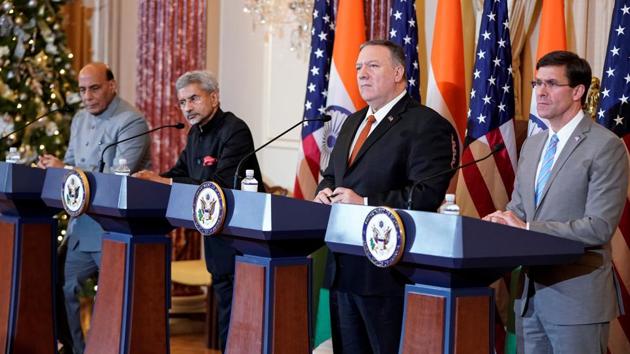
India and the United States had earlier in the day announced the conclusion of a key defence agreement to further enhance the interoperability of their militaries and discussed the threat of cross-border terrorism India faces from Pakistan. They had also discussed a whole range of issues, including trade, the United States joining the Coalition for Disaster-Resilient Infrastructure, a key global initiative launched by India at the last UNGA; H-1B visas and ongoing and increasing restrictions; Iran; the need for free and open Indo-Pacific and China; and the drawdown of US troops in Afghanistan.
The meeting with the president, the possibility of which was first reported by Hindustan Times last week, took place in the Oval Office, after the two ministers had met the National Security Adviser Robert C O’Brien. It was described as a “courtesy call” on the president, but lasted almost 30 minutes.
The president touched on a many subjects about the relationship in his discussions with the Indian minister with a “little” more on trade, and the ministers briefed him about their 2+2 discussions.
Trump recalled with warmth the HowdyModi outreach to the Indian diaspora he had attended with Prime Minister Narendra Modi in Houston in September and he was “very positive, supportive of the relationship and very enthusiastic about various aspects of the relationship,” Jaishankar told reporters.
India and the US signed a defence industry security pact to facilitate transfer of classified technology to private Indian firms even as they demanded Pakistan should take immediate and irreversible action to ensure that its territory isn’t used for terrorism against other countries.
These were among the key outcomes of the second 2+2 dialogue between the defence and foreign ministers of the two sides, which also focused on a range of issues, including trade, the US joining the India-led Coalition for Disaster Resilient Infrastructure, measures to ensure a free and open Indo-Pacific, China and the drawdown of US troops in Afghanistan.
The Industrial Security Annex (ISA), inked during the talks, will allow US makers of defence hardware to partner and share classified information and technology with private Indian companies, thus expanding their ability to jointly develop and produce sensitive military gear. Under existing arrangements, the US firms can only share such information with India’s public sector companies.
The two sides signed three more pacts under the Defence Technology and Trade Initiative (DTTI) that will enhance their ability to jointly develop and produce critical technologies, defense secretary Mark Esper said after the 2+2 talks in Washington on Wednesday.
A joint statement issued on Thursday condemned all forms of terror and called for concerted action against all terror networks, including al-Qaeda, Islamic State, Lashkar e-Taiba (LeT), Jaish-e-Mohammad (JeM), Haqqani Network, Hizb-ul Mujahideen, Tehrik-e-Taliban Pakistan and Dawood Ibrahim’s D-Company.
“The ministers called on Pakistan to take immediate, sustained and irreversible action to ensure that no territory under its control is used for terrorism against other countries in any manner, and to arrest and prosecute the perpetrators of cross-border terrorist attacks, including 26/11 Mumbai and Pathankot,” the statement said.
India appreciated support from the US at the United Nations for terrorist designations, including that of JeM leader Masood Azhar, and the American side welcomed changes in Indian law to facilitate further cooperation on such designations.
Talking about the agreements on defence cooperation, which has grown more rapidly than other aspects of India-US ties in recent years, Esper told reporters the ISA will facilitate collaboration by supporting the secure transfer of information and technology. His counterpart Rajnath Singh said the pact provides the framework for pursuing co-development and co-production.
The two sides called for quick installation of secure communication capabilities between the armies and air forces under the Communications Compatibility and Security Agreement (COMCASA), and decided to continue discussions to finalise the Basic Exchange and Cooperation Agreement (BECA) to enable greater geospatial information-sharing.
External affairs minister S Jaishankar said the two sides discussed the concept of a “free, open, inclusive, peaceful and prosperous Indo-Pacific based on the recognition of ASEAN centrality,” cross-border terrorism in the region and working closely at international forums.
Counter-terrorism efforts were “boosted by growing consensus on the nature of terror threats in the region, and the dangers of cross-border terrorism and sanctuaries”, he said.
“We discussed ways to address these challenges, including by working closely together at the FATF (Financial Action Task Force),” Jaishankar said, referring to the inter-governmental body that has put Pakistan on its “grey list” for failing to counter terror financing and money laundering.
US secretary of state Mike Pompeo expanded on counter-terror cooperation by saying: “We have been unambiguous in our partnership with the Indian government about terror, terror from wherever it emanates, whether it’s from inside of Pakistan or from anyplace else.
“We are determined to protect the American people from the threat of terrorism and we’re determined to work with our great democratic friends like the Indians to protect the people of India as well, and we’ll continue to work on it.”
On China, Pompeo said the two sides discussed “the risks that Chinese-built communication networks, including 5G, pose to our treasured freedoms and how China’s unfair and predatory economic activity in the Indo-Pacific presents a risk to those very freedoms”.
Singh and Jaishankar met one-on-one with their counterparts before the 2+2 talks. Singh tweeted he and Esper “reviewed the full range of India-US defence cooperation”.
The 2+2 dialogue was held against the backdrop of growing strategic convergence between the two countries amid continuing differences on trade, with even the modest, scaled down trade deal the two sides agreed to shoot for still not in sight.
Trade did come up, with Pompeo mentioning ongoing talks between US trade representative Robert Lighthizer and commerce minister Piyush Goyal.
The joint statement said the two sides welcomed these discussions to reach an understanding that will facilitate trade, improve market access and address issues of interest to both. “The ministers looked forward to the swift conclusion of discussions that will advance their shared objective to support prosperity and job creation in both countries and foster greater investment and innovation...” it said.
The two sides will work on building on the India-US strategic energy partnership to modernise India’s power grids, develop greater integration of modern energy sources into India’s power systems, and increase the focus on combating pollution. They also applauded growing exports of US LNG, crude oil, and energy products to India totalling $6.7 billion.
With regard to the bilateral civil nuclear deal, the two sides welcomed “continued progress” by the Nuclear Power Corporation of India and Westinghouse Electric Company on a techno-commercial offer for building six nuclear reactors.
On the Indo-Pacific, both sides supported rule of law, freedom of navigation and overflight, peaceful resolution of disputes, and transparent infrastructure investment. They said closer India-US cooperation is “instrumental to promoting security and prosperity” in the Indo-Pacific and beyond.
The two sides agreed to enhance cooperation between the Indian Navy and the US Navy fleets under its Indo-Pacific, Central and Africa Commands and welcomed the assignment of an Indian officer to liaise with the US Navy’s Central Command in the near future. The US will look into placing a liaison officer at India’s Information Fusion Centre for the Indian Ocean to advance cooperation in maritime security.
The first 2+2 dialogue was capped by the signing of the COMCASA, which dramatically expanded interoperability between the militaries of the two countries. It came after a year-long series of developments such as the US designation of India a Major Defense Partner and according it STA-1 status, bringing it at par with NATO allies for sharing sensitive defence technology.


