
 E-Paper



After Supreme Court’s rebuke, justice Reddy quits panel probing KCR
Following unfavourable remarks from the Supreme Court regarding his conduct, justice (retired) L Narasimha Reddy on Tuesday stepped down as the head of the commission of inquiry, constituted by the Telangana government to investigate alleged irregularities in power procurement during the tenure of former chief minister K Chandrashekhar Rao.


Following unfavourable remarks from the Supreme Court regarding his conduct, justice (retired) L Narasimha Reddy on Tuesday stepped down as the head of the commission of inquiry, constituted by the Telangana government to investigate alleged irregularities in power procurement during the tenure of former chief minister K Chandrashekhar Rao.
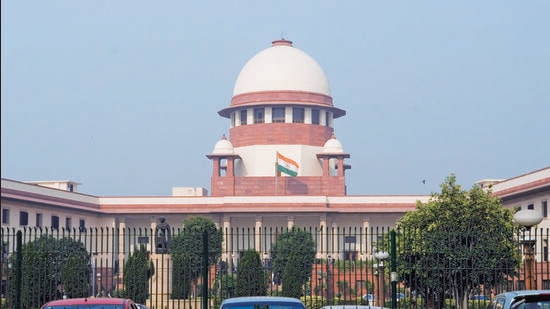
The court, while hearing a petition filed by Bharat Rashtra Samithi president Rao, expressed its disapproval of press statements made by justice Reddy on June 11, suggesting that he had pre-judged the issue.
“It is a little untoward for a person, who has been a judge, to make observations on the merits of the issue. Had he not made those observations, we would have left it at that. But the problem is that there appear observations on the merits. The commission held a press conference where he transgressed the line,” a bench, led by Chief Justice of India Dhananjaya Y Chandrachud, observed.
The bench, which also included justices JB Pardiwala and Manoj Misra, highlighted the need for procedural fairness and that justice must be seen to be done , adding that such fairness should be apparent in the conduct of the commission’s head.
“We are at a stage where he has to inquire but he has gone beyond summarising. He has expressed opinion on the merits...At this stage, he cannot hold a press conference and say there was a loss when that is the issue he is still to examine and submit a report,” it added.
The court further pointed out that although a report of the commission of inquiry cannot lead to civil or criminal consequences, it certainly has an impact on a person’s reputation.
“The problem is that there were quite a few observations on the merits of the case. A report of the commission does not bind anybody, but it impacts the reputation of a person,” said the bench, agreeing with senior counsel Mukul Rohatgi, who appeared for Rao and argued that justice Reddy ought not to have commented on the commission when Rao was still to be heard.
The court suggested that the state government replace the judge in the commission of inquiry to maintain the impression of fairness. Even as senior advocates Abhishek Manu Singhvi and Sidharth Luthra, representing the state, maintained that justice Reddy’s statements were factual , they agreed to seek instructions on replacing justice Reddy with someone else following the court’s adverse comments.
Later, when the hearing resumed at 2 pm, senior advocate Gopal Sankaranarayanan, appearing for justice Reddy, conveyed the former judge’s intention to resign. Simultaneously, Sankaranarayanan pointed out that justice Reddy only referred to the terms of reference during the press conference on June 11, adding there was no statement made against Rao.
Recording this development, the bench disposed of Rao’s petition while also noting that the state government will issue a fresh notification for appointing the new head of the commission of inquiry.
The court also recorded Singhvi’s statement that although the March 14 notification used the term “judicial” for the inquiry, the expression intended to refer only to the status of the judge heading the commission and that the commission will be within the scope of the commission of inquiry Act which confines its ambit to a fact-finding body.
On July 1, the Telangana high court dismissed KCR’s petition seeking to pause the ongoing judicial investigation into the alleged power sector irregularities during his administration.
KCR’s petition, filed in the high court on June 24, questioned the formation of the Justice L Narasimha Reddy Commission to investigate alleged irregularities in the purchase of 1,000 MW of power from Chhattisgarh and the construction of the Bhadradri and Yadadri Thermal Power Plants during his regime.
The former chief minister contended that the order issued by the Congress government on March 14, establishing the judicial commission, violated the provisions of the Commissions of Inquiry Act, 1952, and the Electricity Act, 2003. “The commission has no jurisdiction as the terms of reference were subject to adjudication before both Telangana and Chhattisgarh State Electricity Regulatory Commissions,” he argued.
KCR claimed the commission’s proceedings were biased and that the issues before it had already been pre-judged. He also mentioned that he had written to Justice Narasimha Reddy, requesting him to recuse himself from heading the commission.
However, the high court bench rejected KCR’s argument that the commission’s observations were pre-judged and dismissed his contention that the judicial commission lacked jurisdiction to investigate the power purchase agreement or the construction of the power projects.


