
 E-Paper



Ahead of polls, UP adds 7 new ministers to cabinet
The additions to the Yogi Adityanath-led Cabinet include Jitin Prasada, a Brahmin, while the rest represent other backward castes (OBC) and Dalit subcastes

 Prefer HTon Google


The second and much-awaited expansion of the Yogi Adityanath-led government in Uttar Pradesh happened on Sunday evening, with governor Anandiben Patel administering oath to a cabinet minister and six ministers of state. One of them, Jitin Prasada, is a Brahmin, while the rest represent other backward castes (OBC) and Dalit subcastes.
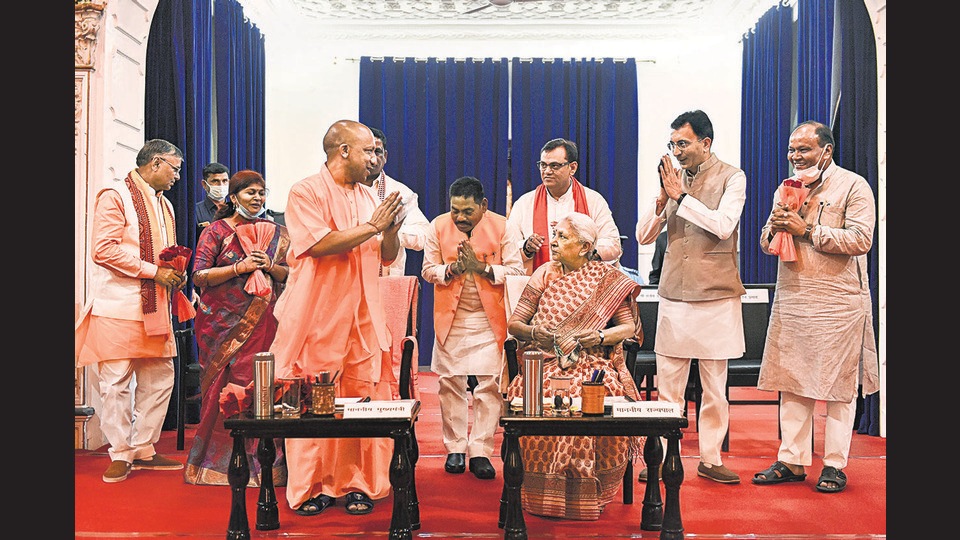
The caste profiles of the new inductees are in line with the Bharatiya Janata Party’s efforts to sharpen its outreach towards the dominant castes in the state and bucking anti-incumbency ahead of the 2022 UP elections.
Former Congress leader Prasada was rewarded with a cabinet berth less than five months after he joined the Bharatiya Janata Party (BJP). The other new faces are Paltu Ram, a Dalit lawmaker from Balrampur; Chattrapal Gangwar, an OBC (Kurmi) leader from Bareilly; Sangeeta Balwant Bind, an OBC leader from Ghazipur; Dharamvir Prajapati, an OBC leader from Agra; Sanjeev Kumar Gond (scheduled tribe) from Sonbhadra; and Dinesh Khatik, a Dalit from Meerut.
“The template is the same,” a BJP leader said, acknowledging that the move mirrors the expansion of the Union council of ministers in July when seven faces from UP were accommodated — three each from the OBC and Dalit groups and one Brahmin face.
The Yogi government so far had 53 ministers, including 23 cabinet ministers, nine ministers of state (independent charge) and 21 ministers of state. Its strength has now gone up to 60 ministers. But the new ministers will have less than 150 days in office.
“In effect, these ministers will get about 90 days to enjoy power or make policy decisions, as the model code of conduct will kick in around January. But it’s not about the time they spend as ministers; they have been picked for their caste profile ahead of the UP polls. So, it’s an out and out political move aimed to symbolically indicate the party’s outreach for the most backward among OBCs and poorest among Dalits,” said a former BJP leader, asking not to be named.
The BJP had won 312 seats in the 2017 UP polls in the 403-member assembly with a vote share of 41.7%. The latest expansion, the last before the 2022 UP polls, party leaders admit, has been taken with an eye on balancing various castes, including those that so far were unrepresented.
Just before he arrived at the Raj Bhavan for the swearing-in ceremony of the new ministers, chief minister Yogi Adityanath tweeted that his government would neither engage in corruption nor tolerate anyone engaging in it.
“Na bhrastachaar karenge, na kisi ko karne denge. Sarkar ki neeti aur neeyat dono saaf hai (We will neither do corruption nor allow anyone else to do it. The government’s policy and plan are very clear),” Adityanath tweeted.
Shortly before that, Adityanath entered a farmers’ rally in Lucknow organised by his party’s farmers’ wing in which he announced ₹25 per quintal hike in the purchase price of sugarcane in the state, a move aimed at placating angry farmers who have been protesting the Union government’s three farm laws.
“We welcome our new friends in government. Together, we will work and win 2022 UP polls,” said the state’s backward classes welfare minister Anil Rajbhar, an OBC. UP is well represented in the Narendra Modi government, too, with 14 Lok Sabha and Rajya Sabha MPs as ministers. The BJP has 84 MPs from the state, including 62 in the Lok Sabha and 22 in the Rajya Sabha, while its ally Apna Dal has two members.
The changes are an indication that while the BJP is strengthening its social engineering formula of bringing together a coalition of disparate castes, it has kept its eye on the OBCs, a category that has more political heft and contributed 40% of the votes that the party bagged in the last three elections — the general elections of 2014 and 2019 and the 2017 assembly elections.
The outreach towards the OBCs comes at a time when the opposition parties and BJP’s own allies are seeking a caste-based census. While those supporting such a census claim getting exact numerical strength of each community will help sharpen the existing policies for their uplift, the BJP has been evasive on the issue. Last week, the Union government told Supreme Court in a petition that collecting data on backward class of citizens during the upcoming census is administratively complex.
Given the clout that OBCs — that make up 40% of the electorate — have in UP, the BJP does not want to risk alienating them or allowing the opposition to benefit from the anger against its non-committal stance on the caste enumeration issue. Therefore, the party has sharpened its outreach by giving the representatives more political empowerment.
Announcing an alliance with the Nishad party and giving representation in the Union cabinet to Apna Dal — both outfits that count OBCs as their support base — carries the unambiguous message of BJP trying to woo the OBCs.
Union minister Dharmendra Pradhan, who was recently appointed as the election in-charge of UP, is being projected as the party’s OBC face.
While it has been on an overdrive to build bridges with the OBC and SC communities, BJP has had to mend ties with the Brahmins as well. The assiduous outreach by the Bahujan Samaj Party (that counts the SCs as its main support group) and the Samajwadi Party (that has support of the Yadavs, considered the politically dominant among the OBCs) towards the Brahmins has pushed the BJP to consolidate its position with the so-called upper caste. In addition to a slot in the state cabinet, one representative will also make it to the legislative council along with three OBCs, one of whom comes from the most backward Bhurji caste.


