
 E-Paper



Air remains toxic as stubble fires nearly double overnight
Weather forecasters said an increase in wind speeds from Friday evening helped disperse the accumulated pollutants to a certain extent.

 Prefer HTon Google


Delhi’s air quality on Saturday improved marginally but remained in the severe zone for the second consecutive day as the smoke from cracker emissions remained suspended in the air while the stubble fire count in Punjab and Haryana peaked to over 6,500 — the highest this season — resulting in a continuous cloud of thick haze in the Capital, the India Meteorological Department (IMD) said.
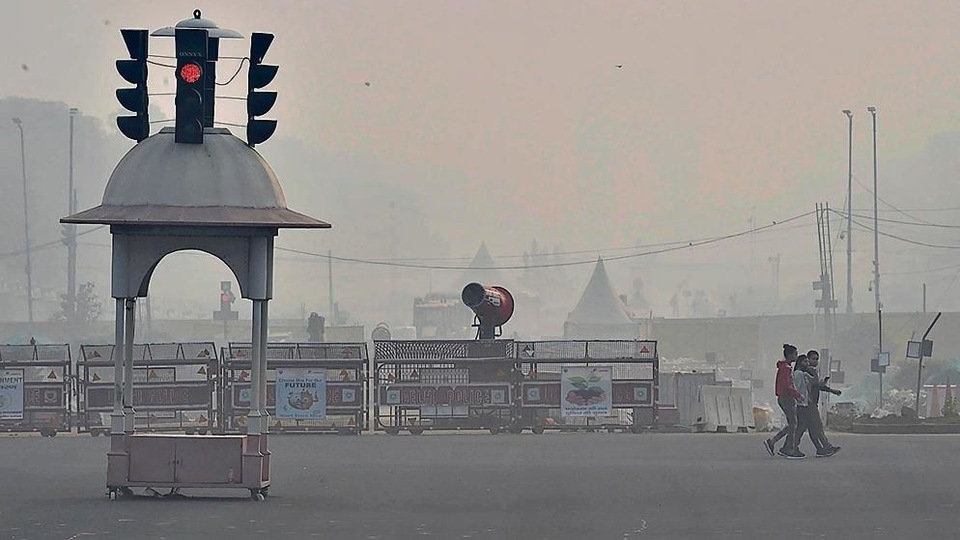
Central Pollution Control Board (CPCB) recordings showed that on Saturday, Delhi’s air quality index (AQI) improved marginally and reached 437. On Friday, a day after Diwali when a blatant violation of the government’s ban on crackers was seen, the AQI had climbed to 462 — the worst day-after-Diwali air quality since 2016.
Places such as Nehru Nagar, Mundka, Wazirpur, and Okhla recorded AQI readings of over 450. In the backdrop of the city recording high levels of pollution in the past two days, the Delhi government on Saturday also started sprinkling water on arterial roads across the city. Environment minister Gopal Rai flagged off 114 water tankers from the Delhi secretariat and ordered monitoring agencies to impose strict action against pollution-related violations.
Weather forecasters said an increase in wind speeds from Friday evening helped disperse the accumulated pollutants to a certain extent.
“Wind speeds till 4pm on Saturday remained in the range of 10-15kmph, which then slowed down and became calm. Direction of the winds remained north-westerly,” said RK Jenamani, senior scientist, IMD.
He added, “Smog conditions on Saturday morning also improved slightly, as was predicted. We saw shallow fog between 5.30am and 9.30am, with the visibility ranging between 600-800 metres at Palam and Safdarjung airports. This was primarily because of winds. There was also some reduction in humidity and moisture.”
IMD scientists also said that moderate winds are likely to continue on Sunday, which might improve the Capital’s air quality by a few more points. The AQI by Sunday evening is expected to reach the very poor zone, according to the IMD.
However, experts also warned that while Delhi might be recovering from the impact of high cracker emissions, thanks to the winds, it also needs to be prepared to tackle the foul smoke from stubble fire peaks being recorded in the neighbouring agrarian states of Punjab and Haryana, being brought into the city by north-westerly winds.
On Thursday, Nasa’s satellite imagery, had recorded over 3,500 farm fire incidents over the north Indian plains. This increased to around 6,500 on Friday.
Pawan Gupta, senior scientist, Earth Sciences Universities Space Research Association (USRA), National Aeronautics and Space Administration (NASA) Marshall Space Flight Centre, said that on Friday, 6,000 farm fires were spotted from Punjab and over 500 fires were seen in Haryana, which was the highest this season.
He also said that despite a slow start to the burning season, between September 1 and October 5 this year, Punjab has reported 30,552 stubble fires, while Haryana has reported 6,051 fires in the same period.
Experts also warned that the worst of the stubble fires is not over yet.
Hiren Jethva, aerosol and remote sensing scientist at USRA, pointed out the “steep rise” in agricultural fires, was predominantly in Punjab. He said that in the coming days, smoke from more such fires could adversely impact Delhi’s air.
According to the Union ministry of earth science’s air quality monitoring centre, System of Air Quality and Weather Forecasting and Research (SAFAR) on Saturday stubble fires in Punjab and Haryana contributed to 41% of Delhi’s PM2.5 (particulate matter with diameter less than 2.5 micrometres) pollution.
“According to satellite data, the total fire count has surpassed the levels observed in 2018 (29,133). A fresh load of smoke appears to be on its way to Delhi and down areas under north-westerly winds,” Jethva said.
While assessing the city’s post-Diwali pollution spike, the CPCB in its task force meeting on the implementation of the Graded Response Action Plan (GRAP) directed all government agencies in the Capital to step up action to control local pollution sources.
Looking at the situation, they also advised that all government and private offices reduce the use of private vehicles by at least 30% by encouraging work-from-home and car pooling.


