E-Paper



AI’s value lies in how it’s applied to solve real-world problems: Bhupender Yadav
He made the comments at the launch of Amitabh Kant and Siddharth Sinha’s book “Smarter Than the Storm: Championing the AI-Climate Nexus for a Truly Sustainable Future”

 Prefer HTon Google


Artificial intelligence (AI) is not an end in itself but a tool whose value lies in how it is applied to solve real-world problems, including improving system efficiency and helping anticipate and respond to climate risks, Union environment minister Bhupender Yadav said at the launch of Amitabh Kant and Siddharth Sinha’s book “Smarter Than the Storm: Championing the AI-Climate Nexus for a Truly Sustainable Future” on Tuesday.
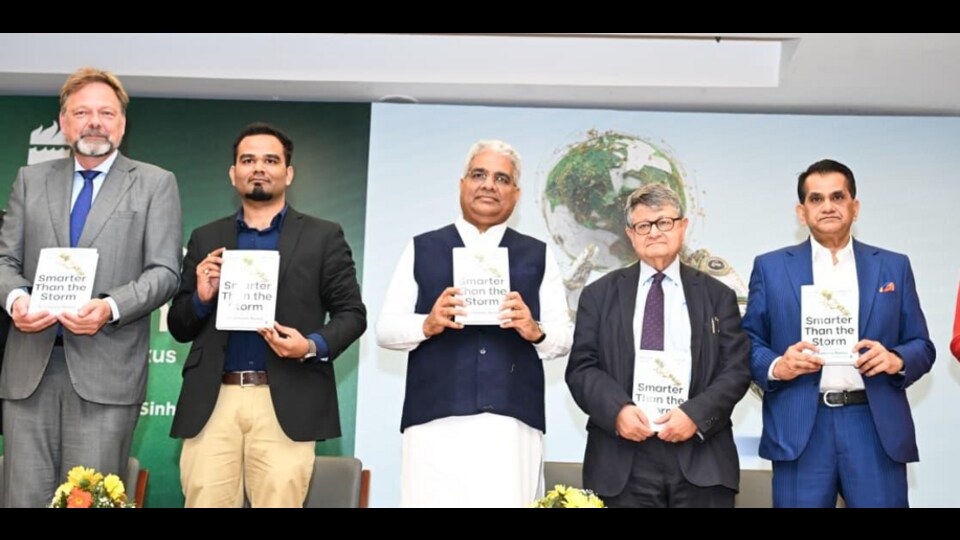
Yadav emphasised there can be no AI without real human intelligence, no human future without the future of the planet on which human life exists. “AI is energy-intensive. AI is not just going to compete with humans for jobs, but also for resources.” Yadav said the AI world is indeed a storm. “The only way we cannot just survive but also thrive amid this storm is by making human experience the centre of it. The human race must commit to AI, not for the sake of AI, but AI for the sake of humans and the planet we inhabit.”
Yadav said India is moving in the right direction on dealing with the inherent contradictions of AI. He added the New Delhi Frontier AI Impact Commitments, launched at the India AI Impact Summit this month, offer a step further in turning this vision into reality. “With India leading the way, the world has committed to advancing understanding of real-world AI usage to support evidence-based policymaking on jobs, skills, and economic transformation. In India, we think of economy and ecology as closely linked.”
Yadav said India has consistently demonstrated that climate responsibility and development ambition can go hand in hand. “Our approach has been guided by equity, scale, and action, not rhetoric. India has shown that emerging economies do not have to follow the carbon-intensive pathways of the past to achieve prosperity. India has taken bold and credible steps across the climate spectrum.”
Kant, a former NITI Aayog CEO, said this is a time of great disruption. “We are seeing the end of globalisation. The post-World War II era has come to an end…global value chains have come to an end. They’re broken. But we are living in an era that is going to see the biggest rise in productivity ever because of data, machine learning, and AI. And this technology is going to be a general-purpose technology which will transform every single sector of the economy.”
Kant said the AI race will be won by those who use it to transform learning outcomes, health outcomes, nutritional standards, and address AI’s energy-intensive nature. “AI today consumes more energy than Japan. AI race will be won by those who do optimisation of computing power with more sophisticated software, but less computing power.”
Sinha, who specialises in the interplay of AI and climate, said their book is not just about AI and climate but also about people. “AI can contribute…from predicting floods to predicting wildfires to enabling a small villager in India to create energy with some of the largest companies in India... AI has completely revolutionised and completely transformed the world as it is today,” said Sinha, who has previously worked at NITI Aayog.
He said climate change is a threat multiplier because it affects everything, starting from the disruption of supply chains to triggering conflicts and sometimes even affecting the critical minerals or the rare earth elements that are required for AI to even function.