
 E-Paper



All 8 cheetahs at Kuno to be released into 6-km soft enclosure on November 5
The eight cheetahs translocated from Namibia on September 17 will be released into a 6-km soft release enclosure at the Kuno National Park in Madhya Pradesh on November 5, a member of the task force set up to tend to them said on Monday.


The eight cheetahs translocated from Namibia on September 17 will be released into a 6-km soft release enclosure at the Kuno National Park in Madhya Pradesh on November 5, a member of the task force set up to tend to them said on Monday.
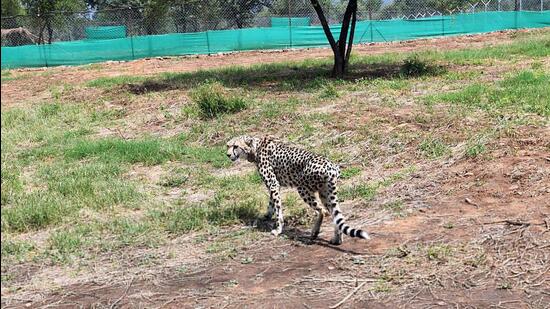
According to a senior official of the Cheetah Task Force (CTF), prey species will be introduced in the soft enclosure so that the cheetahs can hunt them.
Currently, the cheetahs are living in a quarantined enclosure where they are being provided food.
“Cheetah Conservation Fund founder Laurie Marker and National Tiger Conservation Authority (NTCA) on October 24 has made a recommendation to make the internal compartments more secure. The internal fencing should be equipped with solar powered fencing underground too. It was not a part of initial approved design but the field officer of Kuno National Park agreed to this,” said a CTF official.
According to the official, state forest department officers have set a deadline of November 5 to complete the installation work of underground solar powered fencing. After November 5, the cheetahs will be released from the six quarantine bomas (enclosures), the official added.
Also read: A month on, cheetahs adapting well: Officials
The state’s principal chief conservator of forest (PCCF) (wildlife) JS Chauhan said, “We will complete the work according to new suggestions before November 5 so that cheetahs could be shifted. In the 6 sq km enclosure. Cheetahs will eat by killing the prey and acclimatise themselves naturally. The enclosure already has spotted deer, wild pig, Nilgais and others as prey base.”
After 3-4 months, the cheetahs will be shifted in the wild, he added.
In an effort to familiarise people to the newly introduced species of big cats in India, the Centre had called for ideas to rename the 8 cheetahs. The time to provide suggestions for names ended on Monday.
Until Sunday, there were 10,857 names suggested for the cheetahs and 16,670 suggestions on naming the cheetah project in India. The present names of the eight are Elton, Freddie, Oban, Sasha, Siyaya, Savannah Tbilisi and Aasha.
“The name Aasha was given to the eighth Cheetah by the PM, Modi. She did not have a name because she was only recently captured. We are not sure if all other names will be changed,” said an official who did not wish to be named.
“The cheetahs are waiting to be moved to bomas or larger fenced areas where they can practice hunting. They will be in bomas for a month or two and then released to the park. It’s important that they practice hunting and get used to the new prey species. We will monitor whether they are liking or getting used to the new prey species,” added the official.
Environment ministry officials had said in September that Kuno had a good prey base with Chital, Sambars, Nilgai, Wild Pigs, Chowsingha, Langur etc.
“You have to understand that in Africa, their prey consists of Impala, gazelles etc which are very fast. In comparison the Indian prey will be easy for them to hunt,” NTCA member secretary SP Yadav had told HT.
Meanwhile, a group of experts from various think tanks and research institutes, writing in an article in the journal ‘Nature Ecology and Evolution’, termed the translocation project an “ill-advised conservation attempt”.
Also read: Activist held for circulating caricature of Cheetah, later granted bail
In the article, published on October 19, the group of experts said a recent study of a free-ranging cheetah population in the prey-rich Maasai Mara landscape in Kenya offers crucial insights into their numbers.
“This study revealed that even in such large, prey-rich landscapes (a 2,400-km2 area surrounded by more than 20,000 km2 of cheetah habitat), cheetahs are characterized by disproportionately large home range sizes (over 750 km2 ) and very low population densities (about 1 cheetah per 100 km2 ). This bolsters the view that cheetah populations can be highly sensitive to offtakes and thereby not recommended as sources for translocation programmes,” said the article.
In comparison, “Neither Kuno National Park, which is only 748 km2 in area, unfenced, harbouring about 500 feral cattle and surrounded by a forested landscape with 169 human settlements, nor the other landscapes considered are of the size and quality to permit self-sustaining and genetically viable cheetah populations,” it said.
“We will take a call based on what the CTF recommends,” a member of NTCA said.


