
 E-Paper



All excise case accused now free as bizman granted bail
The Supreme Court granted bail to businessman Amandeep Singh Dhall, releasing the last detainee in the Delhi excise policy case linked to AAP leaders.


The Supreme Court on Friday granted bail to businessman Amandeep Singh Dhall in the Delhi excise policy case, marking the release of the last person incarcerated in the high-profile case that landed virtually the entire top leadership of the Aam Aadmi Party (AAP), including Delhi chief minister Arvind Kejriwal and his deputy Manish Sidodia, behind bars for months.
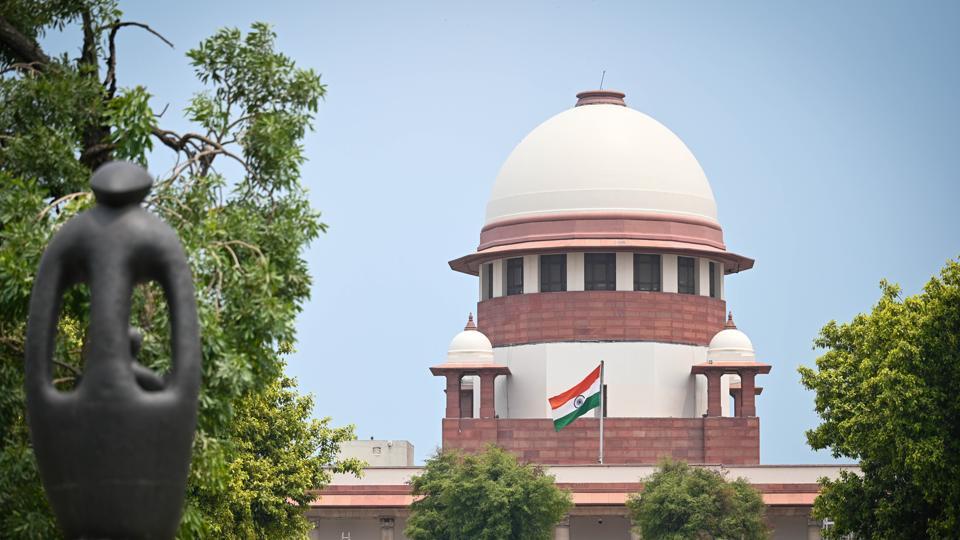
In its bail order related to the Central Bureau of Investigation (CBI) probe, the apex court noted that all other accused in the case were already out, and the trial, with more than 300 witnesses, was yet to begin. In September, the Delhi high court granted bail to Dhall in the money laundering case probed by the Enforcement Directorate (ED) linked to the excise scam.
“The continuation of judicial custody of the petitioner wont serve any purpose. Without expressing any opinion on merits, we direct the petitioner to be released on bail,” said a bench headed by justice Surya Kant.
When Dhall walks out of Tihar jail, there will be no person still incarcerated in connection with alleged irregularities in the now scrapped Delhi excise policy, a far cry from April, 2024, when at least 10top leaders and businessmen were behind bars.
The most high-profile of these accused were Kejriwal, who was arrested by ED in a dramatic raid in March and then re-arrested by CBI in June before being released by the top court in September, former deputy CM Sisodia, who spent close to 17 months in jail before securing bail from the apex court in August, and senior Rajya Sabha MP Sanjay Singh, who was arrested on October 4, 2023 and released on April 3, 2024.
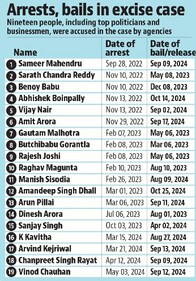
Other prominent politicians who were arrested and spent time in jail included Bharat Rashtra Samithi leader K Kavitha, who was arrested on March 15, 2024 and secured bail on August 27, 2024.
Other people incarcerated in the case included Kejriwal’s aide Vijay Nair, Pernod Ricard regional manager Benoy Babu, businessman Arun Pillai and Butchi Babu considered close to BRS leader Kavitha, among other excise department officials, vendors and distributors.
The AAP has hailed all bail orders in the case as a vindication of its stance that there was no wrongdoing while the BJP has called them procedural and not proof of innocence.
The excise policy was rolled out for the 2021-22 financial year in November 2021, marking the exit of the Delhi government from retail sales of alcohol and allowing private companies to bid for licenses. The objective, the Delhi government said, was to improve the buying experience for citizens by allowing market competition to raise standards.
But the policy was scrapped when Delhi’s lieutenant governor VK Saxena asked for an investigation, citing a report by the chief secretary who alleged irregularities. The agencies alleged that rules were tweaked in exchange for bribes to help wholesellers make windfall gains upwards of ₹300 crore.
In all, between ED and CBI, central agencies arrested 19 people over 20 months in the case that eventually became among the most significant cases with widespread political ramifications.
The string of arrests dented the AAP’s anti-corruption credo, boosted the Bharatiya Janata Party’s campaign in Delhi, and was at the core of the Opposition’s allegations that the Union government was using federal agencies to destabilise non-BJP governments. Discussions around the case echoed in the campaign for the general elections this summer.
The AAP and other accused repeatedly denied the allegations, calling them a BJP ploy and arguing that the prosecution could never establish a money trail or show recovery of bribes.
Over seven of these bail petitions were granted by the apex court, nearly six by the Delhi high court and a few others by local courts. In almost every successful bail hearing, the court frowned on prolonged detention in a case with no hope of trial ending anytime soon and found that it impinged on a person’s fundamental right to liberty under Article 21 of the Constitution. It also sparked a debate around stringent provisions of the Prevention of Money Laundering Act and their potential for misuse and to deny bail.
The SC while granting bail to Kejriwal in September underlined that continued incarceration for an extended period pending trial would infringe right to liberty, traceable to Article 21 of the Constitution. Holding personal liberty as a sacrosanct fundamental right, the court reiterated “Bail is the rule and jail is the exception,” and said, “Bail should not be withheld as a form of punishment.”
The court made a similar observation while granting bail to Sisodia. The top court in its judgment of August 9 said that in a matter pertaining to the life and liberty of a citizen which is one of the most sacrosanct rights guaranteed by the Constitution of India, a citizen cannot be made to run from pillar to post as it would be “travesty of justice”.
The court even questioned the reluctance of trial courts to grant bail by observing, “From our experience, we can say that it appears that the trial courts and the high courts attempted to play safe in matters of grant of bail...It is high time that the trial courts and the high courts should recognize the principle that bail is rule and jail is exception.”
The court noted his incarceration of 17 months with no prospect of trial beginning soon to observe that “keeping the appellant behind the bars for an unlimited period of time in the hope of speedy completion of trial would deprive his fundamental right to liberty under Article 21 of the Constitution.”
Shooting down the CBI’s contention that Kejriwal should be relegated to trial court for bail, the bench underscored that an evolved jurisprudence of bail is crucial for a socially sensitive judicial process. The prolonged incarceration of an accused, pending trial, the bench held, is an unjust deprivation of personal liberty, which is protected under Article 21 of the Indian Constitution.
The court reasoning was similar while granting bail to former CM Manish Sisodia as well, saying that his 17-month long incarceration coupled with his continued detention in a case where there is no hope of trial ending anytime soon impinge on his fundamental right to liberty and speedy trial. In that case too, the court cited Article 21.
Even on Thursday, the top court bench — also comprising justice Ujjal Bhuyan -- underlined that Dhall had already got bail in the PMLA case.
“While directing Dhall to cooperate with the trial, the bench noted that the trial in the case is yet to commence. The petitioner has already been in custody for 18 months. There are approximately 300 witnesses CBI proposes to examine and as such, the conclusion of trial will take reasonable time,” it held.
Dhall is the executive director of family-owned liquor firm Brindco Sales Private Limited and was part of a WhatsApp group “Delhi Liquor Sales Association” where the new excise policy was allegedly circulated before it was finalised. He was accused by CBI of being part of the conspiracy to reap benefits from the new excise policy and facilitating kickbacks to the AAP.
Additional solicitor general (ASG) Raja Thakre, appearing for CBI, submitted that the petitioner was one of the main beneficiaries of the scam and even attempted to bribe ED officers. He informed the court that the charge sheet in the case WAS filed and approximately 300 witnesses were to be examined during trial.
“Today all white-collar criminals are emboldened as they know they will get away. You must undertake scientific investigation so that this does not happen. For this, the prosecution must be made robust and efficient. Unfortunately, conviction rate in these cases is coming down,” the court said.
The bench also pulled up CBI for having hundreds of witnesses that stretched trials. “In 21 years, I have not seen any case of CBI with less than 200 witnesses. Those passing on the road, you make them a witness. See to it that the list of witnesses is kept under 100,” justice Kant said.
Dhall was arrested by CBI on April 18, 2023 and the long period of incarceration also weighed with the court. He was earlier arrested by ED in March 2022. Dhall approached the top court in Augustchallenging the rejection of bail by the Delhi high court in June.


