E-Paper



From NTA's Delhi building to Pune: How NEET questions made it out
At the centre of the 94-page chargesheet are three Pune-based experts appointed by the NTA who allegedly originated the leak.

 Prefer HTon Google


NTA reused the same three subject experts across multiple stages of preparing NEET-UG 2026’s question paper — one of them across all four stages, from item writing to back-translation — and allowed them to see all four of the exam’s master question sets during the final stage, according to the Central Bureau of Investigation’s charge sheet in the paper leak case. Both design choices, the charge sheet sets out, violated NTA’s own protocols. Together, they gave a small group of experts continuous access to most sensitive material for weeks.
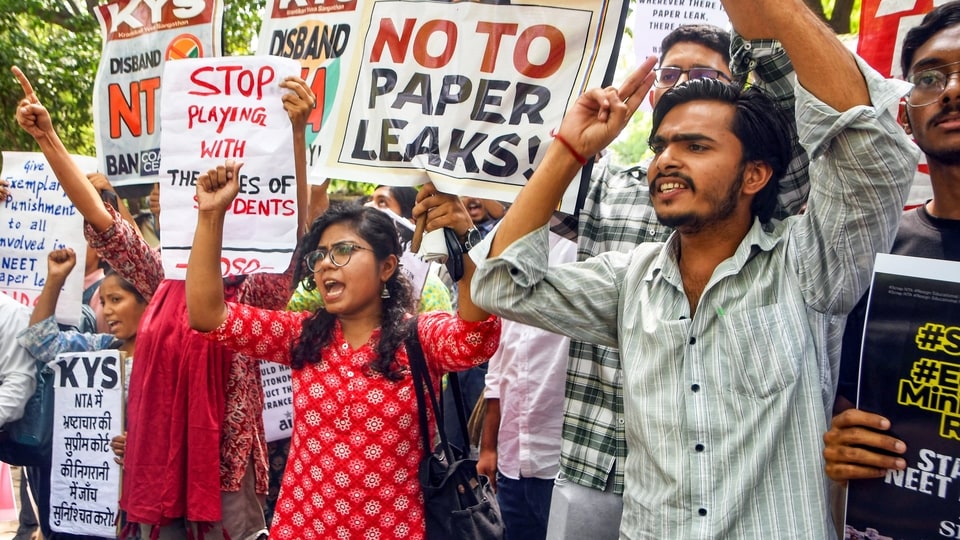
“Many experts have been involved in multiple stages,” the charge sheet states. “From the moderation step onwards, the experts concerned have full access to the final sets of questions. This is particularly so in the translation/back-translation stage as a single expert can see all four of the final master sets.”
Also read: 'Hands off our Jantar Mantar': CJP reacts sharply to HC's remarks on protest site
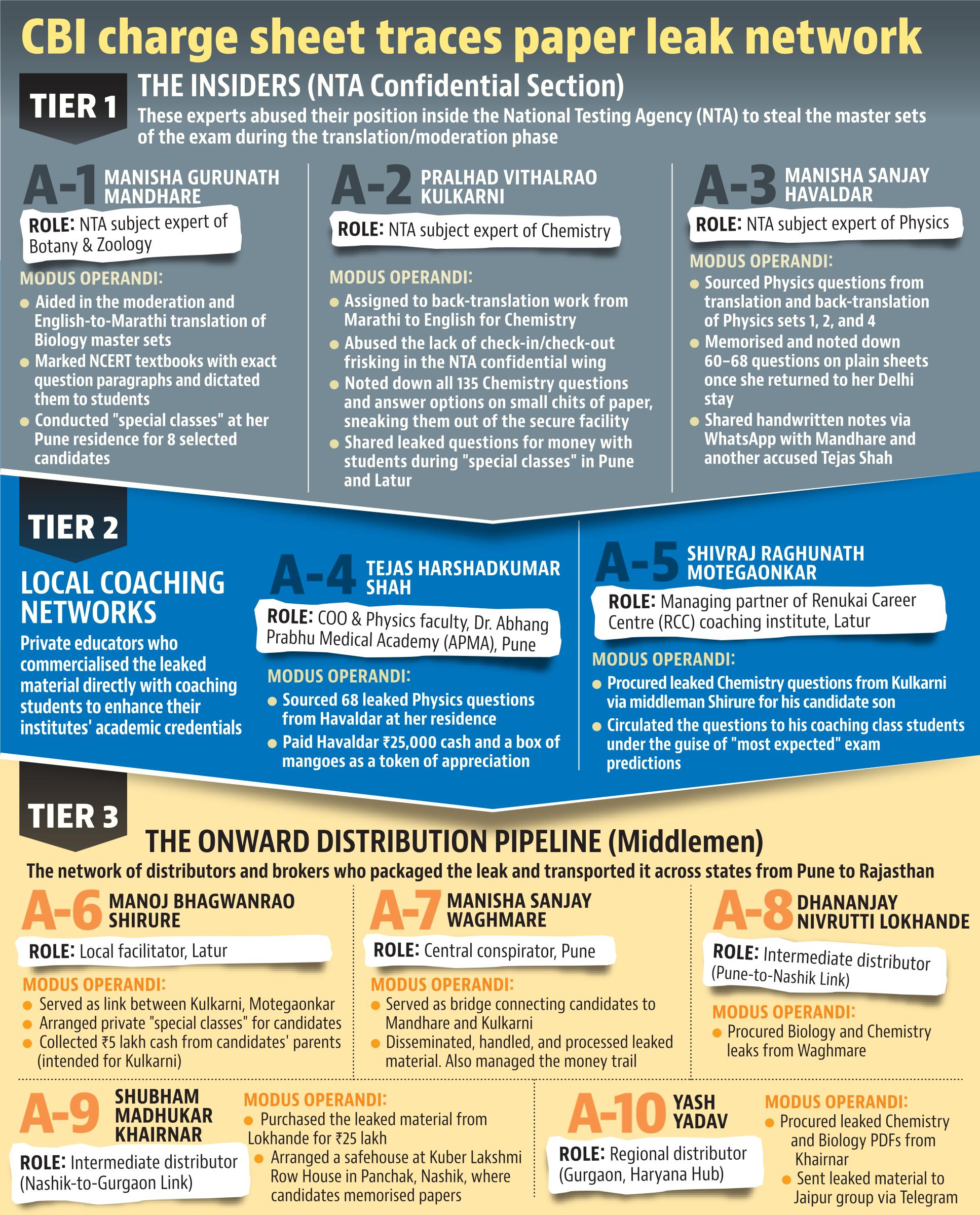
A special court in Delhi is listed to take cognisance of the charge sheet of 94 pages on Monday. At its centre are three Pune-based experts appointed by the National Testing Agency — Manisha Gurunath Mandhare for Botany and Zoology, Prahlad Vithalrao Kulkarni for Chemistry, and Manisha Sanjay Havaldar for Physics. The charge sheet names 13 accused in all; the three experts, who allegedly originated the leak, have been charged under sections covering criminal breach of trust and misconduct by public servants. The CBI has said it found no evidence implicating any government official, including any NTA office-bearer.
Where the access came from
The charge sheet places the theft at NTA’s NSIC Building in Okhla, where all four stages of paper preparation were conducted in what the agency itself calls a “sanitised environment.” Mandhare, per the charge sheet’s timeline, was engaged there across every stage: item writing between February 20 and 24, vetting from March 5 to 7, translation from March 9 to 14, and back-translation from March 31 to April 2. Kulkarni’s services were used for item writing (February 22 to 26) and back-translation (March 31 to April 2). Havaldar’s engagement was shorter — translation on March 14, then back-translation from March 31 to April 2.
Also read: WhatsApp groups, photographs, Telegram: The digital trail that led to NEET UG paper leak
In that three-day window, all three could see all four master sets at once — internally identified as Kailash, Shivalik, Set 2 and Set 3. NTA had not built firewalls between the sets.
Kulkarni allegedly took plain rough-work paper supplied inside the confidential hall and transcribed 135 Chemistry questions with their answer options onto small chits, which he then walked out of the building with. Mandhare and Havaldar, the CBI alleges, memorised the framing and exact parameters, returned to their Delhi hotel rooms, cross-referenced them against textbooks, and transcribed them into personal notebooks.
The charge sheet’s findings sit awkwardly against what the Centre told the Supreme Court just days ago. In an affidavit on the NEET-UG 2026 matter on August 4, the government said question-paper preparation happens in complete isolation, with no electronic devices allowed and every entrant frisked, and that the premises are “under CCTV surveillance and are guarded round the clock by the Central Armed Police Forces.” CBI’s charge sheet alleges that no frisking or metal-detector checks were conducted when experts entered or exited the confidential section, that CCTV feeds were not monitored live, and that only 20-25 days of footage were available when investigators sought the recordings — work in the confidential section had ended on April 7, and the case was only lodged on May 12, so none of the retained backup covered the relevant period.
The government’s affidavit also said no single individual has visibility of the complete paper at any stage, and that multiple question sets are developed independently by separate teams before moving in parallel through translation, printing and storage. By CBI’s account, from the moderation stage onwards, experts handling the papers had access to the complete final sets, with translation and back-translation providing visibility of all four master papers simultaneously.
The ‘leak’
Back in Pune, each of the three ran a different operation with what they had taken.
Mandhare ran her Biology classes at her residence in Ganga Osian Park, Pune, for eight students. Class coordination went through a WhatsApp group she had created in November last year and named “Fifa world cup 2026.” Her method, as the charge sheet describes it, centred on the students’ own textbooks — they bought fresh NCERT Class XI and XII copies, on which she marked exact paragraphs containing the leaked questions and dictated the question formulations into the margins. Students transcribed these into a “fair notebook,” which Mandhare corrected herself. Manisha Sanjay Waghmare, a Pune facilitator the CBI describes as running the operation out of her husband’s dental clinic, later collected the physical registers from students, including two named in the charge sheet— Diya Shinde and Snehanjali Deshmukh — to have them digitised.
Also read: How a 'Fifa world cup 2026' WhatsApp group exposed NEET leak
Kulkarni’s Chemistry classes ran at his house in Nanded City, Pune, from April 25-27, for nine students arranged by Waghmare. Investigators corroborated the timing independently: MyGate, the access-control app used by his housing society, had logged the entry, exit and biometrics of visiting students and parents through April, which the CBI cross-checked against call records and phone-location data. CBI also recovered nine images of Chemistry questions and answer slips from Kulkarni’s phone that matched the actual paper, alongside WhatsApp chats in which a parent asked for his address to hand him a watch in exchange for questions.
Havaldar did not run classes of her own. CBI’s account places her at the centre of a series of one-off transactions instead. On April 14, at her home, she dictated 68 Physics questions to Tejas Harshadkumar Shah, COO at Dr Abhang Prabhu Medical Academy in Pune, in exchange for ₹25,000 in cash and a box of mangoes. Shah transcribed them onto 16 pages. On April 25, he sent high-resolution WhatsApp images of the transcript to Havaldar’s husband, Sanjay Sudhakar Havaldar, who forwarded them to Mandhare. On April 27, Mandhare brought one Dr Usha Adhav to Havaldar’s office. Havaldar transferred the images to her office computer by USB, printed hard copies for Adhav for another ₹25,000, and — the charge sheet notes — the CCTV captured the exchange.
Kulkarni’s chits also travelled outside Pune. Kulkarni dictated the leaked questions to the son of Shivraj Motegaonkar, who runs the Renukai Career Centre in Latur, as part of the special classes. Motegaonkar circulated handwritten Chemistry questions to his own students through a coaching-centre WhatsApp group and later posted a video on social media claiming he had “predicted the entire Chemistry paper for NEET UG 2026.” Most questions in his April mock test appeared in the actual exam, CBI has said.
Also read: 47 NTA officials sacked amid nationwide student protests, more cleanup to follow
An expert panel constituted by Delhi University later matched the recovered leaked material against the four master sets at CBI’s request. Of the 68 Physics questions Havaldar had dictated to Shah, the panel found that only two did not appear in any of the four master sets; the other 66 did. Across the wider body of material recovered from aspirants and intermediaries, the match ran as high as 85% on sets the three experts had access to.
How it came apart
A Kerala MBBS student forwarded the leaked PDFs to his father’s landlord in Sikar. The landlord took them to a local Chemistry teacher, Shashikant Suthar. Suthar reported the leak directly to the director general of NTA on May 7. NTA cancelled the exam five days later and handed the case to CBI.
Arrests began within days. Waghmare was picked up on May 14, Kulkarni on May 15, Mandhare on May 16, and Havaldar on May 22. Nine others named in the charge sheet — including Shah, the Pune intermediary Dhananjay Nivrutti Lokhande, and Nashik-based Shubham Madhukar Khairnar, who allegedly paid Lokhande ₹25 lakh for the digitised material — were arrested through the same period. As the digital chain widened, intermediaries used disguised usernames to blur the trail — Yash Yadav operated on Telegram as “hunter23i” and communicated with Mangilal Biwal under “@Hindustan8360”; PDFs were printed at cyber cafes with instructions to delete the files afterwards.
Efforts to destroy the record began around the same time, per the charge sheet. Havaldar burned her master Physics notebook in her kitchen. Shah destroyed his 16-page handwritten notebook. Lokhande, who had typists digitise Waghmare’s collected registers at her husband’s dental clinic, threw his iPhone 14 Pro Max onto a highway. Khairnar said he had dropped his primary phone from a moving motorcycle. Shopkeepers along the chain were forced to Delete for Everyone on their messaging apps.