E-Paper



APAAR ID must for Class 9, 11 registration: CBSE
The Central Board of Secondary Education (CBSE) has decided to make 12-digit automated permanent academic account registry (APAAR) ID mandatory for registration in classes 9 and 11 from the upcoming 2026-27 academic session

 Prefer HTon Google


New Delhi: The Central Board of Secondary Education (CBSE) has decided to make 12-digit automated permanent academic account registry (APAAR) ID mandatory for registration in classes 9 and 11 from the upcoming 2026-27 academic session. The decision was taken during the board’s 142nd governing body meeting held in December 2025, minutes of which were made public on Monday.
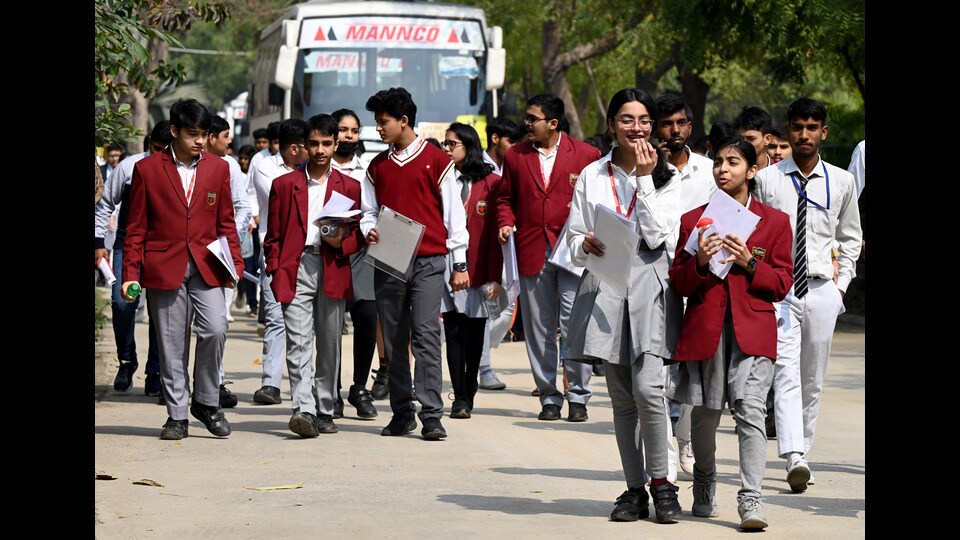
The key proposals approved by the governing body also include redesigning of class 10 marksheet to include scores of two board exams, constitution of global curriculum sub-committee, and expanding multilingual provisions in line with National Education Policy (NEP), 2020.
CBSE had first introduced APAAR-ID integration in the registration of class 9 and 11 students in the 2025-26 session. However, in September 2025, the board relaxed the requirement after schools flagged documentation gaps, parental consent concerns and technical integration issues. At present, about 50% of class 9 and 11 students’ data is linked with APAAR ID across the country, CBSE said.
“The board will initiate communication and hand-holding schools in states where there was a problem in creation of APAAR ID,” the minutes said. The move is aimed at streamlining student data management, academic credit tracking and digital verification of records in line with education reforms under NEP 2020.
CBSE’s governing body, the highest decision-making authority of the board, has also approved the proposal of the examination committee to redesign marksheet format for class 10 in line with two-board examinations in a year.
The existing marksheet design caters to a single annual examination and does not reflect details pertaining to two examinations assessment.
“It is proposed to introduce a new design for the Class 10 marks sheet incorporating the following: Separate sections for first board examination and second board examination results; Clear depiction of marks obtained in each exam and the final result based on the best of the two performances,” the minutes said, citing the examination committee’s proposal, which was ratified by the governing body.
After detailed deliberation, it was decided that the column of Internal Assessment (IA) “may be shifted to the final result column from the main exam column.”
In alignment with multilingual policy priorities, CBSE has also decided to offer four Indian languages — Konkani, Dogri, Maithili and Santhali — as elective subjects in class 9 from 2026-27. The board has also approved the proposal to introduce Computational Thinking (CT) and Understanding Artificial Intelligence (Al) for classes 3 to 8 from the upcoming session.
To establish a dedicated mechanism to address matters relating to CBSE’s global operations, the board has approved the constitution of the ‘Sub-Committee for CBSE Global Curriculum’, which “shall deliberate on matters related to CBSE’s global outreach, academic alignment with international standards, assessment reforms, capacity building, and issues specific to CBSE-affiliated schools abroad.”
The CBSE Global Curriculum is a new, specialised educational framework, set to be launched in April 2026.
‘Class 10 first board mandatory’
Meanwhile, CBSE, which is starting with two board exams for class 10 from 2026, has made it is mandatory for students to appear in the first board exam, and those who do not attempt at least three subjects in the first edition will be placed in the “essential repeat” category, requiring them to repeat the academic year and making them ineligible for the second exam scheduled in May 2026.
In a February 14 notification, CBSE examination controller Sanyam Bhardwaj clarified that while the first exam is compulsory, students who pass will be allowed to improve their performance in up to three subjects — Science, Mathematics, Social Science and languages — in the second, optional exam. Students failing in up to two subjects in the first phase will be placed in the compartment category and permitted to take the second exam.
The class 10 and 12 board examinations of both CBSE and Council for the Indian School Certificate Examinations (CISCE) will begin on Tuesday. While over 4.37 million students — 2.51 million class 10 students and 1.86 million class 12 students — will appear for CBSE board examinations, over 360,000 students — around 260,000 class 10 students and 100,000 class 12 students — will sit for the CISCE board examinations.