E-Paper



Delhi: AQI poor as air hazard hits even before Diwali, Grap over city
For the next three months, perhaps more, Delhi’s 20 million-plus residents will inhale lungfuls of toxic air with every breath

 Prefer HTon Google


Delhi’s pollution levels rocketed into the “poor” zone for the first time in four months on Tuesday, days before Diwali, as dipping temperatures and dusty winds portended the Capital’s annual winter tryst with months of toxic air, prompting authorities to roll out the first stage of the Graded Response Action (Grap) to snuff out pollutants.
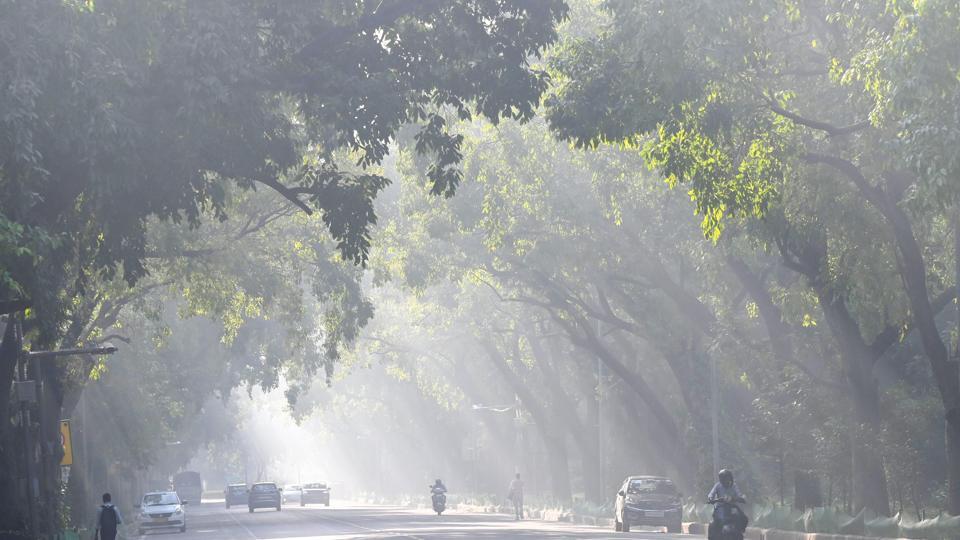
The city’s average 24-hour air quality index (AQI) hit 211 at 4pm on Tuesday, according to the Central Pollution Control Board’s (CPCB) daily bulletin. It was Delhi’s first AQI reading past 200 since 245 on June 11 and a deterioration from 189 (moderate) on Monday.
For the next three months, perhaps more, Delhi’s 20 million-plus residents will inhale lungfuls of toxic air with every breath. Smoke from firecrackers on Diwali, lower temperatures, slowing winds and smoke from stubble fires in upwind Punjab and Haryana will drive up pollution levels to the worst in the world. The skies will turn grey, silhouettes will blur, and administrative collapse will be on display as authorities turn to methods that have failed year after year.
Tuesday’s AQI was, to be sure, down largely to local emissions and falling temperatures. But with Diwali around the corner (and the Supreme Court indicating it may allow the use of ‘green firecrackers in Delhi and the National Capital Region), stubble fires already peppering the farmlands of Punjab (the state has clocked 70 farm fires over the past week, of which 31 were on Tuesday alone) and the wind direction set to turn northwesterly, experts warned that Delhi’s problem will only get more acute in the coming weeks to come.
And as a grey sheet tinted the national capital, officials from the Commission for Air Quality Management (CAQM) huddled and ordered the enforcement of Grap Stage 1. To be sure, the measures under this level are largely preventive, rather than ‘restrictive’ measures.
It lists 27 measures, including periodic mechanised sweeping and water sprinkling on roads, strict vigilance of pollution-under-control norms, action against visibility polluting vehicles, regular lifting of solid waste andfor construction and demolition (C&D) sites with an area of more than 500 sqms -- but not registered on the state government’s online dust portal -- to be shut down immediately.
Grap Stage 1 is generally enforced when the AQI crosses 200. Stage 2 (very poor) measures are invoked when the AQI crosses 300; Stage 3 (severe) when the AQI crosses 350 and Stage 4 (severe-plus) when the AQI is above 400. The Supreme Court last year revised the thresholds for the last two categories, which would earlier be invoked at 400 and 450 respectively.
Forecasts by the Centre’s Air Quality Early Warning System (EWS) warn that the air will only get more noxious, with “very poor” AQI also likely around or after Diwali.
CPCB classifies an AQI of 0 to 50 as good, 51 to 100 as satisfactory, 101-200 as moderate, 201-300 as poor, 301-400 as very poor and 401-500 as severe.
The AQI hit a maximum of 494 (severe) on November 18 last year - the second worst ever AQI in Delhi’s history. It was 468 (November 3) in 2023 and 450 in 2022 (November 3).
Typically, farm fires begin to surge after October 15 — and reach their peak between the last week of October and the first week of November. Though winds are blowing in from the northwest, farm fires in the agrarian states are yet to surge.
Swagata Dey, a policy specialist leading the Air Quality Policy and Outreach group at the Center for Study of Science, Technology and Policy (CSTEP) said that Delhi’s AQI has largely been under control so far this year due to regular rain.
“Local sources of pollution, such as vehicles and construction have continued unabated, but transboundary sources, including stubble burning, have been very low compared to other years. Hence, we were breathing cleaner air so far,” said Dey.
The Decision Support System (DSS) – a model which calculates the estimated contribution of sources of pollution to Delhi’s PM 2.5, said the contribution of stubble burning was only around 0.53% on Tuesday, marginally down from a contribution of 0.62% on Sunday. The top contribution to Delhi’s PM 2.5 on Monday was 19.8% from Delhi’s transport sector, followed by Gurugram (9.3%) and Delhi’s residential sector (5.1%), data showed.
Delhi’s maximum temperature meanwhile stood at 32.6°C on Tuesday – a degree below normal. This is forecast to rise further and possibly touch 34°C by Wednesday. The minimum stood at 19.0°C, which was a degree below normal. The minimum will hover between 18-21°C till Thursday.
The India Meteorological Department (IMD) also said a mist was likely to envelop the city early on Wednesday, with a shallow fog possible October 19 onwards.
Mahesh Palawat, vice-president at Skymet said that strong winds are unlikely at the moment, with no significant change in the weather in the offing. “No rain or strong winds are expected to settle pollutants or sweep them away,” he said.