Are promises on water, power freebies... issue complicated: Supreme Court
“Ultimately, there is no such thing as a free lunch,” commented a bench, led by Chief Justice of India (CJI) NV Ramana, as it mused over the correct definition of ‘freebies’ and the scope of scrutiny a proposed expert panel could undertake if the court were to constitute it.
New Delhi: The concerns are about the right way of spending taxpayers’ money, observed the Supreme Court on Wednesday, musing over the correct definition of “freebies” and the scope of scrutiny a proposed expert panel could undertake if the court were to constitute it.
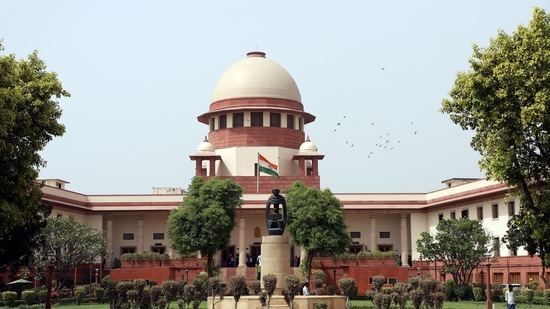
The Supreme Court. (File Photo/ANI)
“Ultimately, there is no such thing as a free lunch,” commented a bench, led by Chief Justice of India (CJI) NV Ramana, while pointing out that the issues surrounding definition of freebies, their distinction with the welfare measures, and the possibility of curbs on electoral speeches are “getting increasingly complicated”.
The bench, which also included justices JK Maheshwari and Hima Kohli, pointed out that there are various aspects of the debate on freebies that the court wants to initiate, and therefore, it must tread cautiously on what constitutes hand-outs, as opposed to welfare measures aimed at providing a dignified life to marginalised classes of citizens.
“One of the suggestions is that political parties cannot be prevented from making promises to the electorate. The question is, what are the right promises? What is the correct definition of freebies? It has to be defined what is a freebie. Can we describe the promise of free education as a freebie? Can free drinking water, minimum essential units of power etc. be described as freebies? At the same time, can consumer products and free electronics, described as welfare measures?” asked the bench.
Referring to Mahatma Gandhi National Rural Employment Guarantee Act (MNREGA), it added that schemes such as MNREGA give dignity of living.
“I don’t think promises alone can decide the outcome of an election. Some make promises and even then, they are not elected...Concerns are about the right way of spending tax payers’ money. Some people say money is wasted; some say it is welfare. These issues are getting increasingly complicated. All of you give your opinions and then after debate only we can come to a conclusion,” said the CJI.
“You cannot prevent a political party or individual from making promises that are aimed at fulfilling this constitutional mandate, if elected to power. The question is what exactly qualifies as a valid promise,” he added.
During the brief proceedings, the bench said that it wants a committee to examine the pertinent issue and give suggestions.
At this point, senior advocate P Wilson, appearing for the Dravida Munnetra Kazhagam (DMK), submitted that the party wants to be heard in the case, and that it is opposing the formation of any committee.
“You are entitled to raise your objections. But that doesn’t mean we cannot pass an order just because you are opposing,” retorted the bench, asking Wilson and all other counsel in the matter to file their written submissions before August 22 when the matter will be heard next.
Apart from DMK, the Aam Aadmi Party and the YSR Congress Party have also approached the Supreme Court seeking permission to be heard in the public interest litigation filed by lawyer Ashwini Upadhyay, who has sought directions for issuance of stringent guidelines to deregister errant political parties and seize their election symbols for offering “irrational freebies”.
The parties have opposed the PIL, arguing that welfare schemes intended to ensure social and economic justice cannot be termed “freebies” and that the top court should leave it to the wisdom of the elected governments, legislatures and voters to decide what is good for them and the economy.
However, solicitor general Tushar Mehta, representing the Centre, contended that the idea is not to oppose social welfare measures. “Nobody is opposing social welfare measures. But if that means distributing everything for free, that’s an immature understanding,” said Mehta.
To this, the CJI replied: “I have already said this on the last date. Freebies and welfare measures are different. Not everything is a welfare measure.”
Stating that all freebies cannot be couched as welfare schemes, the court on August 11 observed that “some financial discipline” must be there to tackle the “serious issue” of hand-outs as electoral promises, adding that a debate should be initiated to assess its impact on the economy of a state and taxpayers.
The bench on that day asserted that a distinction between welfare measures and freebies should be drawn when taxpayers keep questioning governments over lack of basic amenities such as good roads and electricity, even as freebies are doled out as poll promises.
Freebies and poll promises have become the latest bone of contention between the Union government and the states. Prime Minister Narendra Modi has repeatedly spoken of the malaise of freebies in recent weeks whereas Delhi chief minister Arvind Kejriwal and Tamil Nadu finance minister Palanivel Thiaga Rajan have weighed in on it from the other side. The plea in the apex court itself was filed by Upadhyay, who is a Bharatiya Janata Party (BJP) member.
While considering Upadhyay’s petition on August 3, the court remarked that no political party wants freebies to go, even as the Union government termed such hand-outs the “road to an economic disaster” and urged ECI to devise ways to deal with them. The Centre conveyed its stand to the court days after PM Modi hit out at the culture of freebies (calling it “revadi” culture -- reference to a popular sweet) while speaking at an event in Uttar Pradesh on July 16.
On Wednesday, YSR Congress Party also moved a plea to be heard in the case, arguing that a state government’s initiative on education, health, women empowerment, agriculture, housing, poverty upliftment and support to the old and needy, should not be dubbed as freebies.
“No doubt, such programmes that are devoid of any true purpose and are implemented only for the purpose of luring the voters should necessarily be termed as freebies. However, painting the programmes of vast socio-economic importance that are being implemented to alleviate the prevailing distress with the same brush is, to say the least, an insult to the constitutional mandate,” stated the application.
The elected governments, the YS Jagan Mohan Reddy-led party said, must be afforded the latitude to formulate interventions and determine their quantum and the time-period for which certain schemes are to be implemented to achieve the desired socio-economic outcome.
“This is owing to the reason that it is the elected representatives that have a real understanding of the prevailing distress and the real reasons causing that distress,” said the plea, adding that the proposed committee by the top court should recommend ways to enable states to discharge their constitutional duties more effectively.

 E-Paper