
 E-Paper



Congress fixes its line on Article 370, calls party meeting to get it across
The Congress was admittedly caught off guard by the government which pulled out two proposals to scrap special status and split the Himayalan state into two union territories.

 Prefer HTon Google


The Congress has summoned all its state leaders to national capital Delhi on Friday to explain the party’s line on scrapping special status for Jammu and Kashmir, a move designed to ensure that party leaders do not speak in different voices any longer, a senior party functionary familiar with the development said.
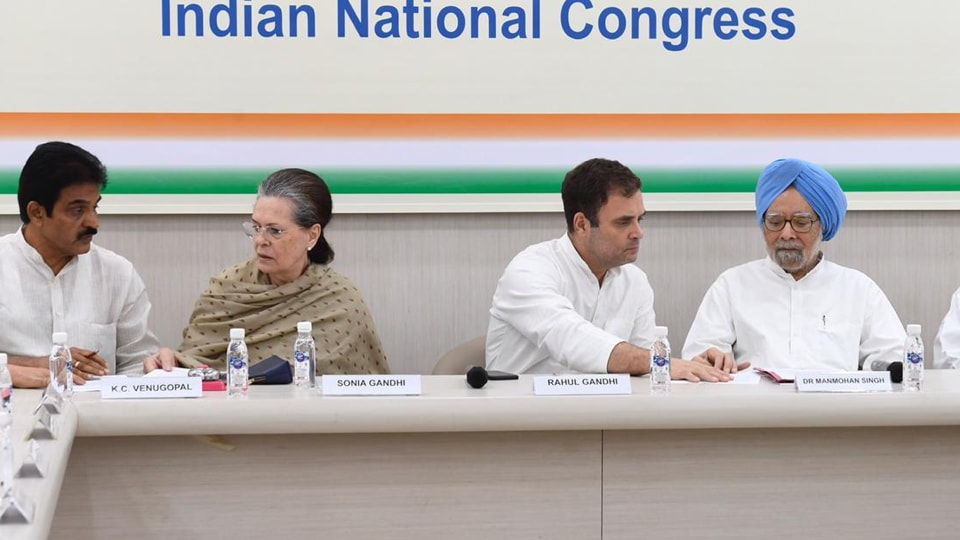
The party has had to face some awkward moments over the last two days after several leaders appeared to welcome the government’s effort to push revocation of Article 370 through Parliament. Ghulam Nabi Azad, the leader of opposition in the Rajya Sabha, said those who supported erasing the constitutional safeguard for J&K were neither familiar with the history of Kashmir, or the Congress.
But the Congress was admittedly caught off guard by the government which pulled out two proposals to scrap special status and split the Himayalan state into two union territories.
In Parliament, the Congress opposed the legislation. But it was only after Parliament had sealed the fate of the twin proposals that the party’s top decision making body, the Congress Working Committee met late on Tuesday night at the Congress headquarters.
The revocation of special status was already a done deal by them.
Watch: ‘Will embrace Kashmiris:’ Amit Shah as LS passes bifurcation bill, scraps 370
Around the same time that the Congress was fine-tuning its position to put out a cohesive stand, President Ram Nath Kovind signed off on the presidential order to end Jammu and Kashmir’s special status.
In the resolution that was put out, the Congress said the government’s move on Kashmir had grave implications on the “idea of India being a union of states”.
“The CWC deplores the unilateral, brazen and totally undemocratic manner in which Article 370 was abrogated and the State of Jammu and Kashmir was dismembered,” read the resolution adopted by the Congress Working Committee.
But it was only after a bit of struggling that the CWC could agree on this resolution.
There was a strong and vocal group of party leaders who wanted the Congress to tone down its opposition to Article 370, against which it had already voted against in Parliament. Some even argued that the party should go along with the public sentiment in favour of Article 370’s abrogation. Just when this suggestion did appear to get support from some party leaders, a Congress leader from Kashmir made an emotional intervention advising caution.
Tariq Hamid Karra, a former Jammu and Kashmir finance minister and a founder member of the Peoples Democratic Party before he switched to the Congress in 2017, underscored that any compromise in its position by the Congress will leave people like him only two “extreme options” – either “go with the separatists by compulsion or join the BJP by convenience”.
“We are at a crossroads where we have to decide whether to stick to our core philosophy or compromise under coercion, compulsion or convenience,” a Congress functionary who attended the meeting quoted Karra as having said.
That remark prompted senior leader Mukul Wasnik to stress that if people such as Karra were being forced to think about options, then there was something “drastically wrong” with the Congress party. Former Lok Sabha speaker Meira Kumar, party general secretary in-charge of Jammu and Kashmir Ambika Soni and in-charge of Odisha affairs Jitendra Singh concurred with Karra’s remarks.
Karra’s intervention came when leaders such as Jitin Prasada and RPN Singh insisted that the party should nuance its stand keeping in mind the “popular perception and widespread public sentiment”.
Rahul Gandhi, who had announced his decision to step down from the party president’s post at the last CWC meeting in May, argued that the party should not tailor its stand on the basis of public perception but do the right thing.
Gandhi also think much of party leaders speaking in different voices on Kashmir’s special status, stressing that this was indeed a point on which there were divergent views in the country. A divergence of views within the party was then natural, he reasoned, according to a party leader who attended the meeting.
The Congress, however, did attempt to make up for the blooper by its party’s leader in the Lok Sabha, Adhir Ranjan Chowdhury, who appeared to suggest that nothing about Kashmir could be an internal matter.
“You say that it (Jammu and Kashmir) is an internal matter. But it is being monitored by the United Nations since 1948. Is that an internal matter? We signed the Shimla Agreement and Lahore Declaration with Pakistan. Was that an internal matter or bilateral?” Chowdhury had told the Lok Sabha. The remarks left Congress Parliament Party (CPP) chairperson Sonia Gandhi, who was sitting next to him, in shock.
In a paragraph that was incorporated in the resolution at the last moment, the CWC underlined that Jammu and Kashmir’s integration with India was final and all issues relating to the state were internal.
“The CWC strongly reaffirmed the consistent and stated position of the Indian National Congress that J&K, including the areas under the illegal occupation of Pakistan and the part ceded by it to China, is an integral part of the Republic of India. The integration of J&K with India is final and irrevocable. CWC firmly asserted that all issues pertaining to J&K are internal matters of India and no outside interference will be tolerated,” the resolution said.
This paragraph was incorporated at the last moment in the draft of the resolution that was prepared by the party’s policy planning group earlier in the day.
The group is headed by former Prime Minister Manmohan Singh, and has Azad, Soni, Chidambaram, Karra and state Congress chief Ghulam Ahmed Mir as members.


