E-Paper



As Baghjan fire rages on, OIL sets July 30 deadline
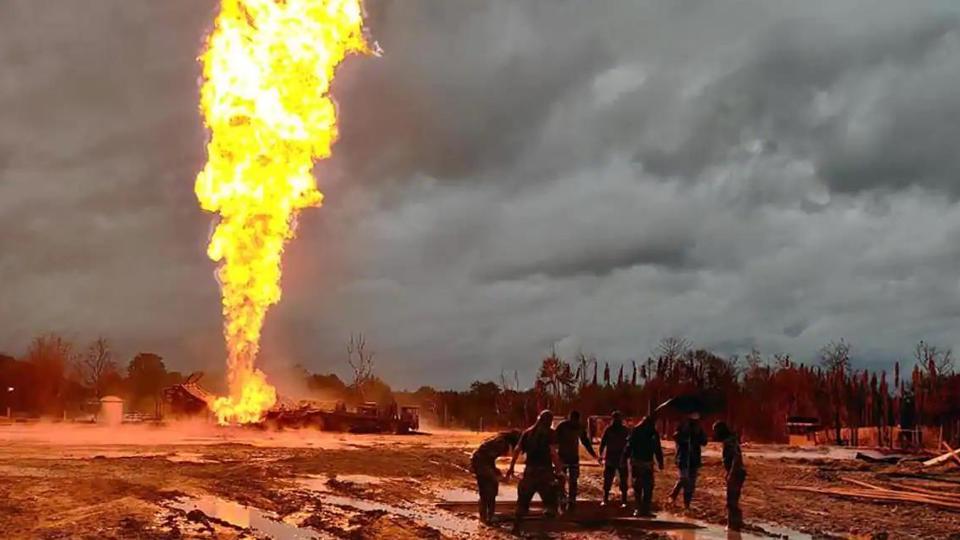
The blowout -- - an uncontrolled release of gas and oil condensate -- which occurred on May 27 has killed two firefighters, and caused a fire that has destroyed adjoining homes, injured three foreign experts examining the wellhead, and displaced at least 9000 people in the district, who have moved to relief camps.


The repair of an Oil India Limited (OIL)-operated well in Baghjan in Assam’s Tinsukia district which has been on fire since June 9, is down to a matter of replacing nuts and bolt-like studs and injecting a kill-fluid into the well, which is expected to be completed by July 30, a company spokesperson said Monday.
New studs, fabricated at OIL’s Duliajan workshop, have been transferred to the site to replace those that were damaged and deformed in the blaze, a statement released by the company on Monday said.
The blowout -- - an uncontrolled release of gas and oil condensate -- which occurred on May 27 has killed two firefighters, and caused a fire that has destroyed adjoining homes, injured three foreign experts examining the wellhead, and displaced at least 9000 people in the district, who have moved to relief camps.
“While all other logistical requirements have been completed, two jobs, namely, capping the well and killing it, remain. To cap the well, we need to install the blow out preventer (BOP) on top of the wellhead,” said Tridiv Hazarika, OIL spokesperson.
The wellhead has a mechanical device called a spool, which carries the weight of the blow out preventer (BOP).It was while removing one such damaged spool on July 22 that the foreign experts sustained injuries.
“While inspecting the second spool which was not damaged, it was found that some studs, similar to nuts and bolts, were damaged. Without preparing the spool, removing the damaged studs and installing new studs, the BOP, which weighs around three tonnes, cannot be installed,” said Hazarika.
A considerable amount of time was spent in removing the damaged studs, he added.
“It is a precise operation and it needs to be done correctly as the spool will carry the weight of the BOP. If there is even the slightest fault, it will lead to severe problems. Hence, these tasks were done with extreme caution and they delayed our operation further,” Hazarika said.
Once the BOP is installed, the process of killing the well would start. This would involve injecting a kill fluid, which is a sludge-like specially prepared mud, into the well slowly to push the gas from the well back to the reservoir.
“The length of the well is 3.5 km. So, it could take around 36-40 hours to fill the well with sludge and kill the well. Once the BOP is in place within the next two days, the killing operation would begin and the entire exercise should be over by July 30,” Hazarika said.
There are 17 oil and five gas wells in the Baghjan oil field. The blowout took place in gas well no.5.
Since the well is located close to Dibru Saikhowa National Park and the ecologically-sensitive Maguri Motapung Wetland, there were fears of environmental damage to the area due to the blowout and fire. Various assessment and impact studies of the blowout as well as the blaze in villages and nearby forest areas by multiple agencies such as ERM India, TERI, CSIR-NEIST and IIT-Guwahati are underway.
Last month, National Green Tribunal ordered the formation of an expert committee to probe the blowout and subsequent fire and assess the damage caused to human life, wildlife, and the environment.