
 E-Paper



Assam: Sivasagar rebuilds a month after the floods but fear remains
A month after floods hit Sivasagar and neighbouring Charaideo, the waters have receded, but the disaster is far from over for many survivors. At least 105 died.

 Prefer HTon Google


Chandravati Manjhi, 65, returned to Bihubor village in Assam’s Sivasagar district 15 days after the devastating July 19 flood, desperate to find her home – Bihubor had been buried under a mudslide that swept down the hills of neighbouring Nagaland.
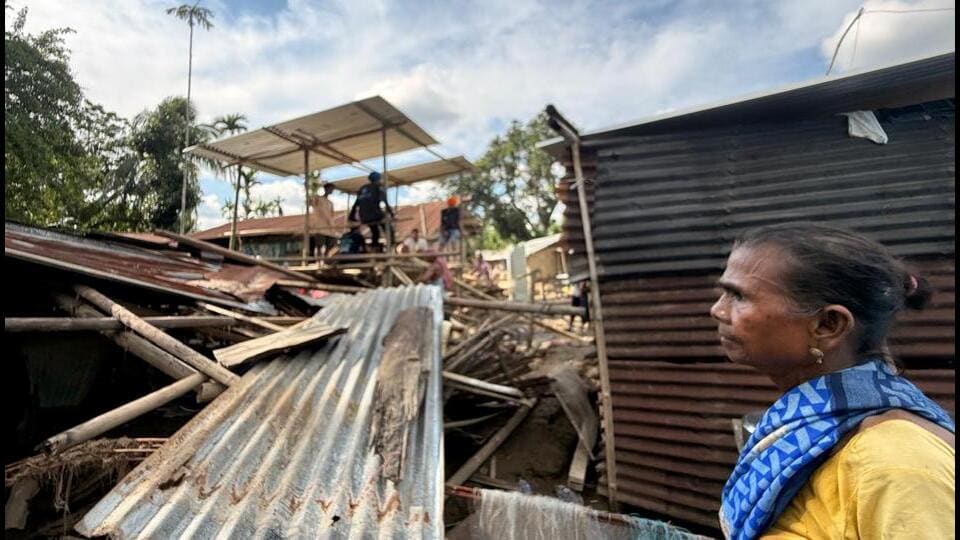
For Chandravati, returning home did not mean returning to the life built over decades; it meant trying to find what remained of it. “I could identify my house only because there was a concrete structure nearby,” she said.
Labourers at a stone crusher, Chandravati and her son lived around 100 metres from the Dikhow river. She recalled the terror of the June 19 flood. “That day, suddenly the water level started rising and we heard a massive sound coming from upstream on the river, which was a warning. We started moving almost immediately, but the water entered before we could get out,” she said, adding that they used small country boats to escape the flow.
A month later
A month after the floodwaters swept through parts of Sivasagar and neighbouring Charaideo -- at least 105 people have died in the floods so far, 54 of them in Sivasagar -- the water has receded, but for many survivors, the disaster is not over.
For families in Nepalikhuti, Bihubor, Nazira and other affected settlements, the loss goes far beyond their homes.
Livestock, agricultural equipment and stored food were swept away. Crops were destroyed and, for many families, so was their means of earning a living.
Also Read: Assam floods: Over 26,000 houses damaged; second phase of monetary relief begins
Pramila Majhi of Nepalikhuti is trying to rebuild her house with support from several organisations, but she feels it will take a long time to return to the life the villagers knew before the flood. “We were happy. We had flourishing agriculture, cows and buffaloes in almost every house. But in just four or five hours, everyone lost everything. Now 20 years won’t be enough to return to normal,” she said.
“It is not the compensation we will receive or the amount of help that has come to us in the last few weeks, but the opportunities to earn that matter, because we cannot live our lives depending on compensation and relief materials,” said Chandravati, echoing Pramila.
‘This was not a normal flood’
According to Nirmal Lahon, a businessman from Nazira, floods were not new to the area, but what happened on July 19 was not a normal flood; it was a disaster. “An excavator used for cutting the hills in Nagaland was dragged down to Nepalikhuti, many miles away. We can imagine the force of the water from this. Many elephants were also washed down for miles,” he said.
Sivasagar and the surrounding areas have rivers including the Dikhow, Disang and Darika, which flow down from the hills before joining the Brahmaputra. People living along their banks have lived with seasonal flooding for generations.
The July one was different. “This was pralay. We cannot describe it. Maybe, it was a tsunami-like disaster, and this was not just a natural calamity; humans were also responsible,” Anil Kumar Gupta, a retired journalist from Sivasagar, adding that allegations of illegal mining in areas near the Assam-Nagaland border had been around for nearly 25 years.
The question of a man-made disaster
Assam chief minister Himanta Biswa Sarma initially said that a cloudburst in neighbouring Nagaland triggered a massive downflow of mud towards Sivasagar, Charaideo, Jorhat and Golaghat. He later attributed the disaster to exceptionally heavy rainfall.
Debabrata Saikia, the son of former Assam chief minister Hiteswar Saikia, described the floods as a “meticulously man-made disaster,” alleging that unchecked extraction of coal, sand and stone has altered the natural environment around the Dikhow basin.
The former Nazira MLA, under whose constituency the worst-affected area falls, said satellite imagery comparing the area around the Dikhow between 2010 and 2024 showed that stretches of its once-green banks and natural channels had been extensively excavated.
Also Read: Assam’s floods deserve national calamity status
In 2019, Saikia filed a public interest litigation in the Gauhati High Court challenging illegal sand and stone extraction along the Dikhow river. The petition cited regulatory lapses and argued that unchecked mining was contributing to flooding. The court subsequently directed the Assam government to establish a specialised Mines and Minerals Task Force Battalion to curb illegal mining.
“The High Court had directed the Assam government to take measures and submit a report, but the state government said the area was disputed and ignored the matter,” he said. “This disaster was created by us. There were enough warnings, complaints and High Court directions. Everything was ignored, and this is happening in various parts of Assam and the Northeast. If we don’t take steps, more incidents are awaiting,” he said.
The Assam government has not officially attributed the July 19 floods to illegal mining. Hindustan Times reached out to several ministers, including former mines and minerals minister Kaushik Rai and the present minister Jayanta Mallabaruah, but none agreed to comment on the issue.
Environmental degradation has emerged as a concern among residents and local groups in upstream areas. Even local residents living near mining sites blamed extensive mining, hill-cutting and deforestation for aggravating a disaster they had never witnessed before.
Damage Assessment and Rehabilitation
Sivasagar Deputy Commissioner Mridul Yadav said the scale of the destruction was much more intense than normal floods and that the state government was first conducting a proper assessment to understand what rebuilding would require.
In July, the chief minister had said the scale of destruction was much more intense than what could be seen in videos on social media and television.
The state government began a special damage assessment earlier this month and has also released ₹15,000 in interim financial assistance for flood-affected families in the four worst-hit districts.
Also Read: Assam govt begins flood damage survey, compensation to start by mid-September
But for families who have lost homes, crops and livestock, reconstruction cannot be completed with a single payment. That is where volunteers and organisations from across the country have stepped in.
In Nepalikhuti, the Punjab-based Global Sikh Organisation has been helping families rebuild houses rather than simply distributing relief materials. Tejendar Pal Singh, a senior businessman from Amritsar, said their teams first located the houses, examined their condition and started rebuilding.
“For a human, returning home is the ultimate goal after such a loss, but for them, it is nearly impossible. They are getting other help, but without a house, life cannot restart. So, we decided to build houses,” Singh said.
‘Who can guarantee that we will survive the next one?’
For victims, the immediate challenge is to rebuild what has been lost. By the time families began returning home nearly two weeks after the flood, the nature of the crisis had changed. Though rebuilding is under way and people are returning home, the fear of another flood, perhaps even more destructive, remains.
Deeplal Sharma, 70, has lived in Nepalikhuti for three generations. His family has its roots here. So does the land on which they built their lives. But the flood has made him think about leaving. “We have lived here for three generations and this is our land. But now I am afraid. A disaster of this intensity, or even worse, may come,” he said. Sharma’s fear is not about the compensation being announced now. It is about whether there will be a next disaster. “Compensation and relief may reach us while we are alive. But who will guarantee that we will survive the next one?” he said.
For Chandravati, the choice is equally painful. “I want to go somewhere else where we won’t face such floods. But where?” she said, adding that she does not have enough assets to buy land and start again elsewhere. That leaves her confronting the same uncertainty as thousands of other survivors: stay on land that has already been devastated, or leave without the means to build another life.


