
 E-Paper



Back-to-back floods: How a relentless monsoon is testing Odisha
Many households in northern and coastal Odisha had only just cleared the layers of mud and debris left behind by the first flood when the second deluge arrived.

 Prefer HTon Google


Many households in northern and coastal Odisha had only just cleared the layers of mud and debris left behind by the first flood when the second deluge arrived.
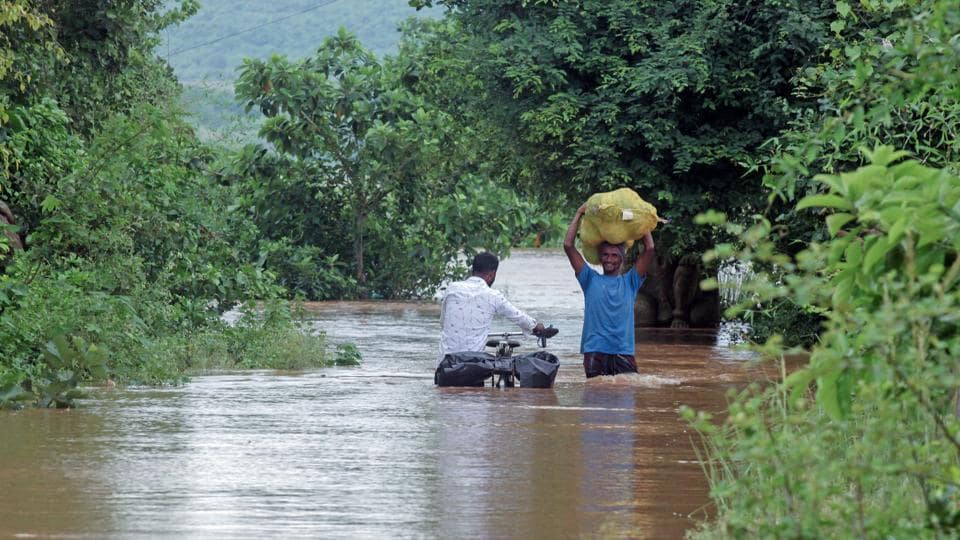
Fresh torrential rains fuelled by successive low-pressure systems over the Bay of Bengal within a fortnight caused the Brahmani and Baitarani rivers to breach their banks again, submerging villages that had only just begun to recover from the aftermath of the first flood.
Over 9.4 lakh people across six districts have been affected in the latest deluge, forcing the evacuation of more than 2 lakh people. The scale of the crisis prompted chief minister Mohan Charan Majhi to announce a ₹1,110-crore relief package in two tranches.
Low-pressure systems and depressions are a normal feature of the southwest monsoon. But meteorologists said their persistence and slow movement this year have resulted in prolonged spells of heavy rain over Odisha.
“A low-pressure area formed over the northwest Bay of Bengal on July 25 and intensified into a depression a day later, but instead of moving inland quickly, it travelled less than 500 km over four days, reaching near Jharsuguda,” said Indian Meteorological Department (IMD) scientist Umasankar Das. “The very slow movement of the system has brought a huge amount of rainfall, leading to flood conditions across the state.”
The latest flooding, which intensified around August 13-16, followed a spell in late July and early August that affected as many as 22 districts with Balasore, Bhadrak, Jajpur, Mayurbhanj, Keonjhar and Kendrapara bearing the brunt with some riverside villages inundated multiple times.
In July, four low-pressure systems developed, two of which intensified into deep depressions. One system formed around July 25-26 and remained nearly stationary for several days. It travelled less than 500 km in four days, moving towards Jharsuguda, and dumped large amounts of rain over the state.
Data from the Indian Meteorological Department (IMD) showed that July 2026 recorded 24 days affected by low-pressure systems over India, against a normal of about 13.5 days, the highest such figure since 2017.
The weather pattern has been reinforced by the position of the monsoon trough. Senior meteorologist of Bhubanewar-based SOA University Sarat Sahoo said the trough, which normally extends from Ganganagar to the Bay of Bengal through parts of north India and West Bengal, has remained close to Odisha and West Bengal.
“Because of the monsoon trough, it favours the creation of small cyclonic circulations due to changes in the wind patterns. After those circulations form, rain continues. Since the monsoon trough is staying almost in the same position, rain is continuing in Odisha almost every day,” Sahoo said.
He added that while rainfall becomes heavier when a weather system develops, light to moderate rain continues on other days, with isolated areas also receiving heavy rain.
However, Regional Meteorological Centre, Bhubaneswar, director Manorama Mohanty said there was “nothing unusual” about the formation of low-pressure systems during the monsoon. “The monsoon trough normally follows a path through the northern Bay of Bengal. Good rainfall in Jharkhand and Chhattisgarh was also contributing to rising river levels in Odisha,” she said.
With rivers already running high, rainfall in neighbouring states and releases of excess water from upstream areas added to the pressure. Rivers crossed danger marks at several locations, while embankment pressure, localised breaches and waterlogging compounded the impact in low-lying areas.
The state has entered the second flood spell with its catchments already saturated. Odisha had received more than 1,000 mm of cumulative monsoon rainfall by August 19, against a long-period average of about 786.5 mm for the June 1-August 19 period, a surplus of around 28 per cent.
The impact has been particularly severe on agriculture, with thousands of hectares of paddy and other crops submerged. Schools have been closed in several districts, university examinations postponed and urban areas disrupted.
R L Das, a retired director of state agriculture department said saturated soil could absorb little additional water after prolonged rainfall. “With rivers and drainage channels already carrying substantial volumes, continued rain can leave agricultural land waterlogged and weaken embankments, roads and other infrastructure,” he said.
New Delhi-based thinktank Council on Energy, Environment and Water (CEEW) said Odisha’s long coastline and heavy dependence on the monsoon make the state particularly vulnerable to extreme rainfall, heat and humidity, as well as prolonged dry spells.
“Odisha’s average monsoon rainfall increased from 1,052 mm during 1981–2010 to 1,159 mm during 2011–2024. It is projected to rise moderately to 1,211 mm during 2031–2050 and further to 1,309 mm during 2051–2070,” said Vishwas Chitale, a CEEW fellow.
As per IMD, Odisha recorded 1,150.9 mm of monsoon rainfall in 2025, continuing a pattern of relatively high rainfall over the past decade. Monsoon rainfall was 1,092 mm in 2024 and 1,115.4 mm in 2023, while 2022 saw 1,196.8 mm. The highest annual monsoon rainfall in the 2016-2025 period was recorded in 2018, at 1,290.2 mm, followed by 1,232.5 mm in 2019. Rainfall stood at 1,141 mm in 2020, 1,046 mm in 2021, 1,053 mm in 2017 and 1,031 mm in 2016.
Meteorologists said another low-pressure area was expected to form in a couple of days raising concerns over the state’s continued vulnerability.



