
 E-Paper



As Delhi heads to elections, CAA is important but not key issue for Muslims
As tension continued in areas around Jamia Milia Islamia university, there is growing anger against the BJP for pushing its “communal agenda”.


The large-scale violence in Jamia Nagar on Sunday against the contentious Citizenship Amendment Act and the alleged “brutality” by the police have got the capital’s Muslim community united ahead of the assembly elections. Community members say that the recent developments have strengthened their resolve to defeat the Bharatiya Janata Party (BJP) and a split in votes between the Congress and the ruling Aam Aadmi Party (AAP) is unlikely in the assembly elections.
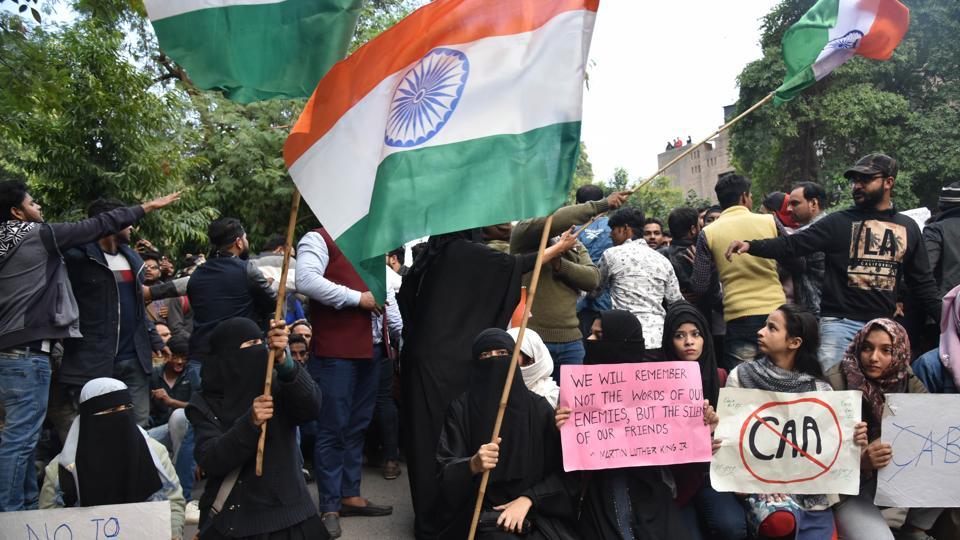
As tension continued in areas around Jamia Milia Islamia university, there is growing anger against the BJP for pushing its “communal agenda”. Meeran Haider, a research scholar at JMI said, “People will defeat communal forces which want to divide people of the country.”
In Jama Majid area in the Walled City, locals watched the violent clashes in between students and locals, and the cops on their television screens yesterday. Social activists Haji Mian Faiyaz Uddin (82), says that the images were disturbing and the BJP-led central government is trying polarise to divert people’s attention from real issues like women safety, economic slowdown, unemployment, impact of demonetisation on country’s economy etc.
“This brutal action taken by the police against student is wrong. The citizenship amendment Act is an attempt by the BJP to polarise and create a divide. But the community and all the secular people irrespective of their religion are against it,” said Faiyaz Uddin.
Though this is an important issue and has united the community, Faiyaz Uddin says, it will not be an important issue based on which people will vote in the Delhi assembly elections, which are scheduled early next year. “We are against communal politics and CAA is an important issue. But people will vote for a party which has worked them and is capable of defeating the BJP in the state. AAP has done considerable work in the sectors like education, healthcare and providing essential services. It is strong in Delhi,” the octogenarian said.
The Muslim community, which was considered a Congress vote bank, played a crucial role in AAP’s sterling performance in 2015 assembly elections in which the party won 67 out of 70 seats.
But in the recent Lok Sabha elections, it was the Congress which gained substantially in Muslim-dominated areas like Chandni Chowk, Ballimaran, Seelampur. The party came second in five out of seven parliamentary constituencies including North East Delhi and Chandni Chowk, which have a sizeable Muslim population.
In Chandni Chowk’s Matia Mahal segment, 65.17% votes were polled in favour of Congress’s J P Agarwal while AAP’s Pankaj Gupta got only 8.39%. The BJP got 25.02% of the total votes polled. Similarly, in Ballimaran assembly constituency, Congress polled 52.9% votes with AAP at a dismal 8.97% during the Lok Sabha elections earlier this year.
In assembly constituencies like Trilokpuri and Okhla, which has a substantial Muslim population, the Congress and AAP got almost the same percentage of votes polled during the Lok Sabha elections.
In Okhla, of the 1.63 lakh votes, 64% of the total votes polled got split between Congress (37.1%) and AAP (26.9%). Similarly in Trilokpuri, the Congress and AAP got almost the same percentage of votes polled (18-19%) while the BJP got 58% votes. This had helped the BJP in securing a high vote share.
Locals say that it won’t happen this time. “The community’s votes got divided as some voted for the work done by AAP while others saw Congress as an alternative to the BJP. But this time, it won’t get divided, as the state elections is about the work done for the people. AAP has done good work in the education sector and it is the only party which can defeat the BJP right now in Delhi,” said Shahnawaz, a resident of Trilokpuri who works with a private firm.
In North East Delhi’s Mustafabad assembly constituency, which has a sizeable Muslim population, “Bijli-paani” are the main issues for the locals. Mustafabad is one of the three assembly constituencies which the BJP had won in 2015 elections because of split on Muslim community’s votes. “It won’t happen this time, as people are firm to defeat the communal politics of the BJP. AAP has done a lot of work for the people and Bijli-paani are the core issues for people here,” said Haji Ishaq Malik, president of Rajiv Gandhi nagar RWA in New Mustafabad area.
Political analyst Tanvir Aeijaz, professor of political science at Ramjas College, Delhi University, doesn’t foresee a split in community’s vote in the upcoming assembly elections. “The BJP is trying to polarise voters, as it will help them to strengthen its voter base. The CAA has led to fear in the community and united it as it is upfront and in their face. But the community and people in Delhi will largely vote based on the performance of the present government. The AAP government has done considerable work in education, healthcare and reduced the water and electricity bills. These things matter to people and in the Delhi, AAP is seen as a formidable force against the BJP.”


