
 E-Paper



Assault boats, modern gear, high-speed vehicles in Ladakh capability boost
The new equipment and systems will enhance the operational preparedness of the army and increase its efficiency


In a needed capability boost for Indian soldiers deployed along the border with China and amid the lingering row on the Line of Actual Control (LAC) in Ladakh, defence minister Rajnath Singh on Tuesday symbolically handed over to the army indigenously-developed military hardware including assault boats for patrolling Pangong lake, new battle gear to make troops more lethal, high-mobility protected vehicles, remotely piloted aerial systems, detection equipment and gear for improved communication.
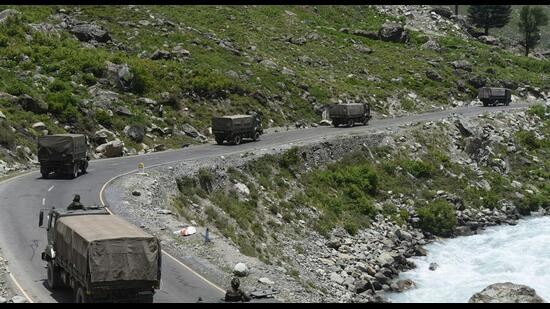
The new equipment and systems will enhance the operational preparedness of the army, increase its efficiency, and are a shining example of the country’s growing self-reliance prowess, Singh said.
The current boats operating in the Pangong Tso – the world’s highest saltwater lake two-thirds of which is controlled by China – have limited capability and the landing craft assault (LCA) will be easier to launch, faster and have better capacity, the defence ministry said in a statement.
“The LCA is much more versatile. It has enhanced the capability (of the army) to operate across water obstacles in eastern Ladakh,” the statement said. The boats have been built by Goa-based Aquarius Shipyard.
In his Independence Day address on Monday, Prime Minister Narendra Modi made a special mention of the indigenous advanced towed artillery gun system (ATAGS) used for the ceremonial 21-gun salute at the function while calling for greater self-reliance.
In a big push to the F-INSAS (future infantry soldier as a system) project stalled for years, the defence minister handed over its constituent systems to the army and set the stage for its roll-out in infantry battalions. As part of F-INSAS, infantry soldiers will be equipped with three primary sub systems – the AK-203 assault rifle with day/night sights, another sub system for enhanced protection and a third for improved communication and surveillance, officials familiar with the matter said.
The sights will be mounted on the weapon as well as the helmet for 360-degree visibility and accuracy in operational conditions. Soldiers will be kitted with multi-mode hand grenade, multi-purpose knife and mine protective shoes where mine threat is imminent. They will be equipped with specially designed helmets and bullet proof jackets along with modular pouches and harnesses to carry grenades, magazines, radio sets and other operational equipment, the officials said.
Each soldier will also carry a hands-free radio set while the section commander will be equipped with additional communication and surveillance devices for real time contact with the squad. F-INSAS is capable of further upgradation by incorporating real-time data connectivity with commanders, the ministry said.
Singh also handed over to the army the mini remotely piloted aerial system (RPAS) for improved surveillance, detection and reconnaissance at the infantry battalion and mechanised unit level. “RPAS removes the operational limitations faced by the Indian Air Force aircraft and the Heron unmanned aerial vehicles at tactical level,” the ministry said.
Infantry protected mobility vehicle (IPMV) and quick-reaction fighting vehicle (QRFV), both made by Tata Advance Systems Limited, are among the other equipment the army has been given. “IPMV provides mobility and more protection to a large number of infantry soldiers posted at the northern borders (with China). The QRFV facilitates quick deployment of troops and will enable faster reaction. These are tailor-made vehicles with high mobility, enhanced firepower and protection. It will facilitate in creating moral ascendency along our northern borders,” the statement said.
New anti-personnel mine called Nipun is also ready for use by the army, which was using vintage NMM 14 mines. The mine is more potent and effective than the existing anti-personnel mine. A new thermal imaging sight for T-90 tanks will improve battlefield capabilities. It will give enhanced visibility and range to the commanders of armoured columns as the existing image intensification systems have their own limitations, the officials said.
Downlink equipment with recording facility is another system ready for use on helicopters that carry out reconnaissance and surveillance of the borders and operational areas.
“When the helicopters are out for their missions, the reconnaissance data observed is recorded in the system and can be accessed only when the helicopter returns to the base. Sometimes operational and time-critical information is not accessible to the commanders due to unavailability of real-time information for analysis. This capability has now been acquired by the Indian Army,” said one of the officials cited above.
The upgraded radio relay (frequency hopping) system is another new addition for improved capability.
“In challenging forward areas, where no lines or other forms of communication are available, the army has to extend its communication system. With this radio relay system, forward troops are in a position to operate their communication equipment and radio sets at much longer ranges and in greater depths than before,” the statement added.
To push self-reliance in the defence manufacturing sector - a top priority for the government - India has imposed a phased ban on the import of 310 different weapons and systems during the last two years. These weapons and platforms will be indigenised in phases over the next five to six years.


