
 E-Paper



Exclusive: EC chief Gyanesh Kumar promises level playing field as five states prepare to vote
"Election Commission of India has 0 tolerance towards any kind of violence, intimidation or inducement towards any elector," Gyanesh Kumar told Hindustan Times.

 Prefer HTon Google


With Assembly elections to the states of Assam, West Bengal, Tamil Nadu, Kerala and Puducherry being announced, the Election Commission is committed to make the forthcoming exercise as the most transparent elections ever in the history of independent India.
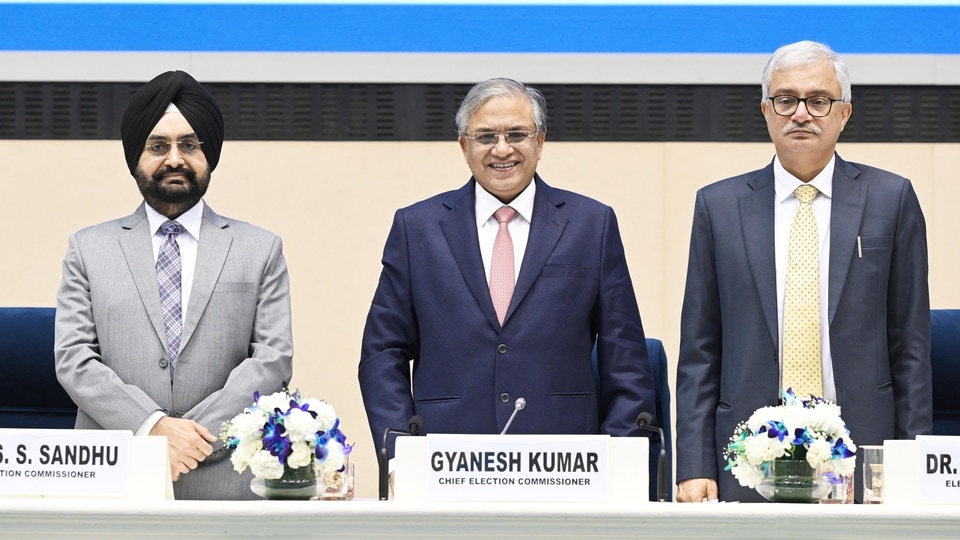
Talking to Hindustan Times, Chief Election Commissioner Gyanesh Kumar said: "Election Commission of India has zero tolerance towards any kind of violence, intimidation or inducement towards any elector." Unfazed by criticism mounted by Opposition parties against him and the Commission, the CEC did not elaborate any further.
While the Trinamool Congress (TMC) leadership has targeted the Commission and the CEC in particular, the electoral body is committed to totally impartial, transparent and as per law Assembly elections in April so that the elector is allowed to exercise his mandate without fear or favor.
In this context, the ECI has made it clear to the electoral and administrative machinery in the poll bound states that there should be no violence, intimidation or inducement during the entire electoral exercise. The administrative machinery has been directed to ensure that there would be no booth or source capturing or “chappa (illegal vote stamping)” in any of the poll bound states.
While the Election Commission has no electoral favorites in the forthcoming hustings, the electoral body has tried to provide a level playing field to all political parties by taking action against compromised or biased officials in the state administrations. The EC has deployed 1,111 central observers in the poll-bound states to ensure that the elections are conducted as per the Constitution and the reshuffle of officers of the rank of superintendent of police, district magistrates, district electoral officers, range officers to Director General of Police, Home Secretary and even Chief Secretary has been ordered to ensure impartiality in the elections.
The reshuffle of officers was ordered by the ECI in all poll bound states particularly West Bengal as it found that officials in power were politically tuned towards the ruling party while those doing their duty were punished by the government of the day. “ Some officers were punished for just doing their duty as per law in the past Assembly elections while others who sided with the ruling regime flourished with lucrative postings and power,” said a former CEC.
While Opposition parties ruling West Bengal, Tamil Nadu and Kerala have accused the ECI of bias towards the ruling party at the Centre, the electoral body is undaunted by criticism as the electoral body is not playing favorites. It is doing its job.


