
 E-Paper



At meet with chief ministers, PM Modi’s 5 clear messages on Covid-19 battle
PM Modi, who was speaking at his fourth interaction via video conference with chief ministers on the Covid-19 challenge, underlined that the country had to think of the way ahead, beyond May 3, when the second round of the national lockdown ends.

 Prefer HTon Google


Prime Minister Narendra Modi told chief ministers on Monday to focus on a graded exit from the national lockdown from May 3 and plan for a step-by-step revival of economic activity in green zones that haven’t reported Covid-19 cases.
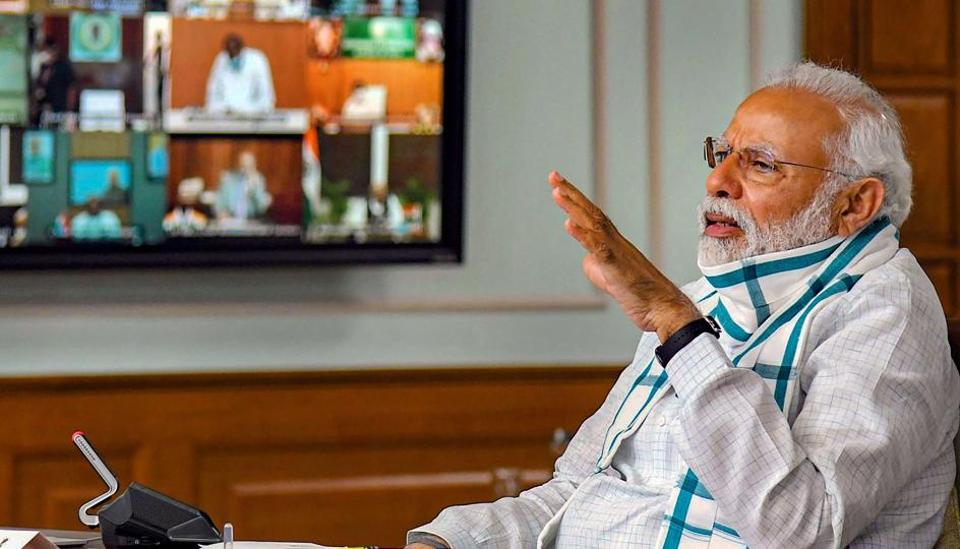
PM Modi, who was speaking at his fourth interaction via video conference with chief ministers on the Covid-19 challenge, underlined that the country had to think of the way ahead, beyond May 3, when the second round of the national lockdown ends.
The states should strictly enforce the lockdown guidelines in the hotspots, or the red zone areas, and focus on converting them into orange zones - areas with a few Covid-19 cases - and thereafter to green zones.
Watch | PM Modi discusses lockdown exit strategy with CMs: All the key details
Apart from a graded exit from the lockdown, PM Modi outlined his government’s thinking on reviving the economy, the plan to evacuate Indians stranded abroad, the condition of migrant workers and stressed that fighting Covid-19 was a collective responsibility.
India had gone into a complete lockdown mode on March 25 to prevent the coronavirus disease from spreading. The lockdown brought economic activity to a grinding halt, and put a lid on consumption that powers the economy. PM Modi renewed the lockdown on April 14 but this time, started easing the restrictions to revive economic activity.
But the lockdown had saved lives, PM Modi told the chief ministers. Many countries, much smaller than India, had lost many more lives in the pandemic. But he cautioned that the danger of the virus is far from over in India.
Instead, the prime minister asked states to consolidate their gains and at the same time, revive economic activity. But you should ensure that there is no casual attitude towards the virus, he told them.
Meghalaya chief minister Conrad Sangma summarised PM Modi’s message, saying that even as the lockdown is relaxed from May 3, the entire mindset of the lockdown should continue.
PM Modi also hinted that the government might look at certain reforms that had been held up earlier. “We have to be brave and bring in reforms that touch the lives of common citizens,” he said. PM Modi did not elaborate on the reforms that he had in mind.
PM Modi also underlined the plight of migrant workers and asked chief ministers to take special care of workers from other states and ease their hardship.
The government has been reluctant to facilitate the return of millions of migrant workers on grounds that mass travel can take the infection to unaffected areas. Maharashtra chief minister Uddhav Thakceray has repeatedly asked for special trains to be run to let the migrant workers return home. Some other states have offered to run buses.
PM Modi didn’t rule out the Centre’s approval but appeared to message that states should assess how they would be able to run the factories and industrial units in the absence of the migrant workers.
The prime minister also indicated that the Centre’s evacuation plan for Indians stranded abroad was on track. Since Indian citizens stuck abroad would have to be placed in quarantine centres immediately on their return, the Centre has made it clear that this plan would depend heavily on the ability of states to accommodate them at quarantine centres and hospitals.
This, PM Modi said, had to be done keeping in mind that the citizens don’t get inconvenienced on their return and their families are not under any risk.
PM Modi, who has more than once spoken of the crucial role played by state governments in fighting Covid-19, underscored that it was the collective responsibility of the Centre, states and people to stop the virus from spreading.
If one state goes down, it will take the entire country down, he said. The remark came against the backdrop of West Bengal chief minister Mamata Banerjee’s faceoff with the Union home ministry over the visit of a central team to her state.


