
 E-Paper



Ayni in Tajikistan: India completes another capacity-building programme
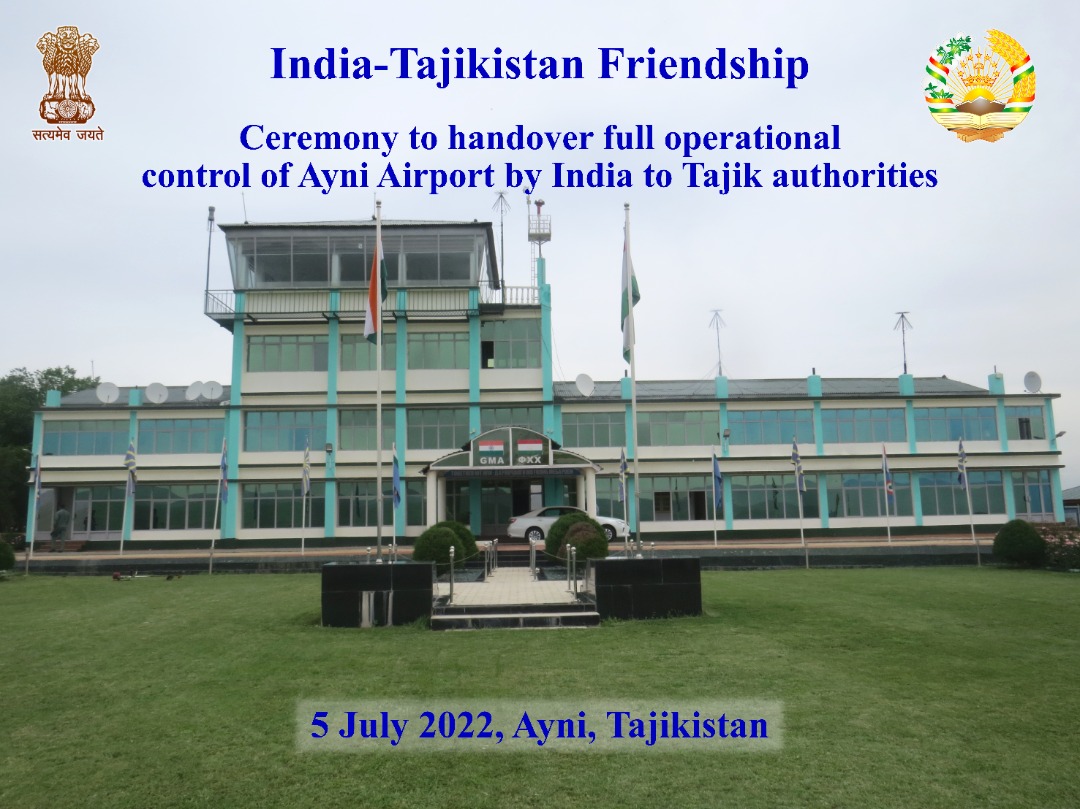
To make the Ayni airport fully operational, the existing runway was upgraded to ‘PCN 40’ classification and many construction works were carried out. This includes construction of new ATC tower, runway lighting, emergency landing strip, perimeter road and guard posts.

 Prefer HTon Google


India and Tajikistan have enjoyed good diplomatic relations ever since diplomatic relations were established in 1992.
India’s relations with Central Asian countries have acquired a new salience with the institutionalisation of the ‘India-Central Asia Summit’ mechanism in January this year. India and Central Asian countries, except Turkmenistan, are important constituents of the SCO mechanism.
Most of the cooperation with Central Asian countries have a development aspect, which is increasingly becoming an important facet of India’s relations with these land-locked countries.
Since Tajikistan’s independence in 1991, India has played the role of a development and aid partner to it. In 1995, India extended a credit line to set up a pharmaceutical plant (Ajanta Pharma). In January 2005, a fruit processing plant was established in Dushanbe by HMT. An information and technology centre (Bedil Centre) was commissioned in 2006. The project ran for full hardware cycle of six years and trained almost all the first generation IT experts in the country's government sector.
In June 2011, India set up a modern engineering workshop. It also undertook rehabilitation and modernisation of a 1936 vintage Varzob-1 Hydro Power Station through Bharat Heavy Electricals Limited (BHEL) and National Hydroelectric Power Corporation (NHPC).
After renovation, the installed capacity was enhanced from 2x3.67 MW to 2x4.75 MW. The rehabilitated Power Station was inaugurated on 28 December 2012 and is running successfully. A project for setting up of computer labs in 37 schools in Tajikistan (announced during Prime Minister Narendra Modi’s visit in July 2015) was completed and delivered in August 2016.
However, lack of overland connectivity with Central Asia has negatively impacted trade and commerce between India and the Central Asian region. Therefore, there has been an increased focus to bolster connectivity with the Central Asian region, including through joining of connectivity corridors like International North-South Transport corridor and the Ashgabat agreement. As part of these efforts, India rehabilitated, renovated and developed the Ayni airport near Dushanbe.
To make the Ayni airport fully operational, the existing runway was upgraded to ‘PCN 40’ classification and many construction works were carried out. This includes construction of new ATC tower, runway lighting, emergency landing strip, perimeter road, guard posts, apron including its lighting, 14.5-km perimeter wall and 7.183km of road from Dushanbe to Ayni as well as repair of hangers and parking surfaces. An instrument landing system (ILS) was installed in 2015.
India has regularly upgraded its technical infrastructure and equipment to ensure full operational readiness over the years.
Apart from infrastructure and technical upgradation of the Ayni airport as a key asset, India has also refurbished and widened the Gai-Ayni road that leads from Dushanbe to the airport. Another ongoing six-eight lane road project being done by India under grant assistance further connects the Ayni-Gai road to Chortut highway which would help in de-congestion of Dushanbe traffic. This project is expected to be complete by end of this year.
Following the full realisation of the existing mandate in respect of Ayni airport, India believes that Tajikistan is ready to fully maintain and operate the airport.
Last month, India also handed over the India-Tajikistan Friendship Hospital in the Bokhtar region that was developed and refurbished into a fully functional 50-bedded hospital.
This is yet another example of India’s development partnership model wherein the facility is handed over to the host side after upgradation and training. This is also why the Indian Line of Credit, grant projects and training programmes under ITEC has so many takers across the world.


