
 E-Paper



BBMP to resume demolitions from Oct 10
Girinath said that surveys are ongoing and that the BBMP along with the revenue department will complete all necessary requirements, issue notices and demolish structures that have been classified as encroachments.


Bengaluru
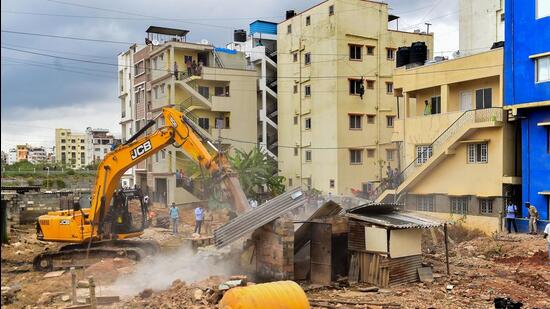
The Bengaluru city corporation on Thursday said that it will resume demolition of encroachments on drains, lakes and valleys, among other places, from Monday.
“The process of clearing encroachments is ongoing. Physically the JCBs (earth movers) will be taken to demolish homes and other structures (encroachments) from Monday according to the relevant laws wherever there are encroachments,” said Tushar Girinath, the chief commissioner of the Bruhat Bengaluru Mahanagara Palike (BBMP, the city’s civic body).
The demolition of encroachments on drains will resume after a break for Dussehra, which the government believes is the main reason for flooding in several parts of Bengaluru in the months of August and September as heavy rains led to waterlogging and flooding of homes, offices and other places.
Girinath said that surveys are ongoing and that the BBMP along with the revenue department will complete all necessary requirements, issue notices and demolish structures that have been classified as encroachments.
The statements come at a time when recent rains has brought Bengaluru to its knees, forcing people out of their homes and leaving a trail of destruction on account of flooding in several parts of India’s IT capital. Most of the flooding was reported from Mahadevapura, Bommanahalli and the eastern zone of the Bruhat Bengaluru Mahanagara Palike (BBMP, the city’s civic body) among other places, displacing hundreds from their homes.
According to officials, it has been one of the wettest September in Bengaluru’s history. However, the government has tried to deflect attention away from the fact that these buildings which include major technology parks, housing complexes and other establishments were approved by the administration and collected taxes from them as well.
Authorities have carried out demolition drives in several parts of Bengaluru where they believe that SWDs (storm water drains) or Rajakaluves are encroached and have led to impeding natural flow of water that resulted in flooding.
There has been anger against the government for taking swift action against homes and buildings of poor and middle-income groups in these localities but not against technology parks or big developers.
Rapid and unplanned urbanisation are some of the main reasons for these encroachments, according to experts.
According to the Land Use Land Cover [LULC] Dynamics paper by the Indian Institute of Science-Bengaluru, the city shows a 1005% increase in urban built up area between 1973-2016, HT reported earlier.
“Unplanned rapid urbanisation during post 2000’s (concentrated developmental activities due to IT parks and SEZ’s development in the city) has led to drastic and unrealistic land use changes (Ramachandra et al 2012). Urban land use shows that it is reaching saturation with respect to lateral development, whereas the scope of built up area development remains in vertical growth, but this will have telling influences on the city infrastructure (road, drinking water and sanitation facilities),” according to the report ‘water situation in Bengaluru’ by T.V. Ramachandra, Vinay S, Durga Madhab Mahapatra, Sincy Varghese, Bharath H. Aithal.
They further show that vegetation in key catchment areas have declined by 88% and water bodies have declined by 79%.
”Land use prediction using Agent Based Model showed that built up area would increase to 93.3% by 2020, almost on the verge of saturation. Number of lakes in Bangalore has reduced by 790% from 1973 to 2016,” according to the report.


