
 E-Paper



Behind cynical exploitation of Aravallis: Apathy, corruption
The categorisation of land under the former facilitated its illegal exploitation; and the categorisation under the latter was supposed to prevent illegalities, but with local governments turning a blind eye, this did not happen.

 Prefer HTon Google


Illegal mining; farm houses and universities located on land they have no business being located on; state governments pushing for commercialisation and development of land protected by a series of court orders — that’s the story of the Aravallis, one of the oldest hill ranges in the world.
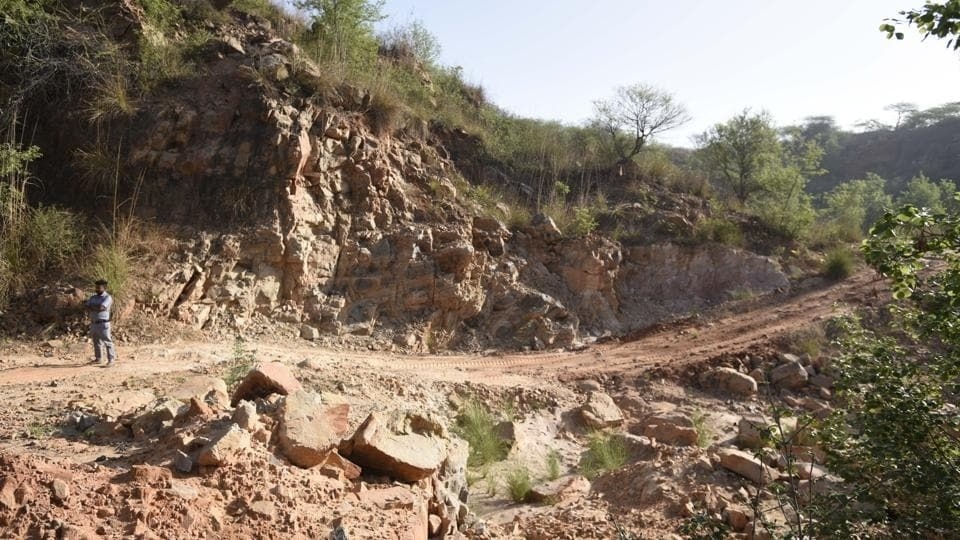
At the heart of the story is land — as it always is in narratives of exploitation and corruption. The land is of two types — village commons (commonly called Gair Mumkin Pahar) and land that is notified under sections 4 and 5 of the Punjab Land Preservation Act (to make things complex, some of the former were also classified under the latter, which basically protects land critical to prevent erosion in the area) which bars their use for mining and construction — but there the narrative diverges.
The categorisation of land under the former facilitated its illegal exploitation; and the categorisation under the latter was supposed to prevent illegalities, but with local governments turning a blind eye, this did not happen.
Take, for instance, around 450 acres of village commons in Kot and Mangar (the second is home to perhaps the only patch of primary forest in the national capital region and the Aravallis) that, according to documents seen by HT, belong to a company called Gaurisuta Building Solutions. The company is part of Yoga guru Ramdev’s Patanjali Group and wants to use the land for a university.
Or consider the Manav Rachna International School of Research and Studies, a well-regarded engineering college that sits on around 32 acres of land that is classified as forest under PLPA’s sections 4 and 5.
Neither should have been possible under the various protections granted to the respective patches of land.
“Several legal protections for Aravallis in Haryana are there on paper. These include (i) Supreme Court orders since 1996 and reiterated in 2011 and 2022 that require the state to identify and protect forests that are not formally notified but meet the dictionary meaning of forest — but Haryana has not identified a single acre yet; (ii) the NCR regional plan 2021 has a provision of the natural conservation zone that protects Aravallis from construction and landuse change — this protection has been deleted in the new draft Regional Plan 2041 — under Haryana’s authorship; (iii) Haryana itself notified around 60% of Aravallis under the stringent PLPA notifications in the 1980s-90s, but now the same state is trying to emasculate the Act via amendment. The MoEFCC’s Aravalli Notification of 1992 prohibits construction in the Aravallis in Gurugram, but a single Aravalli village Raisena’s Ansal Aravalli Retreat has hundreds of violations. In short, many of these protections have not been complied with leaving large tracts of Aravallis vulnerable. What is worse is the consistent effort to delete and dilute these protections by the state. In fact, Haryana, with the lowest forest cover at 3.6% has even questioned if the state has Aravallis which is laughable,” said Chetan Agarwal, Gurugram based forest analyst.
But the beginnings of the story lie in laws, how they have evolved, and how land grabbers and builders have gotten around them, sometimes with the active connivance of local government officials. In Haryana’s ambitiously named Raisina village, farm developers changed the land category in revenue records to allow its use for farmhouses. What was it previously? Gair Mumkin Pahar, of course.
With many of the illegalities being committed by the rich, the powerful, and the influential, the worry is that some of these changes are going to be as permanent as, say, Delhi’s Sainik Farms, an illegal colony of the rich in South Delhi that no government wants to do anything about.
The Aravallis are critical to the region. They act as a natural boundary to the Thar, preventing the relentless march of the desert (and indeed, the increasing levels of road dust in Delhi can be partly attributed to the fact that many of the hills have vanished, victims of mining). They serve as a natural water recharge facility. And they provide green cover in an otherwise arid region.
“These forests are home to a lot of wildlife and birdlife. Hyenas, leopards, porcupines, jackals are species that exist in good numbers here. There are also over 300 species of birds here if you take Alwar also. Prosopis juliflora dominates these forests, but in pockets, particularly in areas like the Mangar Bani, Jhiri etc, you see local tree and plant species. For example, on the Gurugram-Faridabad Road you can see pockets of Dhok. These forests are integral to controlling flash floods, desertification, reduce run-off and recharge groundwater for entire NCR. They are the last patch of forests left for the region that can provide these ecological services without which functioning of cities in NCR can be jeopardised,” said Vijay Dhasmana, ecologist and curator of the Aravalli Biodiversity Park in Gurugram.
But rather than protect them, states in the region, notably Haryana, have done everything in their powers to remove existing safeguards. This unswerving focus on development is also believed by some to be the reason why Haryana is dragging its feet over recognising and protecting prehistoric cave paintings in Manger.
Over the next few weeks, Hindustan Times will run a series, part investigation, part explanatory writing on the Aravallis, what we are doing to them, and what the cost could be.


