
 E-Paper



Bhutanese engineers to train with ISRO for satellite launch next year
The launch of the satellite is part of India’s efforts to back Bhutan King Jigme Khesar Namgyel Wangchuck’s plans to use advanced technology, including ICT and space technology, for developing his country. It also fits in with India’s “neighbourhood first” policy, that has gained fresh impetus amid the Covid-19 pandemic and the border standoff with China.


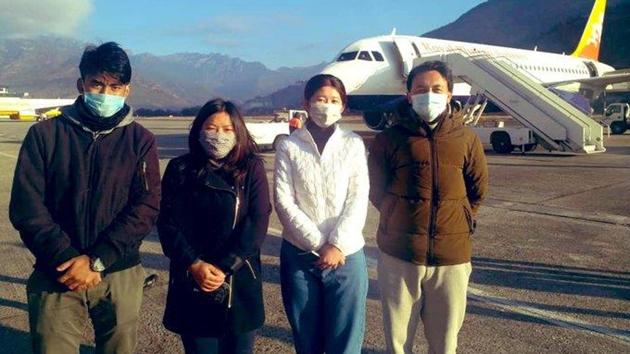
Four Bhutanese space engineers arrived in India on Monday to train with the Indian Space Research Organisation (ISRO) for the launch of their country’s satellite next year as part of New Delhi’s efforts to build space infrastructure under its “neighbourhood first” policy.
Prime Minister Narendra Modi had announced during a virtual meeting with his Bhutanese counterpart Lotay Tshering on November 20 that India would launch the small satellite next year. Bhutan’s first nano-satellite Bhutan-1, built with Japan’s assistance, was launched on a SpaceX rocket in 2018.
The space engineers from Bhutan’s department of information technology and telecom will undergo the first phase of training at ISRO’s UR Rao Satellite Centre in Bengaluru from December 28 to February 25. This training will cover theoretical and technical aspects and include visits to laboratories and test facilities, officials said.
The Bhutanese team will also work with ISRO to draw up the second phase of training, which will include activities aimed at developing INS-2B satellite for Bhutan.
The launch of the satellite is part of India’s efforts to back Bhutan King Jigme Khesar Namgyel Wangchuck’s plans to use advanced technology, including ICT and space technology, for developing his country. It also fits in with India’s “neighbourhood first” policy, that has gained fresh impetus amid the Covid-19 pandemic and the border standoff with China.
India has been closely working with Bhutan in space technology. In August 2019, Modi and Tshering jointly inaugurated a ground earth station for the South Asia Satellite (SAS) in Thimphu, which was built with ISRO’s support. SAS was launched by India in 2017 for countries in South Asia, and currently provides frees services for television broadcasts and VSATs to members of the South Asian Association for Regional Cooperation (Saarc).
In view of the impact that SAS has on Bhutan’s socio-economic development, especially in areas such as communications and disaster management, the Indian side had offered increased bandwidth on an additional transponder in line with Thimphu’s requirements.
The decision to collaborate on the development of a satellite for Bhutan was made during Modi’s visit to Thimphu in August 2019. A joint working group was formed for the project and other activities, including developing a geo-portal system for Bhutan for natural resources and disaster management, using remote sensing and geo-spatial data.
“Cooperation in new frontiers such as space technology has been given an impetus by the leadership of the countries and will be bolstered further through the joint development of the small satellite for Bhutan,” the Indian embassy in Thimphu said in a statement.


