
 E-Paper



Bihar polls to be held in two phases, Nov 14 decision day
The elections will be a referendum not just on chief minister Nitish Kumar and Opposition leader Tejashwi Yadav, but also on the legacy of the Mandal (social justice) politics that the two parties represent in one of the movement’s original playgrounds

 Prefer HTon Google


Roughly 74.2 million people across 243 constituencies in Bihar will vote in assembly polls across two phases on November 6 and 11, the Election Commission of India (ECI) announced on Monday, marking the beginning of an electoral contest that will have strong ramifications on national politics.
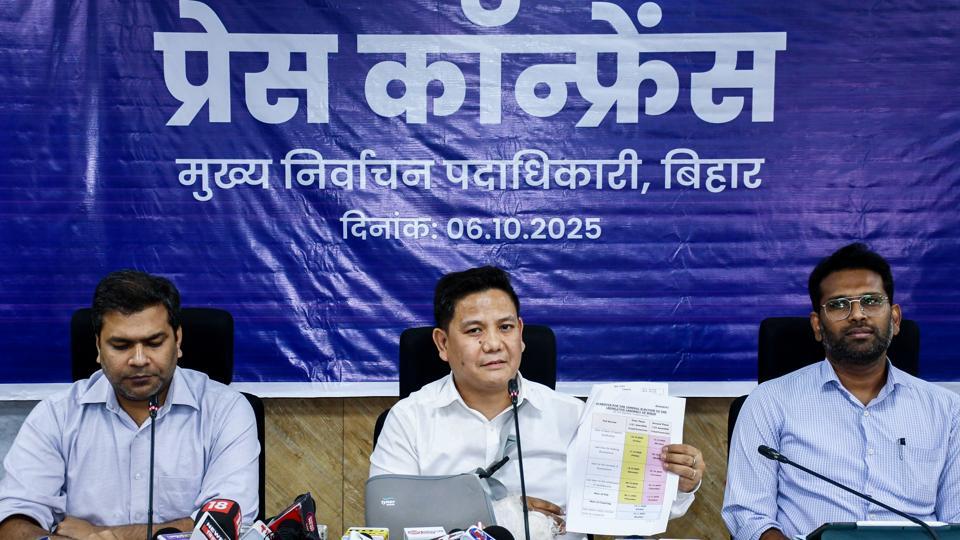
Elections in India’s third-most populous province are usually chaotic, steeped in caste calculations, and rested on a razor’s edge five years ago – the difference between the two major coalitions was less than 12,000 votes – even as questions of aspiration, welfare and jobs figure high up in one of the country’s poorest states.
The votes will be counted on November 14.
The elections will be a referendum not just on chief minister Nitish Kumar and Opposition leader Tejashwi Yadav, but also on the legacy of the Mandal (social justice) politics that the two parties represent in one of the movement’s original playgrounds.
“This is the mother of all elections,” said chief election commissioner Gyanesh Kumar.
The elections will also have ramifications beyond Patna. For the National Democratic Alliance (NDA), it is yet another opportunity to show that its unexpected setback in the 2024 general elections was merely a blip, and continue its march of assembly elections victory after Haryana and Maharashtra. It will set the mood for a clutch of key assembly polls next summer as well as pull the rug from underneath the campaign agenda of Congress leader Rahul Gandhi, who has spent months alleging irregularities in India’s voting and vote counting mechanism. And it will focus public attention on domestic politics instead of international relations where recent tumult in the relationship with the US and President Donald Trump’s caprice has bruised sentiments.
For the Opposition, the elections offer a chance to stem the tide of losses that followed its stellar performance in the 2024 general elections and win a major state with enormous political heft. It will re-establish the Opposition as a force in the Hindi heartland as well as position Rahul Gandhi and Tejashwi Yadav as inheritors of the Mandal mantle, pushing politics away from communalism towards caste.
“This time the elections in Bihar will be the easiest, most transparent, simplest for voters, with maximum focus on law and order and maintaining peace…our hope is that it turns out to be the best elections,” said CEC Kumar.
Chief minister Nitish Kumar will hope to buck anti-incumbency as he seeks an unprecedented fifth consecutive term with his ally-turned-enemy-turned-ally-turned-enemy-turned-ally Bharatiya Janata Party, focussing on his governance record, clean reputation and pull among women. But the Opposition alliance led by the Rashtriya Janata Dal, which has not won an election on its own in 20 years, will hope to cash in on simmering dissatisfaction among young people, mounting questions about the health of the chief minister, and its own social calculations.
Queering the pitch will be a clutch of smaller parties that represent single castes, and strategist-turned-politician Prashant Kishor, whose vow to break the state free from the usual duopoly of Lalu Prasad and Nitish Kumar can strike a chord with some voters.
Plus, the elections will be held on a fresh electoral roll, created after a contentious special intensive revision process that excised nearly 6.9 million names, added 2.3 million, sparked petitions in the Supreme Court, and allegations of vote theft by the Opposition. HT’s analysis showed that almost six in 10 names deleted in the SIR were women.
The first phase on November 6 will see 121 constituencies go to the polls, followed by 122 seats five days later. The electorate comprises 39.2 million men and 35 million women, who will cast their franchise across 90,712 polling stations, where 100% webcasting will be done, ECI announced. In all, 850,000 polling officials will be deployed.
In the 2020 assembly elections, the NDA secured 125 seats while the Opposition’s Grand Alliance got 110. But the vote share difference between the two coalitions was just 0.03% even as the BJP emerged as the bigger partner than the JD(U) that was damaged by Chirag Paswan’s Lok Janshakti Party. The NDA fared much better in the general elections last year, winning 30 of the 40 seats on offer.
The NDA campaign will hope to encash Kumar’s considerable political capital, the BJP’s cadre strength, and the unprecedented welfare spree unleashed by the state government, which continued to inaugurate projects and schemes right up to the announcement deadline on Monday. In the past two months, the government has announced welfare schemes estimated to be worth ₹30,000 crore, prominent among them a ₹10,000 hand-out to 7.5 million women two weeks ago.
“Under the leadership of Modi ji, the NDA government has pulled Bihar out of Jungle raj and given it a new direction of development and good governance,” Union home minister Amit Shah wrote on X.
But questions linger about Kumar’s health and mounting anti-incumbency against a man who has helmed the state for 20 years and has switched alliances twice in the past five years.
The Opposition alliance, which fell agonisingly short of the majority mark five years ago, is hoping that it will be able to expand its social coalition beyond the Rashtriya Janata Dal’s base of Muslims and Yadavs, utilise grassroots anger against a lack of jobs and corruption, and popular disenchantment among young people to its advantage.
“Bihar will vote for a change in the coming assembly polls. After 20 years, a grand festival will arrive that will dispel all sorrows and troubles. On that day, every Bihari will join Tejashwi in celebrating victory, because on that day, every Bihari will become Bihar’s CM — that is, CHANGE MAKER,” Tejashwi said on X.
But the RJD has struggled with wooing smaller and weaker communities, perception of lawlessness during its 1990-2005 regime, and the underperformance of ally Congress. Against the backdrop of patriarch Lalu Prasad’s indifferent health, another failure by the RJD to secure power will raise questions for the second-generation leadership, especially within the ruling Yadav family.
In the state’s fragmented polity, the recent entrant Prashant Kishor will be hoping to make a splash. A key strategist who has worked with nearly every party in India, Kishor’s Jan Suraaj Party is aiming to use corruption, civic apathy and unemployment as wedge issues to garner a significant vote share and emerge kingmaker in a contest that has increasingly become bipolar over the past decade.


