
 E-Paper



BJP govt careful in not antagonising dominant communities: Analysts
The state government made eight changes which include “errors” on topics like BR Ambedkar, Basavanna, Sri Siddaganga Math, Adichunchanagiri and Kuvempu, among others


The Basavaraj Bommai-led BJP government’s decision to make changes in school textbooks appears to be an attempt to diffuse tensions among large communities whose support the party seeks to win elections in Karnataka, analysts said.
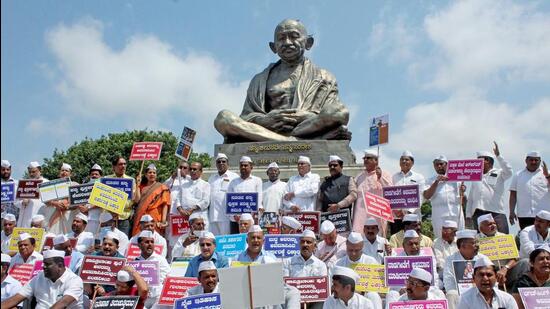
The state government made eight changes which include “errors” on topics like BR Ambedkar, Basavanna, Sri Siddaganga Math, Adichunchanagiri and Kuvempu among others out of several more pointed out by activists and the media as these issues can dent its support base with just one year to go before the assembly polls.
“The aspects they want to change are to ensure there is no blowback. They are looking only at dominant communities and do not want to antagonise them. They (BJP) do not care about minorities,” a political analyst told HT, requesting not to be named.
He added that the government will make “superficial” changes but the purpose of these changes is very clear.
The BJP, however, denied any link between the changes and the 2023 assembly election.
“There is absolutely no connection to the textbook issue and elections. This is an issue which the Congress is raising to remain relevant and using writers to attack the government,” a senior BJP leader said requesting not to be named.
Another BJP legislator from the Old Mysuru region had confronted senior leaders of the party over changes made to Ambedkar and expressed his concerns on the impact it would have on elections and its outreach programme.
Removal of “Samvidhan Shilpi” or architect of the Constitution while referring to Ambedkar is likely to blunt its Dalit outreach while “distortions” made to 12th century social reformer Basavanna directly impacts its core-Lingayat support base -- a community that has stood firmly with the BJP at least since 2008.
The government was also quick to make changes to edits made to contribution of Adichunchunagiri, the most influential religious centre of the Vokkaliga community, who are key to making inroads in the Old Mysuru region where the BJP has little or no presence.
Former prime minister HD Deve Gowda’s letter prompted a response from the government and the BJP put up revenue minister R Ashok, who is from the Vokkaliga community, to face the media and counter allegations against the textbook on June 23 and not BC Nagesh, the state education minister, who is a Brahmin.
In the very beginning, Ashok referred to Gowda as a “big leader of his community”, indicating that the entire press conference was carefully planned to deflect attention away from the glaring mistakes and towards the changes made by the Siddaramaiah-led Congress government.
“We are no longer on the defensive but will now go on the offensive,” the BJP leader cited above said, referring to the government’s strategy to go after the opposition and not address the concerns raised by various quarters of society.
Activists, however, don’t believe that many of these changes will be implemented.
Harshakumar Kugwe, a social activist, who has reviewed all the school textbooks and made a compilation of changes, said the acknowledgement by the government was nothing but an eye wash.
“The so-called changes the government says it will make will not be implemented as the textbooks are not withdrawn but a separate booklet will be distributed to teachers. But the students will continue to read from the same textbooks with these mistakes. This attempt is to make people believe that it will make changes as it has not accepted demands that the entire textbook itself be withdrawn,” Kugwe said.
He said the government has said it will make eight changes but there are over 100 mistakes in just Kannada medium books.
A Narayana, political analyst and faculty at Azim Premji University, said the BJP was being brazen in changes it was making and the word “mistakes” cannot be applied to the government’s strategy.
“They know that this will face resistance but are bent upon doing it. They still think that what they are doing it right as the gang that is operating behind it is so brainwashed to believe that the previous textbooks were propaganda work,” said Narayana.
He said if the BJP does believe these changes are required then it should have first changed history books and not school textbooks which would leave a lasting impression on young minds.
According to minister Ashok, the government will print a separate booklet within the next week or so and distribute it among teachers who will use it when the contended topic comes up in the syllabus.
The BJP has been experimenting with Hindutva in Karnataka which is due to head to the polls next year, trying to override caste-based politics in the southern state.
While Hindutva has worked for the party in the coastal parts of Karnataka, the BJP has been attempting to take the same ideology to other parts of the state by almost condoning the systematic targeting of Muslims and Christians on issues like halal, hijab, azaan, restricting minorities from taking part in temple fairs, anti-conversion and anti-cattle slaughter bill among others.
Though religion and Dharma, the vernacular version of the same word, is deliberately used to create a clear distinction in school textbooks, activists allege.
“Religion is a European concept. The belief is that this starts with one defined person and about one person and one community. Every religion has a sacred text,” according to the new 8th grade textbooks under the Chapter titled : Jain and Buddhist Math (which in Kannada also means sects).
“In Bharata (India) Jews, Christian and Islam are the only ones that can be called a religion. Buddhism, Jainism and various traditions (Sampradaya) are different from religion. They can be distinguished and identified as believers and non-believers in them. Those traditions (Sampradaya) who believe in Vedas are called theist traditions. Those who do not believe in Vedas are non-believers or atheists. Dharma refers to a concept of a way of life,” the 8th grade book adds.
There are also references in which Buddhism and Jainism are referred to as “Math” (in Kannada) meaning sect to project the same as coming under the umbrella of Hindu or Sanatana Dharma or Hinduism. The appropriation of all ‘Dharmas’ under Hindus and all ‘religion’ as foreign, experts said, was part of the “saffronisation” process that attempts to isolate communities based on their identities.


