E-Paper



Breakthrough likely in semiconductor supply chains ahead of Modi’s visit: US NSA
US NSA Jake Sullivan said there will be a “host of substantial announcements in many areas” and “some serious deliverables in the major domains” of India-US ties during the Indian prime minister’s state visit to the US next week

 Prefer HTon Google


As India and the US race to shore up deliverables for Prime Minister Narendra Modi’s visit to Washington, US National Security Advisor Jake Sullivan said on Wednesday there could be “substantial results” on bilateral collaboration in semiconductor supply chains as early as next week.
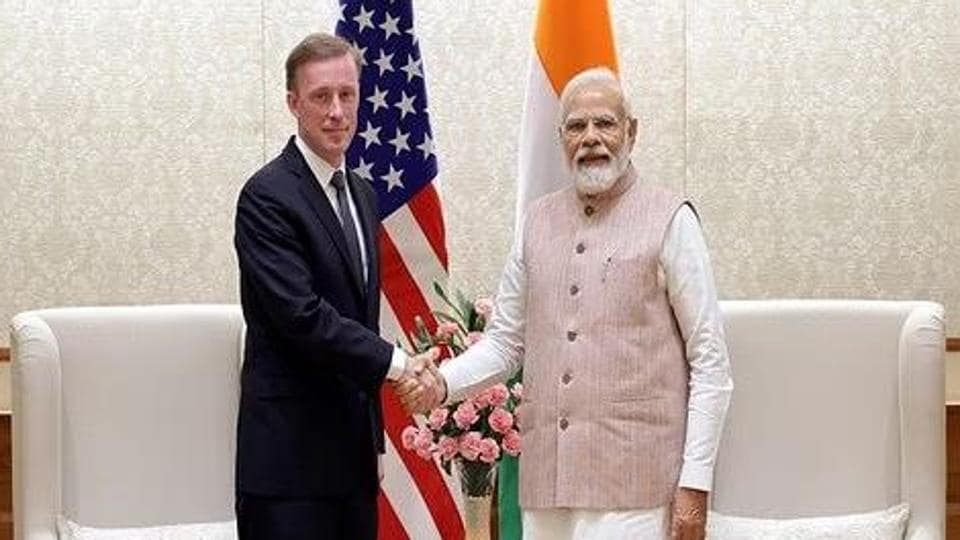
President Joe Biden has directed all wings of the US government to remove obstacles and barriers standing in the way of deeper defence trade and technology cooperation and the US is committed to meet India’s requirements in key areas such as maritime domain awareness, Sullivan said while declining to discuss specific defence deals such as the supply of engines for India’s homegrown fighter jets and possible sale of armed drones.
With US Secretary of State Antony Blinken set to travel to China this week – the first such visit in five years – Sullivan told a small group of Indian journalists that such contacts are aimed at responsibly managing the competition with China so that it “doesn’t enter a downward spiral”.
The “core elements” of Washington’s approach towards Beijing remain unchanged, and the US will work with allies and partners to compete with China in areas ranging from economics to military deterrence, he said.
Sullivan also spoke publicly for the first time on work being done by the US, India, Israel, Saudi Arabia and the United Arab Emirates (UAE) on a major infrastructure project to link West Asian railway networks to Indian ports, saying the plan was discussed during his two-day visit to New Delhi.
In addition to holding two rounds of talks with his Indian counterpart Ajit Doval, the two NSAs reviewed progress in the initiative on Critical and Emerging Technologies (iCET), which was launched in January, and set new priorities and objectives for the process. The initiative fosters closer cooperation between private industry and scientific institutions in seven areas – AI and quantum computing, advanced materials, defence, semiconductors, next-generation telecommunications, biotech and space.
Sullivan said there will be a “host of substantial announcements in many areas” and “some serious deliverables in the major domains” of India-US ties during the Indian prime minister’s state visit to the US next week, only the third such visit hosted by Biden during his presidency.
“One is in semiconductor supply chains, and I think you can expect to see some substantial results from that as soon as next week. The second area is 5G and Open RAN [open radio access network], where US software companies and telecommunications firms are working very closely with Indian telecommunications firms on how we deploy 5G, 6G, and Open RAN at scale and I think you will also see some progress there,” he said.
With India and the US opting to keep Chinese telecom majors such as Huawei out to ensure the security of their networks, the Quad has stepped up efforts to roll out Open RAN in the Indo-Pacific by enabling service providers to use non-proprietary components from a variety of vendors.
Modi and Biden are also expected to focus on artificial intelligence because it is “going to be so transformative of our economies, our societies, our national security”, Sullivan said. The two sides can align their approaches in this area and the US National Science Foundation is working to sponsor joint research between the two sides in AI, machine learning and advanced wireless, he said.
Sullivan was more circumspect in responding to questions about an agreement on manufacturing the GE-414 engine, developed by GE Aviation, in India to power the country’s home-grown combat aircraft and the possible sale of armable MQ-9B drones made by General Atomics. The GE engine “has been a major focus of us trying to get progress [but] I won’t say more on exactly where it is because I’ll leave that, just stay tuned and we’ll see where things are next week”, he said.
Both sides are focused on the “long-term vision of greater integration of our defence supply chains, greater co-production, co-development and the opportunity for us to do the kinds of technology transfer that is in India’s interest”, Sullivan said. Towards this end, Biden has directed every element of the US government to “remove unnecessary and outmoded obstacles and barriers to deeper defence trade and technology cooperation”.
“He [Biden] wants to make good on a long-standing promise made between the US and India that we would deepen our cooperation, including co-production and co-development and having co-production mean that critical defence technologies are produced here in India,” Sullivan said.
Sullivan, who spoke to reporters shortly before the US announced that Blinken will travel to China on Friday, said Biden has been “very straightforward and consistent” in his approach to China. “We are in competition with China. But we do not see conflict or a new Cold War, and we want to manage that competition responsibly so that it doesn’t enter a downward spiral,” he said.
While the US will continue to work with China on issues such as global macroeconomic stability, climate and public health, Biden has made it clear “intense competition requires intense diplomacy”. The US has “myriad concerns with China’s behaviour and activities” and the “core elements of our China approach remain as they were from the day President Biden entered office”, he said.
“We’re investing in the sources of our own strength. We are aligning with allies and partners and we are competing vigorously in every significant domain, from economics and technology to military deterrence to writing the rules of the road of the 21st century,” Sullivan said.
In response to a question from HT, Sullivan outlined how the US is working with India, the UAE, Saudi Arabia, Israel and “potentially other partners” to pursue infrastructure projects that increase economic connectivity from Europe to Southeast Asia. The proposals in this regard cover green hydrogen, renewable electricity and fibre networks and will involve working through I2U2 and with Saudi Arabia, he said.
Noting that the plan was discussed during his visit, he said: “The US wants to support and encourage and facilitate and play a part in those kinds of infrastructure projects. I can’t speak to the details of the main projects that we are discussing because there’s still a...certain matter of discretion in that.”
He added, “We see just an enormous opportunity for the Middle East not to be a source of instability, but rather to be a source of connectivity that becomes the crossroads from India all the way to Europe.”
On May 7, Sullivan, Doval and UAE NSA Sheikh Tahnoon bin Zayed Al Nahyan met Saudi Crown Prince Mohammed bin Salman in Jeddah to discuss the major connectivity project expected to link West Asian rail networks to Indian ports.