E-Paper



Can’t go on: SC pulls up Punjab on stubble fires
The Supreme Court asked the Punjab government to take stringent steps against farmers who continue to light farm fires

 Prefer HTon Google


“Stick must also follow the carrot”, the Supreme Court said on Tuesday, asking the Punjab government to take stringent steps against farmers who continue to light farm fires despite a restraining order by the top court, adding both the state and central governments should keep all politics out while ensuring enforcement of measures to stop stubble burning that has become a major source of air pollution in the national capital region every winter.
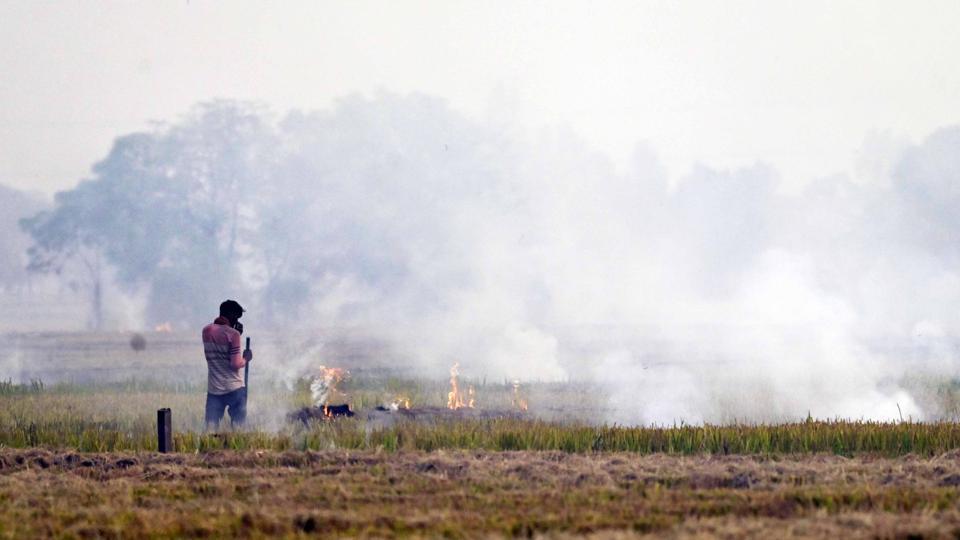
“No section of society can say we will do whatever we want even at the cost of the health of people. It’s not acceptable. They can’t go on burning fires... Stick must also follow the carrot...The bottom line, according to me, is money. Somehow, they (farmers) are not showing the sensitivity that it’s (farm fires) affecting people and children so long as they are making some extra money,” a bench, led by justice Sanjay Kishan Kaul, remarked as it continued monitoring the progress of its previous orders in the matter. The court remained emphatic that farmers trying to gain monetarily by stubble burning must be deprived of all incentives.
READ | Punjab to honour farmers who shunned stubble burning, says speaker Kultar Singh Sandhwan
During the last hearing on November 10, the court told the Centre and the governments of states neighbouring the national capital to take steps and stop farm fires, stating that a “carrot and stick policy” approach — a balance between incentives and penalties — was necessary to stop stubble-burning incidents.
Fearful of the court’s censure, Punjab clamped down on the fires on November 9 and 10, but with the court shut for a week for Diwali, the number of fires peaked. They are now declining again because most of the harvest in the state is done. To be sure, ahead of Tuesday’s hearing, Punjab has been aggressive in filing FIRs (though most do not name anyone) and fining farmers, although it isn’t clear how much of the money is actually collected.
The bench, also comprising justice Sudhanshu Dhulia, directed the Punjab government to recover the environmental cess of ₹2.62 crore imposed on farmers for lighting farm fires. While emphasising that farmers violating court orders should be identified and penalised suitably, it also acknowledged that depriving errant farmers of MSP for paddy or other crops could be a complex issue.
READ | Spike in farm fires in Punjab, 932 FIRs so far
The court further directed the Aam Aadmi Party (AAP) government in Punjab to consider providing enhanced financial assistance to the farmers for hiring machines for stubble management instead of expecting more subsidy from the Centre.
“You have to do it. If other states can do it, why can’t you do it? [But] you don’t want to spend even a penny,” the court told Punjab’s advocate general Gurminder Singh.
In its order, the bench asked the state government to come back with a response on why the latter cannot pay for fuel and manpower to the farmers hiring machines from the custom hiring centres while the government could pick up the stubble to be used appropriately. “We have put it the state government why they cannot subsidise and pick up the byproducts that may compensate for the subsidies,” the order recorded.
The bench also took on record the submission of the Centre made through attorney general R Venkataramani that 88.7% of stubble burning cases have been reported from Punjab in 2023 but fines have been imposed only in a little more than 20% of such cases. The Centre added that largest share of funds – that is over 45% of the total – has been released to Punjab under its crop residue management and maximum number of machines have also been supplied to the AAP government but only 50% straw is being managed so far.
Senior advocate Aparajita Singh appearing as amicus curiae along with senior advocate ADN Rao also highlighted inadequate enforcement by the Punjab government.
Gurminder Singh claimed that there is a 29% reduction in farm fires in 2023 and 984 FIRs have been lodged against the landowners, besides over 1,000 flying squads being constituted to check and put out farm fires. He maintained that as of November 20, six districts in Punjab were completely free from stubble burning incidents (which is understandable as the harvest is mostly complete). According to Punjab, a higher MSP for alternate crops to wean state farmers off paddy and crop diversification along with an additional subsidy from the Centre could help.
At this point, the bench urged both the Centre and the Punjab government to consider the long-term effect of growing paddy that can make land arid. “The effect on the quality of land can be disastrous. We are not experts, but you can consider everything. The bottom line is that both the Centre and state must keep aside their politics,” added the court, fixing December 7 as the next date of hearing.
In its order, the bench also asked Centre and governments of Delhi, Punjab, Haryana, Uttar Pradesh and Rajasthan to constructively participate in the meetings chaired by the Union cabinet secretary to consider steps to bring down high levels of pollution gripping Delhi.
The court asked the committee headed by the cabinet secretary to consider suggestions for utilising the stubble, which it said is turning out to be a profit-making venture for big farmers. The committee was further asked to work on growing alternate crops pointing to the disastrous consequence of growing paddy that can turn Punjab into a dry land.
To be sure, Punjab, responsible for the majority of stubble fires, has shown little interest in clamping down on them, with the chief minister’s own constituency, Sangrur, seeing a high number of farm fires in the state. Farmers in Punjab, and also in Haryana, Rajasthan, and parts of Uttar Pradesh (although to a much lesser extent in the three states), burn stubble of their paddy crop after harvesting it to get their fields ready quickly for the next crop. As the temperatures dip, Delhi’s air becomes heavier and is catalysed by slow winds that change direction — all of which along with stubble fires push the air quality into hazardous levels.
The court on November 7 maintained that it is going to monitor the issue so that residents in Delhi are not left gasping for breath due to bad air. “It is time that something is done as of yesterday than postponing it and we do believe that matter requires immediate attention and court monitoring irrespective of the fact whether it improves or not in the next few days,” the order of the day read. It had then asked the cabinet secretary to convene a meeting of all the stakeholders to chalk out a strategy to control pollution.
In its previous hearings earlier this month, the court listed out certain short-term and long-term measures to control farm fires in Punjab. “With technology available now, information is forthcoming to be utilised to control the farm fire where the exact location of farm fire can be immediately detected. How to proceed with it and what measures are to be taken are administrative in character and the function of the court is to make sure that the administrators perform the task assigned to them,” the court order on November 10 stated.