
 E-Paper



Centre files caveat in Supreme Court on petitions against Agnipath scheme
Ahead of registrations for the first batch of Agniveers in the defence forces beginning Friday, the government has approached the Supreme Court, urging that it be heard before any action is taken on petitions challenging the new recruitment scheme


Ahead of registrations for the first batch of Agniveers in the defence forces beginning Friday, the government has approached the Supreme Court, urging that it be heard before any action is taken on petitions challenging the new recruitment scheme.
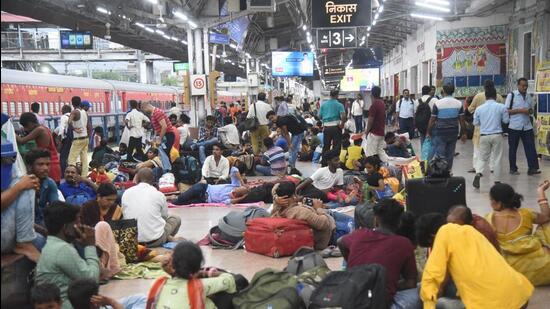
“Let nothing be done in the above-mentioned matter (Agnipath scheme) without notice to the undersigned,” the Centre said in a caveat filed in the Supreme Court on Sunday.
Since the launch of the Agnipath scheme on June 14, three public interest litigations (PILs) have been filed in the apex court, with the latest filed on Monday by advocate Harsh Ajay Singh. Earlier, two lawyers — Vishal Tiwari and ML Sharma — filed separate PILs against the scheme.
The Agnipath scheme provides for the recruitment of youth in the age bracket of 17-and-a-half to 21 for four years, with a provision to retain 25% of them for 15 more years, while the remaining 75% will get a one-time financial package of approximately ₹11.71 lakh. The announcement led to widespread protests in several states. Later, the government extended the upper age limit to 23 years for recruitment in 2022.
Pressure mounted on the Supreme Court to list the petitions as two of the petitioners mentioned their PILs before a vacation bench of justices CT Ravikumar and Sudhanshu Dhulia for urgent listing. Tiwari was the first to mention to the court for listing of his PIL filed on June 17. The matter required urgent hearing in the wake of protests in the country against the scheme, he told the bench.
Tiwari has sought a judicial committee headed by a retired Supreme Court judge to study the impact of the new scheme on national security and the army, and also demanded a special investigation team to look into the violence seen across states that led to damage to public property.
The bench told Tiwari that as per the circular issued by the Supreme Court, no PIL can be listed during the vacation without approval of the Chief Justice of India.
Later on Tuesday, the PIL filed by Singh was mentioned by advocate Kumud Lata Das before the same bench, claiming their matter was placed before the chief justice but the registrar was yet to receive a word from him. “As per the circular, all such matters are to be placed before the CJI, and if that’s done, we can consider,” the bench reiterated.
The latest PIL by Singh delved deeply into the army recruitment scheme. “Agnipath scheme undermines the armed forces’ professionalism, ethos, and fighting spirit and will potentially lead to the militarisation of civil society,” it said.
Pointing to the large-scale violence seen in the country against the scheme, the PIL stated: “The scheme is facing a countrywide violent protest due to its uncertainty, future insecurity and giving precedence to economy over security.”
The petition also pointed at how the Agnipath scheme has sought to cut down on the burgeoning defence pension expenses that have seen an upshot with the implementation of the one-rank-one-pension (OROP) scheme.
“In 2010-11, the pension outgo was 19% of the total defence expenditure. In November 2015, OROP was introduced and by 2020-21, pension outgo rose to 26% of defence expenditure,” the petition pointed out.
It also mentioned a comparative study on defence pensions done by the Manohar Parrikar Institute of Defence Studies and Analyses found that the US spent only 10% of its defence expenditure on pensions in 2018, while in the UK, the pension outgo in 2019 was 14% of its total defence spending.
The PIL indicated that out of a defence budget outlay of ₹5,25,166 crore for 2022-23, the total expenditure on defence pension was ₹1,19, 696 crore, leaving little for military’s modernisation. As per a parliamentary committee report in 2020, India has 3.2 million defence pensioners.
With the new recruitment scheme, the Agniveers will get a first year salary package of ₹4.76 lakh that will rise up to ₹6.92 lakh by the time they enter the fourth year of service. The process of recruiting 46,000 soldiers, sailors and airmen is being done on an “all-India, all-class” contrary to the traditional practice followed by the army having regiments representing races and regions in the country.
Stating that Israel and China also have a military recruitment policy similar to Agnipath, and it has been found to be efficacious, the petition, however, added: “The racial and national homogeneity has been omitted in these two countries in their anxiety to emphasise their perspective.”
The PIL even questioned the efficacy of the six-month training for the Agniveers as “inadequate” for having a “battle worthy” and “suitably proficient” force. Quoting former defence officers, the PIL said it takes a minimum of three to five years to be trained for the armed forces.
“This is a half-baked reform with multiple ramifications…as usual it was pushed from top by politicians and bureaucrats, with the three defence chiefs left to defend the indefensible,” the PIL stated.
Calling for a reconsideration of the Agnipath scheme, the PIL raised concerns over the Agniveers trained in handling weaponry to be ready recruits for Maoist activities. It requested the top court to form a committee to suggest possible amendments to the scheme, including the provision to provide alternate job opportunities to the bulk of 75% recruits who will be retiring in four years after induction under the scheme.


