E-Paper



Centre plans to expand Delhi's ‘3rd Ring Road’ with eastern arm to cut traffic snarls
The new six-lane highway will begin at Alipur in North Delhi—currently the northern endpoint of UER-II—and run through Tronica City in Ghaziabad.

 Prefer HTon Google


The National Highways Authority of India (NHAI) is planning a major eastern extension of the Urban Extension Road-II (UER-II), widely known as Delhi’s third Ring Road, to ease pressure on key arterial roads such as the Ring Road, Outer Ring Road, Kalindi Kunj, and Sarai Kale Khan by routing traffic through northeast Delhi into Ghaziabad and ultimately Noida, officials aware of the development said on Wednesday.
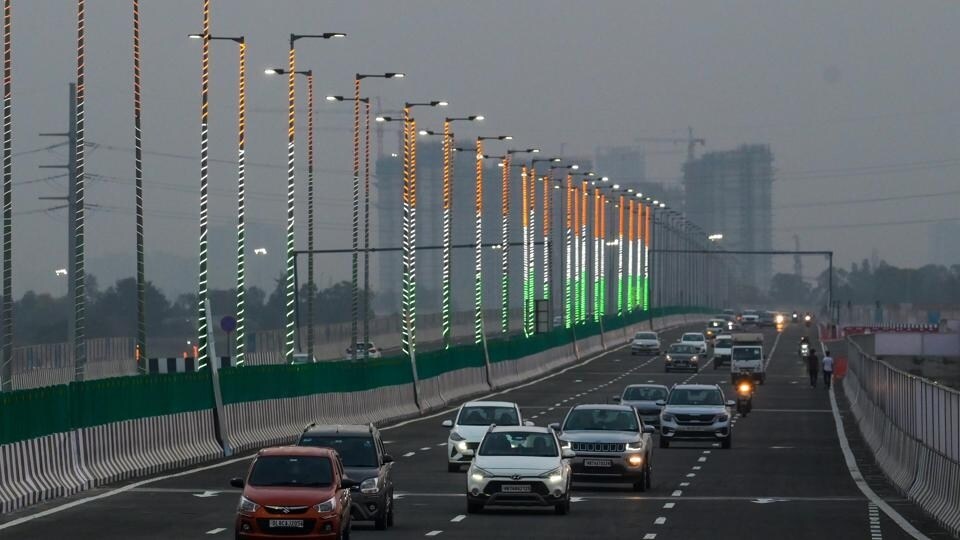
The new six-lane highway will begin at Alipur in North Delhi—currently the northern endpoint of UER-II—and run through Tronica City in Ghaziabad, connecting to the Delhi-Dehradun Expressway near Mandaula. From there, it will wind through Ghitora and Farukhnagar, link up with the Delhi-Meerut Expressway, and end along the Noida-Greater Noida Expressway, documents accessed by HT show.
This expansion complements the UER-II, which is expected to be fully operational by August.
When completed, the eastern arm of UER-II will offer a seamless corridor cutting across Haryana, Delhi, and Uttar Pradesh. It is designed to serve both local and out-of-town vehicles, giving commuters from southern and southeastern Delhi a direct route north—without entering the city’s already choked core—and allowing long-distance traffic to bypass Delhi altogether.
A senior government official, asking not to identified, said the extension was among the top infrastructure priorities discussed during a meeting between Delhi chief minister Rekha Gupta and Union road transport minister Nitin Gadkari on June 4.
“The goal is to decongest Delhi by creating alternative corridors that allow intercity and freight traffic to avoid the city centre,” the official said, requesting anonymity.
An NHAI project report estimates the cost of the first 17-km leg of the extension at ₹3,350 crore. This stretch will link UER-II with the Delhi-Dehradun Expressway near Tronica City.
“The idea is to create an alternative bypass that diverts traffic moving between Haryana, Rajasthan and Uttarakhand. This will reduce load on NH-48 (Delhi-Jaipur), NH-44, Ring Road and the Barapullah corridor,” the official added.
NHAI has also proposed a second leg—about 65km in length—that will run from Mandaula to Noida via Ghaziabad, skirting towns such as Ghitora, Farukhnagar, Hidan and Indirapuram. This segment is likely to cost ₹7,500 crore. It will improve connectivity between Loni, Baghpat, Ghaziabad, Noida, and Faridabad to different parts of North, Northwest and Southwest Delhi, officials said.
“The second leg will act as a high-speed bypass for vehicles travelling between Ghaziabad and Noida and parts of Delhi, reducing traffic on corridors such as Kalindi Kunj, Sarai Kale Khan and Delhi-Meerut Expressway,” the NHAI report noted.
Together, the two highway segments will span 82km and are expected to cost around ₹10,850 crore. Officials said that bids for the preparation of detailed project reports (DPRs) for both sections are currently being evaluated and are likely to be awarded soon.
This eastern expansion complements the main UER-II, construction of which is nearing completion. As HT reported earlier this month, the 75km UER-II is expected to be fully operational by August and will reduce travel time by up to 60% between the Indira Gandhi International Airport and parts of southwest and northwest Delhi.
Sections around Najafgarh, Mundka and Alipur are already operational. Once complete, UER-II will form a ring of high-speed corridors connecting major expressways including the Delhi-Jaipur, Delhi-Meerut, and Delhi-Dehradun expressways with the Dwarka Expressway and the Delhi-Mumbai Expressway.
“This is part of a larger strategy to push highway-grade bypasses around congested urban centres and improve freight mobility while enhancing commuter convenience,” an official said.
NHAI did not respond to requests for comment.