
 E-Paper



Centre plans to map and assess anganwadis, shelters for women
The proposed move comes after the fifth National Family Health Survey showed an alarming rise in the number of children with stunted growth across 11 states


The Union women and child development ministry plans to map and assess anganwadis (rural child care centre) and swadhar grehs (shelters for distressed women) to address any functional problems through focused interventions, officials familiar with the matter said.
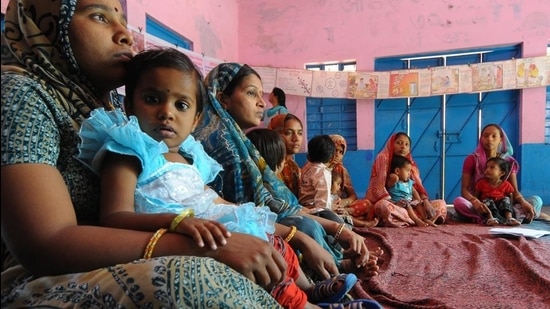
The proposed move comes after the fifth National Family Health Survey (NFHS) showed an alarming rise in the number of children with stunted growth across 11 states. Meghalaya (46.5%) recorded the steepest rise, followed by Bihar (42.9%). The population of underweight children has also increased.
The government is yet to decide which body will conduct the survey. Officials said that organisations affiliated to the UN were earlier considered but the idea was later dropped.
According to government data, there are over 1.3 million anganwadis and other child-care centres with a strength of over 1.2 million workers and more than 1.1 million helpers. There are 419 shelters for distressed women with 12,608 workers. These centres are run under centrally sponsored schemes, but the state governments or non-governmental organisations (NGOs) manage them.
“The assessment was approved last November,” an official said on the condition of anonymity. “It will help us identify the problem areas and to resolve them.”
Also read | Gross enrolment ratio of girls in schools improved from 2014-15 to 2018-19: WCD
The official added that the assessment of the anganwadis could lead to the restructuring of the funding system to focus on the vulnerable areas. “...we can also identify which states and centres need more help.”
HT reached out to a ministry spokesperson and the office of women and child development minister Smriti Irani for comments but did not receive any responses immediately.
Anganwadis were set up in 1975 to tackle malnutrition. They provide supplementary nutrition, pre-school, non-formal education, nutrition and health education, immunisation, health check-ups and referral services to children under six, adolescent girls and pregnant/lactating mothers.
Women in distress can stay at swadhar grehs for a maximum of three years or before they turn 60. The ministry’s website cites an over-dependence on NGOs and state governments among the challenges the swadhar grehs face.
Enakshi Ganguly, a co-founder of HAQ Centre for Child Rights, said anganwadis often face issues related to space and accessibility. “There are proper and mini anganwadi centres. We do not have an idea of how anganwadis centres are run. It would be good to do a 21st-century assessment. The NFHS is a signal for us to look at the anganwadi programme.” Gaguly added it is better if a sort of an audit is done.” How the survey will be conducted will be a challenge as all the centres are run in different ways, with food needs being different for different states. The study must take all of these challenges into account.”


