
Uttarakhand glacier burst: Toll climbs to 18, 202 still missing
Rescue operations by personnel of state disaster response force, national disaster response force, army, and Indo-Tibetan Border Police resumed on Monday morning
Eighteen bodies have been recovered so far in affected areas of Chamoli district, with 202 people still missing, including 25 to 35 workers inside Tapovan dam tunnel where rescue operation is underway, said officials
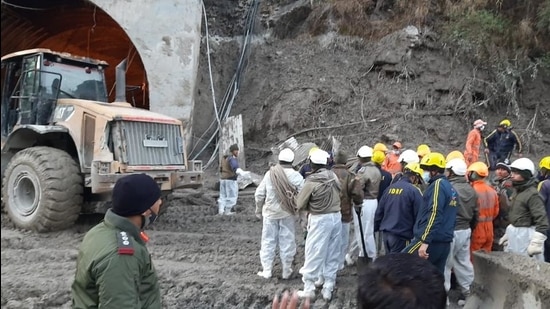
Praveen Alok, media in-charge of state disaster response force confirmed that 18 bodies were recovered till 12pm from Rishiganga and Dhauliganga downstream.
He said the missing 202 include 5 people from Reni village, 11 from Tapovan Rithwik Company, 2 each from Karochi, and Ringi village, 46 from Rishiganga company, 21 from Om Maital, three from NHPC and 2 from Tapovan village.
Another 25 to 35 workers are still trapped inside the Tapovan dam tunnel, where rescue operation is underway.
Also Read | Not just climate change, Chamoli disaster was human-induced
So far, 15 people have been rescued from Rishiganga dam site and 12 from NTPC’s Tapovan dam site.
Alok added that 70 SDRF personnel, two teams of National Disaster Response Force , 425 personnel of Indo -Tibetan Border Police, one team of Seema Suraksha Bal and 125 army personnel are carrying out the rescue and relief operations in affected areas of Chamoli.
A search operation is on to recover bodies downstream at Reni village, Tapovan, Joshimath, Ghochar, Karnprayag , Rudraprayag, Dharidevi and Srinagar.
ABOUT THE AUTHORNeeraj SantoshiNeeraj Santoshi is the Chief of Bureau for Hindustan Times in Uttarakhand, where he leads the state reporting team while covering government, politics, environment, wildlife, Uttarakhand High Court, and issues shaping the Himalayan region. With more than two decades in journalism across conflict zones, he has covered politically sensitive regions and environmentally fragile landscapes, and focused on stories that combine public interest with in-depth storytelling. An alumnus of Pune University with a Master’s in Communication Studies, he has reported extensively from Jammu & Kashmir (2003-2010), Madhya Pradesh (2010 to 2018 ) and Uttarakhand (Since 2018), covering subjects ranging from insurgency, elections and governance to wildlife conservation, mining, climate change, agriculture, human rights and social justice. He has covered politics and legislative assemblies of both Jammu & Kashmir and Madhya Pradesh over more than a decade. Before taking over as Chief of Bureau in Uttarakhand, he served as Special Correspondent with Hindustan Times in Madhya Pradesh and earlier reported for both Hindustan Times and The Indian Express in Jammu & Kashmir, where he covered state politics, environment and insurgency-related developments. Over the years, his stories have focused on environmental degradation, wildlife, illegal mining, governance and the changing social fabric of Himalayan states and Central India. He is particularly interested in long-form explanatory journalism, and stories that explore the intersection of ecology, conservation, governance and society. Outside the newsroom, Neeraj enjoys reading widely on neuroscience, consciousness studies, Artificial Intelligence and quantum physics, with a special interest in Kashmiri Tantric Shaivist traditions. He is also passionate about wildlife, mountaineering and the Himalayas, interests that continue to inform his reporting and deepen his understanding of the region he covers.Read More

E-Paper


