
 E-Paper



Chandrayaan lander’s signal lost but Isro’s dream lives on
Prime Minister Narendra Modi consoled disappointed Indian scientists including a teary-eyed ISRO chairman, K Sivan, whom he warmly embraced.

 Prefer HTon Google


Bengaluru Scientists at the Indian Space Research Organisation (ISRO) lost contact with Chandrayaan-2’s Vikram lander two minutes before it was to reach the lunar surface, in a temporary setback to India’s ambition of becoming the first country to explore the South Pole of the moon for the presence of water and to expand human understanding of earth’s only natural satellite.
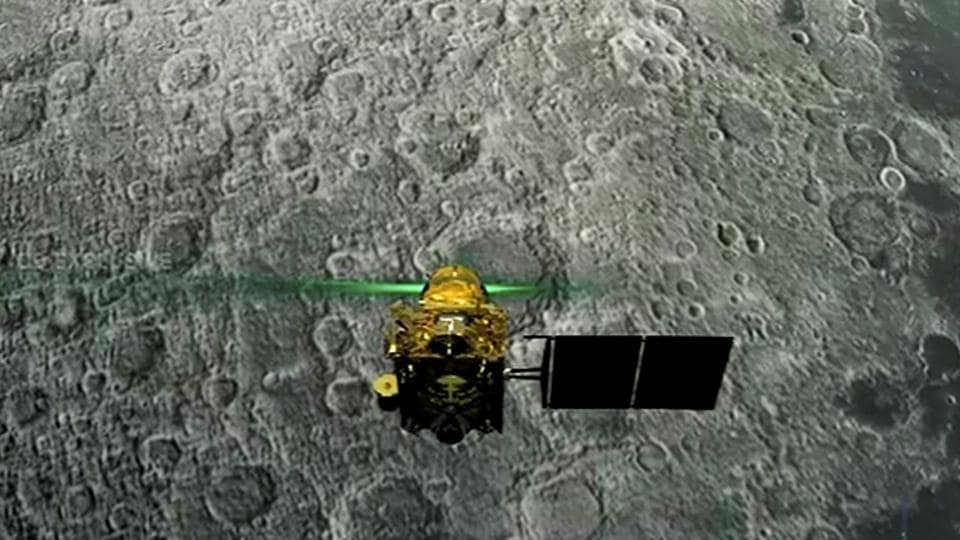
ISRO said it would try to re-establish communication with the lander, named after the late physicist and astronomer Vikram Sarabhai, for 14 more days, declaring that the mission had already achieved 90-95% of its objectives and would contribute to lunar science .
The mission also succeeded in demonstrating India’s prowess in developing complex technologies such as the lander, and accomplishing fuel-efficient travel to celestial bodies, rekindling interest in space science among many million young Indians.
Prime Minister Narendra Modi consoled disappointed Indian scientists including a teary-eyed ISRO chairman, K Sivan, whom he warmly embraced.
“We might not have reached the lunar surface as planned... You came as close as you could, stay steady and look ahead. We are full of confidence {that} when it comes to our space programme the best is yet to come,” Modi, who was in Bengaluru to watch the touchdown of Vikram on the moon together with ISRO scientists, said.
In its first statement after the setback, ISRO described Chandrayaan-2 as a highly complex mission that represented a “significant technological leap”. The space agency also underscored that 90-95 per cent of the mission objectives had been achieved. It said the precise launch and mission management was one success area that would enable the orbiter to stay in place for the next seven years instead of the planned one year.
“This was a unique mission which aimed at studying not just one area of the Moon but all the areas combining the exosphere, the surface as well as the sub-surface of the moon in a single mission,” the statement said.
India was seeking to become only the fourth country, after the US, the erstwhile Soviet Union and China, to make a soft landing on a celestial body. ISRO lost contact with Vikram, which was carrying the Pragyan lunar rover, 2.1 kilometres from the moon’s surface. Experts, however, focused on the positives.
“It was a fantastic mission and a great learning exercise. The mission is already 99% successful, we reached up to 2.1 km near the surface of the moon; the closest we have got to any heavenly body. And the kind of euphoria it has generated among the students; any institution I go to today, everyone says they want to become space science researchers,” said VK Saraswat, member of the policy think tank NITI Aayog and former director general of Defence Research and Development Organisation.
With Chandrayaan 2, India had set an ambitious goal of not just landing on the moon but doing it in a location no one else has attempted to probe – the lunar South Pole, where the shadowed regions are thought to contain 100 million tons of water and a well-preserved history of the solar system.
For this mission, apart from the orbiter used in previous missions like Chandrayaan 1 (2008) and the Mangalyaan Mars Orbiter Mission (2014), scientists at ISRO also indigenously developed the lander and the rover technology.
“A lander is a complex technology that can only be developed with a multidisciplinary approach involving communications, propulsions, descent control etc. I do not know what went wrong today, but it seems like 95% of the systems must have worked the way they were supposed to.
So, we now have the capability to develop a lander, which can in future be used for other planetary missions,” said Sanjay Nekkanti, founder of Dhruva Space, a private small satellite developer. “This is, of course, a simplistic approach. The implementation would differ depending on the atmosphere of the planet, but the core technology remains the same.”
Earlier, the lander for the mission was to be developed by Russia, which delayed the project and backed out after the failure of its mission to land on the Martian moon Phobos. This is the reason for the 11-year gap between India’s two lunar missions.
For this mission, all the scientific payloads were also developed by India. “Unlike Chandrayaan-1, when we did not have the capability or the resources to bring on board all indigenous technology, all the payloads for this mission, except the NASA payload, were developed in India,” said an ISRO scientist who was part of the previous moon mission. The scientist requested anonymity.
The Vikram Lander followed the planned descent trajectory from its orbit of 35 km to just below 2 km above the surface, tweeted K VijayRaghavan, principal scientific advisor to the government.
“All systems and sensors of the Lander functioned excellently until this point. Tested and proved many new technologies such as the variable thrust propulsion technology used in the Lander,” VijayRaghavan wrote.
This was also the first operational flight of the GSLV (Geosynchronous Satellite Launch Vehicle) Mark III after two developmental flights in 2017 and 2018. And the launch vehicle performed extremely well. After a technical snag led to the launch getting postponed by a week, the rocket put the spacecraft in a higher than intended orbit, reducing one manoeuvre around the earth that the scientists had to perform.
This was the third mission where India demonstrated a trajectory for travelling to other celestial bodies that used less fuel by using the Earth’s gravity to fling the spacecraft towards the moon. “The precise launch and mission management has ensured a long life of almost seven years instead of the planned one year,” said VijayRaghavan.
The orbiter is still in a nearly 100x100 km orbit around the moon and will relay data on lunar terrain, exosphere, and abundance of elements for a year or more.
“This trajectory conserves fuel and look at the Mangalyaan, it is still in the orbit. Even Chandrayaan -1 still has fuel, we know because it is still in orbit, but we cannot communicate with it. The Chandrayaan -2 hardware is also the same and is likely to perform over its life,” said M Annadurai, former head of ISRO’s UR Rao Satellite Centre in Bengaluru.
Such a fuel-efficient mission also reduces the weight of the payload. “This means we do not need powerful and heavy launch vehicles, like those used in other countries, even for sending such complex missions to another heavenly body,” said Saraswat.
In both Chandrayaan -1 and Chandrayaan-2, India demonstrated the ability for a precise injection into a trans-lunar trajectory from where the spacecraft was injected into a lunar orbit to achieve a 90-degree inclination, a “unique requirement” of missions that plan to land on the pole.
Scientists also noted that the mission lost communication with the lander just 2.1 kilometres from the destination after travelling 384,400 kilometres to the moon.
“Although the lander technology was being demonstrated for the very first time, we almost did it. Now, we need to understand what happened. The scientists are still at the Bangalore office studying the data and figuring out what happened. This will help in future missions. In fact, India might attempt another moon mission in another year or two,” said Annadurai.
He said that India might demonstrate just the lander technology in a mission in a couple of years before a sample return mission is planned for Chandrayaan-3.
“The next mission will take place at the earliest possible. The second one took over a decade, but now we have all technology in place and everything worked except the last leg. The next mission is possible within the next couple of years,” he said.
The mission was not restricted to the scientific community, everyone across the country was invested in the landing. Chandrayaan-2 captured the public imagination in a way that will help inspire future generations of researchers, experts say.
“I have seen the difference myself, there was a lot more public participation in the mission than in 2014 for Mangalyaan. These kinds of large scientific missions by a space organisation raises the profile of the country, but it also excites the children and people about space science,” said Rajeswari Rajagopalan, head of the nuclear and space initiatives at Observer Research Foundation.”This might well have inspired the next generation of ISRO scientists. Such missions also create more opportu


