E-Paper



Changing norms hurting testing: Experts
The number of Covid-19 tests carried per million people in India is a little over 3,100, a number that experts have said is inadequate to determine the true extent of the problem in the country, even as the total infections rose by another nationally.

 Prefer HTon Google


For about a week since her father succumbed to the coronavirus disease (Covid-19), 27-year-old Delhi resident Shipra Ujjainwala has made dozens of phone calls to helplines, approached multiple private testing centres, and approached at least one government hospital to be tested for the coronavirus infection.
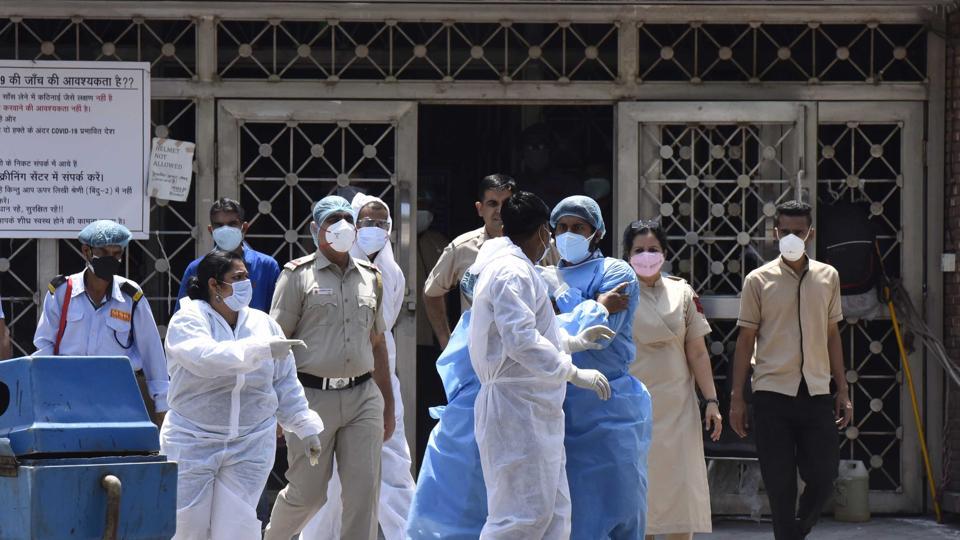
Ujjainwala has no symptoms but she needs a “negative” certificate to get back to work and address the misgivings of her neighbours and relatives who have avoided the family for weeks.
“I was refused as I didn’t have prescription from a doctor for I had no symptoms. The fact that I had a Covid death in my family and that my organisation demands a Covid-free certificate was not enough to agree them to test me. Nobody wants to see us because of our Covid positive case history how am I supposed to get a prescription,” she said.
Her experience captures the convoluted protocols that make it difficult for even at-risk people to be able to get a Covid-19 test, complicating efforts to determine the size of the outbreak. Till Tuesday, Ujjainwala would have qualified for a test but the rule has now been changed to allow only symptomatic close contacts of a confirmed patient.
The number of Covid-19 tests carried per million people in India is a little over 3,100, a number that experts have said is inadequate to determine the true extent of the problem in the country, even as the total infections rose by another nationally.
“Our [India’s] condition may be worse than Italy, but we don’t know since we aren’t testing enough. We don’t acknowledge our real status in terms of disease spread because it seems our focus is largely on proving we are doing better than other countries in managing the disease. We have tested about 3.9 million people from a population of 1.3 billion, which is roughly about 0.3% of the population. How can you plan how to control a pandemic for the rest of the 99.7% of the population by merely looking at the results in 0.3% of the population?” said Dr T Jacob John, former virology head, Christian Medical College, Vellore John.
The problem is not merely that the rules are restrictive but that they are also changing rapidly.
“There is perpetual confusion over who to test, as the government keeps changing guidelines. It feels like harassment and it appears they want private labs to stop testing by making it difficult for us to operate,” said the owner of a private laboratory owner, asking not to be named.
Representatives of the Indian Council of Medical Research – the apex body that sets the standards for such protocols across the country (though they can be tweaked by states) – said the changes are due to evolving demands. “ICMR has been time to time revising guidelines as per what the situation demands. The protocols have been clearly laid out that states should follow. Some states are perhaps going by their own rules by making additions or to ICMR protocol that is probably creating problems,” said Dr Rajnikant Srivastava, spokesperson, ICMR.
Manufacturers of test kits say they are prepared to meet higher demands. “We are currently producing 2 lakh tests a day; there is absolutely no shortage of kits. I can say for sure that in some time India is going to be a competitive market globally,” said Hasmukh Rawal, managing director, Mylab Discovery Solutions, Pune-based manufacturers of RT-PCR diagnostic kits.
Current bottlenecks, however, could be in the labs. “There is no shortage of kits and equipment but there is only a particular number of tests that a laboratory can do, which is the testing capacity of a lab. You cannot go beyond that, no matter how many extra kits you have. It is not possible to test the entire 1.3 billion population,” said Dr Srivastava.
Testing will also need to be timed in order to avoid false negatives. Dr RR Gangakhedkar, head, epidemiology division, ICMR, said, “We cannot open up testing for asymptomatic people because a negative RT-PCR test does not rule out infection in the early stages of infection, and in people with low viral load, the chance of RT-PCR returning a false negative is there.”