
 E-Paper



Charities alarmed over closure of Amnesty offices, ask govt not to be like China
India should not replicate China by trying to stamp out dissent, civil liberty activists said on Thursday, alarmed over Amnesty International’s decision to temporarily close its offices in India after facing political protests and sedition charges.

 Prefer HTon Google


India should not replicate China by trying to stamp out dissent, civil liberty activists said on Thursday, alarmed over Amnesty International’s decision to temporarily close its offices in India after facing political protests and sedition charges.
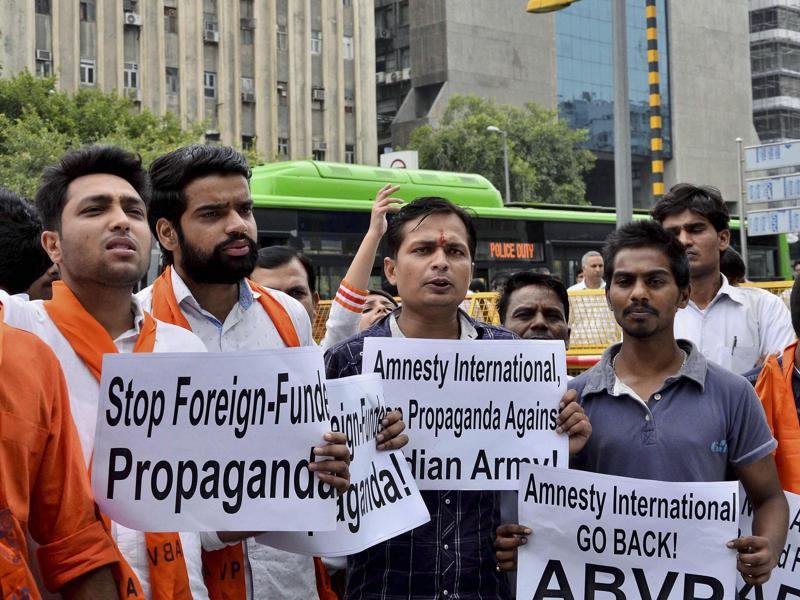
Police launched an investigation after receiving a complaint from a right-wing students’ group that “anti-India” slogans were raised at an event hosted by the charity in Bengaluru last week. The rights group has asked its staff not to come to office for now.
The move has left charities and non-government organisations nervous.
“The government is investigating and I hope no charges will be framed,” said Meenakshi Ganguly, director human rights watch, South Asia.
“But the broader concern is that the anti-national narrative is picking up and we need to hear people raising slogans, which is a peaceful way as compared to (using a) gun.”
Since Prime Minister Modi came to power, the government has tightened rules regulating charities, including cancelling the registration of about 10,000 groups for failing to declare details of overseas donations.
Read: Amnesty India temporarily closes offices, postpones events after sedition row
The government accused foreign charities of trying to hamper industrial projects on social and environmental grounds, and Modi criticised what he called “five-star activists.” The charities say they are being targeted selectively as part of a campaign to control free speech and dissent.
The Amnesty move signals a further shrinking of space for civil society and dissent in India, said Ravi Chellam, head Greenpeace India, which faced shutdown after authorities blocked foreign funding and froze its bank accounts last year.
“I don’t think amnesty will close office in India. Police has received a complaint and registered it. I don’t think action can be taken against the institution,” Chellam told Hindustan Times.
“On the larger issue of action against NGOs, if the institution is at fault action should be taken but someone should not be targeted for raising voice against the government.”
Nikhil Dey, a leading Right to Information activist, termed the sedition charges against Amnesty as unfortunate, saying an institution cannot be booked for sedition.
Read: Space for civil society and dissent in India is shrinking: Amnesty India chief
“The Supreme Court has clearly spelt that sedition charge can be invoked only if there is incitement to violence. In Amnesty’s case, nothing like that happened,” he said.
Earlier this week, political activists linked to the BJP protested against the rights group, accusing it of inciting hatred against the state at a seminar aimed at raising awareness over the lack of justice for families of victims in Kashmir.
Amnesty said the allegations against the organisation were unsubstantiated, but admitted that slogans calling for Kashmir’s independence were chanted by some people attending Saturday’s seminar.
Most activists Hindustan Times spoke to said if Amnesty closed its office in India then it would send a wrong message to the world.
“India should not try to replicate China where dissent is not allowed,” said Ganguly.
“The Government boasts of democracy, the role of civil society to promote India as an attractive place for international investors. Using laws like sedition and allowing hecklers to shut down free expression will severely damage those claims.”


