E-Paper



HT@Belem: China leads the Global South at COP30
India, as part of the Like-Minded Developing Countries (LMDCs) and China (G77+China), has been moving in lockstep on all major positions

 Prefer HTon Google


China has one of the biggest and prominent pavilions at the 2025 United Nations Climate Change Conference (COP30) in Brazil’s Belem. Delegates, visitors, and businesspeople have been thronging the pavilion, often taking selfies and networking with Chinese businesses.
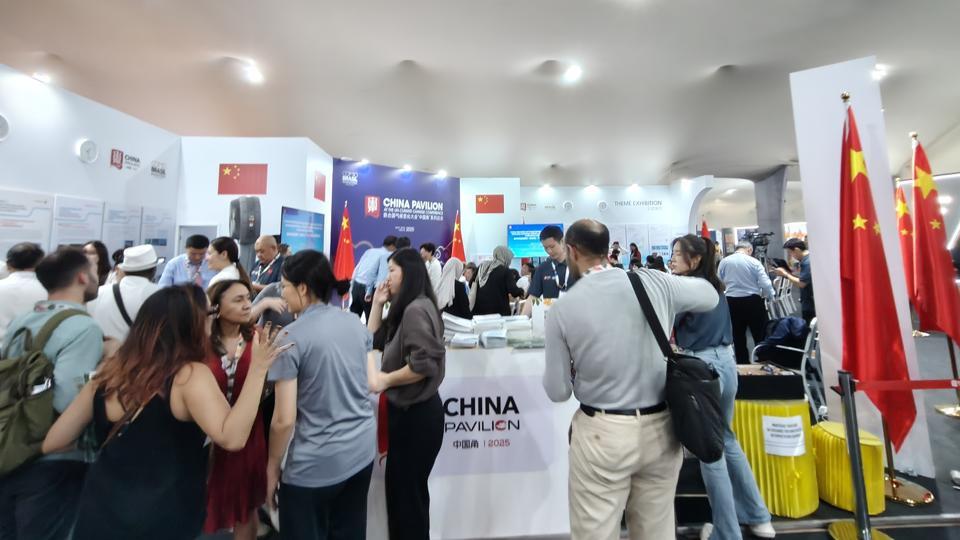
Optics aside, China has been leading the Global South at the climate talks. It has backed developing countries on the most contentious issue at COP30—Article 9.1 of the Paris Agreement. The provision mandates developed nations to finance developing countries for their climate change mitigation and adaptation.
India, as part of the Like-Minded Developing Countries (LMDCs) and China (G77+China), has been moving in lockstep on all major positions—treating Article 9.1 as the backbone of the Paris Agreement, and tying mitigation ambition to predictable finance.
On adaptation finance, both have insisted that any “ambition” conversation is meaningless without scaled-up public finance from developed countries. They have coordinated interventions that frame adaptation as grossly underfunded and demand new, additional, predictable support.
On trade, they have jointly opposed Unilateral Trade Measures (UTMs), arguing they are restrictive and incompatible with equity. India has framed UTMs as barriers that hurt developing countries. China backs the same line and stresses that climate ambition cannot be linked to trade conditionalities.
At a consultation, where the Chair opened the meeting by saying “this is a collective therapy session,” India, for LMDCs, shot back that therapy should be mandatory, not voluntary. China jumped in, “Not just therapy. We need yoga and a massage,” an observer said.
A developing country negotiator said China is fighting for developing countries. “There is no ambiguity that they are in the developing bloc as per the United Nations Framework Convention on Climate Change,” said the negotiator. “This may help get a balanced package out of Belem.”
China dominates the solar and wind component markets. It has a share of at least 60% for wind turbine manufacturing capacity. China is by far India’s largest trade partner in sectors such as solar PV and batteries. As of 2017, India was the top recipient of Chinese solar PV exports, at roughly $3.5 billion worth of goods, according to a UC San Diego School of Global Policy and Strategy white paper on the India-China clean energy trade.
On the opening day of the climate talks, COP30 President André Corrêa said that India and China will be major markets that will lower the price of energy transition globally, as both countries have embraced this transition. “In an extraordinary way, because they [China] added the elements that I believe were missing. One of them is scale, the other is technology, and the other is the fact that, as a developing country, it needs to bring solutions that are affordable to more people.”
He added he does not need to say how important China has become for EVs, for solar panels, for wind, for batteries. “But I think that there is also a consequence of that that is quite important to stress is that by lowering, thanks to their scale, by lowering the price of all these essential elements in the transition, they are at the same time doing an amazing job of cooperation, international cooperation.”
Corrêa, responding to a question on China’s role in the climate talks, said that if the solar panel now costs 90% less than a few years ago, many more people in the developing world can afford them.
Observers believe that China, the largest greenhouse gas emitter, is positioning itself to fill the void the US created by leaving the Paris Agreement, especially because it also has economic interests in the green transition.
Centre For Social and Economic Progress fellow Pooja Vijay Ramamurthi noted that President Xi Jinping pitched to remain committed to global climate goals at a COP event in April —the Leaders’ Summit on Climate and Just Transitions. “Xi has called out the protectionist stances of powers on the free circulation of high-quality green products,” said Ramamurthi last week.
She added that China may call for the continuation of multilateral platforms, encouraging countries to engage in constructive climate negotiations. “Rather than keeping a low profile, it is expected that China will portray itself as a champion of green transitions, given that other major powers such as the US are backing down.”
Asia Society Policy Institute’s China Climate Hub director Li Shuo said the European Union (EU) is embarking on a multi-layered, multi-front climate–trade confrontation, risking both capitulation to Trump and alienating many in the Global South. “The greatest danger is that it ultimately fails to achieve its intended objectives—gaining geopolitical partners, enhancing competitiveness, or reducing emissions. The EU’s longstanding green ambition is laudable, but in a rapidly evolving trade and geopolitical environment, its approach requires especially careful consideration,” said Li in a statement.
University of San Diego associate professor (economics) Teevrat Garg said India and China’s expanding clean-energy trade has the potential to define Asia’s decarbonization trajectory. “As COP30 begins, their collaboration shows that the future of the energy transition lies not just in moving green hardware across borders, but also in sharing the digital and behavioral innovations that make renewable systems work reliably.”
Garg said by pairing China’s manufacturing depth with India’s growing demand for flexible, tech-enabled energy solutions, the region is demonstrating that integration—of markets, data, and design—can accelerate both growth and decarbonisation.