E-Paper



Climate finance emerges as dominant issue as COP30 Summit opens in Brazil
Developing countries demanded support from developed nations amid ongoing disputes over agenda items

 Prefer HTon Google


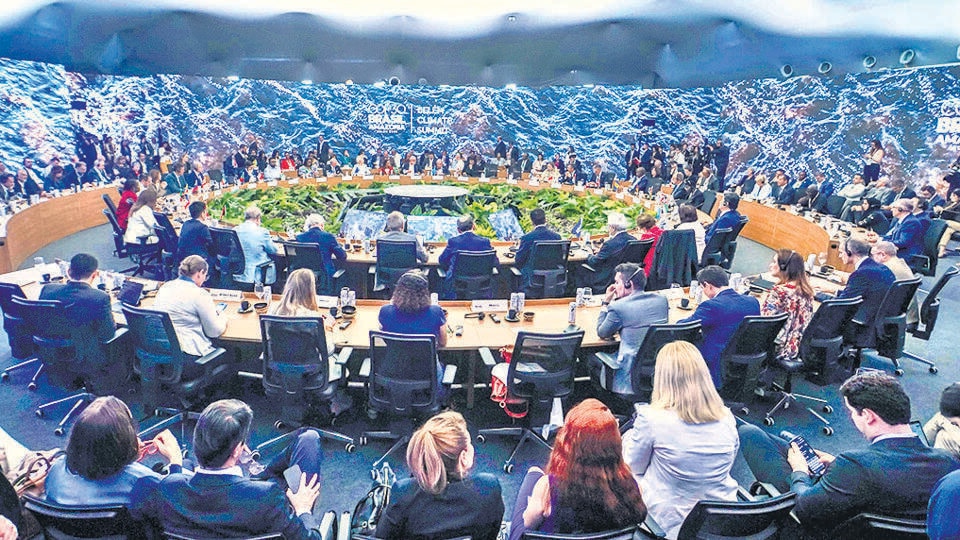
The COP30 Summit opened in Brazil’s Belem on Monday with a brief agenda dispute that was swiftly resolved before the formal opening ceremony, with climate finance emerging as the dominant issue for the summit.
The disagreement centred on Article 9.1 of the Paris Agreement, which mandates developed countries provide financial resources to assist developing nations with mitigation and adaptation. Developing countries, particularly the G77 bloc, demanded its inclusion on the official agenda following inadequate and unpredictable climate finance flows. Developed countries, including the EU, resisted. The matter was resolved after it was agreed Article 9.1 would be discussed under Presidency consultations rather than on the formal agenda. The June Bonn climate meeting had also been delayed over the same issue.
“India was among the first countries to raise concerns about the inadequacy of the finance outcome at Baku, and has carried that forward to Bonn demanding an agenda item on Article 9.1. This will remain crucial as finance is prominent in its absence and inadequacy across many tracks be it adaptation, mitigation and even the loss and damage fund that is yet to disburse fund. India must carry this mantle even at COP30,” said Avantika Goswami, programme manager at the Centre for Science and Environment’s Climate Change division.
Climate finance will be an important issue at COP30, observers said. The focus is particularly significant for India, which led a fierce pushback against the underwhelming finance deal at COP29 in Baku last year. On November 5, the Brazilian COP30 and Azerbaijan COP29 Presidencies released the ‘Baku To Belem Roadmap To USD 1.3T’, documenting how to deliver $1.3 trillion annually for developing countries from all international sources by 2035. However, this document will not be on the negotiating agenda.
During the opening ceremony, COP29 president Mukhtar Babayev handed the baton to incoming COP30 president André Corrêa do Lago while calling on parties to deliver on past promises, especially on finance.
“Today we are presenting donors with this invoice, which you can find on the COP29 media channels. This covers what donors have already promised. It includes the essential milestones that will keep us on track. First, we must double adaptation finance. This was due at the end of 2025... Second, we need to triple the UN climate funds by 2030. This was a key demand of Small Island Developing States. And we all agreed. So, we need substantial contributions to each fund’s next replenishment round. The invoice concludes with the 300 billion, promised by 2035. And, in the same way that we expect countries to publish ten years of plans in their nationally determined contributions (NDCs) and national adaptation plan (NAPs), we also expect donors to publish their plans for how they will deliver their fair share of the 300 billion over these years,” Babayev said.
Earlier in the day, Lago told media that rich countries have lost enthusiasm for combating the climate crisis while China is surging ahead in producing and using clean energy. Observers believe China, the world’s largest greenhouse gas emitter, is positioning itself to fill the void created by the US, particularly given its economic interests in the green transition.
“Earlier this year, at a COP event in April 2025 — the Leaders’ Summit on Climate and Just Transitions, President Xi Jinping made a strong pitch for China to remain committed to global climate goals. Xi has also called out the protectionist stances of powers of the free circulation of high-quality green products,” said Pooja Vijay Ramamurthi, fellow at the Centre For Social and Economic Progress.
Brazil President Lula da Silva used his opening speech to prioritise climate investments over military spending and restore multilateralism. “It is much cheaper to put 1 trillion 300 billion dollars for us to end the climate crisis than to put 2 trillion dollars and send 700 billion dollars to buy weapons and go to war. More than 30 years ago, at the Earth Summit meeting in 1992, the leaders of the world gathered in the city of Rio de Janeiro to discuss development and environmental protection,” he said.
“In that moment, multilateralism was experiencing its apex. The world was going to the so-called conference decades, where many great contacts guided humanity during these three decades. Between them came up the concept of sustainable development and the principle of common, but shared responsibilities, common but differentiated responsibilities. That is a legacy of Rio 92. Today, the climate convention is back in its home country. It makes the way back to reclaim the enthusiasm that has driven its birth,” Lula stressed, adding that over the next two weeks, Belem will become the capital of the world.
Paris Agreement working but more speed needed
UN Climate Chief Simon Stiell told the opening session that the Paris Agreement is working, with the emissions curve bending downwards. “Ten years ago in Paris, we were designing the future – a future that would clearly see the curve of emissions bend downwards. Colleagues - Welcome to that future. The emissions curve has been bent downwards. Because of what was agreed in halls like this, with governments legislating, and markets responding,” he said.
However, Stiell called on parties to accelerate efforts to return to the 1.5C goal after any temporary overshoot. “We must move much, much, faster on both reductions of emissions and strengthening resilience. The science is clear: we can and must bring temperatures back down to 1.5C after any temporary overshoot. Lamenting is not a strategy. We need solutions,” he said.
Stiell added that parties need not wait for late-submitted NDCs to identify gaps in mitigation and finance. “We don’t need to wait for late NDCs to slowly trickle in, to spot the gap and design the innovations necessary to tackle it. Not one single nation among you can afford this, as climate disasters rip double-digits off GDP. To falter whilst mega-droughts wreck national harvests, sending food prices soaring, makes zero sense, economically or politically. To squabble while famines take hold, forcing millions to flee their homelands, this will never be forgotten, as conflicts spread,” he said.
Stiell emphasised that the economics of the energy transition are indisputable. “Solar and wind are now the lowest-cost power in 90% of the world. Renewables overtook coal this year as the world’s top energy source. Investment in clean energy and infrastructure will hit another record high this year – with investments in renewables outstripping fossil fuels 2 to 1.”
NDC submissions show stark divide
According to a Centre for Science and Environment factsheet, a review of 65 new NDCs submitted between November 6, 2024 and October 2, 2025 representing over 30% of global emissions shows that 52 developing countries and 13 developed countries have submitted new pledges.
Developing countries’ pledges focus on access to climate finance, renewable energy expansion, adaptation and loss and damage priorities, and just transition pathways. Developed countries focus on economy-wide emission reductions and net-zero pathways, emphasising clean energy transitions, technological innovation and domestic policy instruments rather than conditionality or external finance.
Most significantly, 32 out of 65 countries — all developing nations — framed their mitigation targets as conditional on international support, stressing the obligations of developed countries to provide resources for climate action.
The official agenda for COP30 includes the Global Goal on Adaptation, the United Arab Emirates just transition work programme, and the Sharm el-Sheikh mitigation ambition and implementation work programme.