
 E-Paper



Coalition calculus fuels Bihar sweep for tight-knit NDA
Leaders credited the win to caste coalition-building, Nitish-Modi appeal, early groundwork and a no-negative-campaign strategy, backed by welfare schemes

 Prefer HTon Google


The 2025 assembly election in Bihar was not a typical electoral battle for the Bharatiya Janata Party (BJP) ; the state was a battle ground in more ways than one. The party had to walk the tightrope between balancing its own interests -- its graph has been on an ascendant in the state -- and that of the coalition it is part of, headed by long-time partner the Janata Dal (United). It also had to deal with anti-incumbency , and a seemingly energised opposition.
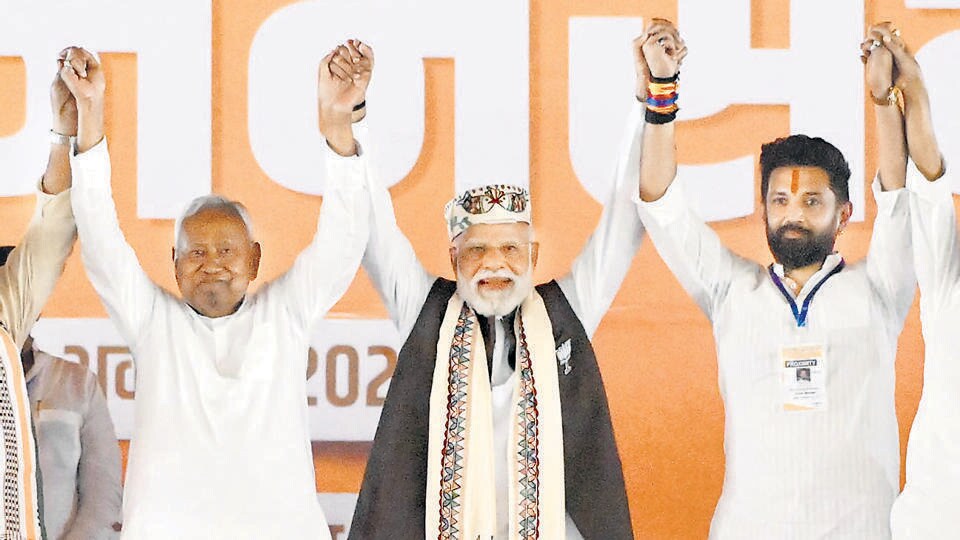
It has reason to be pleased with the results.
The NDA won 202 seats, with the BJP itself winning 89, making it the single largest party in a state where it has never had a chief minister.
Party leaders attribute the NDA’s landslide win to smart alliance politics, the choice of the right campaign issues, and the ability to leverage the popularity of chief minister and Janata Dal (United) leader Nitish Kumar and Prime Minister Narendra Modi.
Cohesive coalition
The first step, the leaders cited above said, was to bring together a coalition of castes. Getting on board a clutch of parties, each with its dedicated caste-based votebank, ensured that the NDA could cast its net wide.
According to senior party functionaries who played a pivotal role in negotiations between allies and steered the election campaign, the preparations for the Bihar polls began around the same time as the Lok Sabha elections last year, but after JDU’s support made it possible for the BJP, which did not have a majority on its own, to stake claim to form the government at the centre for the third time, the terms of engagement were revisited.
The BJP, which has habitually played big brother and the lead player of the NDA, had to opt for a less dominant role in Bihar. “The BJP has always maintained coalition dharma, even when we had the numbers and did not need allies . This time there were more allies so it was natural to face some challenges , but in the end it was a gathbandhan ka chunav (contest of the coalition) and we delivered,” said a senior party functionary.
In addition to the BJP’s upper caste votebank, the NDA had on board the JD(U), which counts the Extremely Backward Classes (EBCs) and a section of the Kurmi and Kushwaha (Koiri) communities, apart from women as its core support base; the Lok Janshakti Party (Ram Vilas) whose primary vote bank is the Paswan community, a major Scheduled Caste group; the Hindustani Awam Morcha (Secular) that banks on the Mushahar community, an extremely poor and marginalized SC group; and the Rashtriya Lok Morcha (RLM) that has the support from OBC Koeri community.
“It was the most cohesive campaign . There were no differences, no disagreements in the campaign. [BJP] Workers from around the nation did the work they were assigned in constituencies where the allies were contesting…there was no difference in canvassing for the allies be it the JDU or the LJP,” said Nawada Lok Sabha MP Vivek Thakur.
There were initial reports of HAM’s Jitan Ram Manjhi and RLM’s Khushwaha being upset over being given just six seats each to contest,but these differences were prevented from exacerbating. “Seat sharing is always tricky, as all parties feel they should have more seats. In this case, the BJP led by example and did not push for more seats even though our tally and strike rate in 2020 was better than that of the JDU…And once the senior leadership sat across to iron out issues the campaign took off without a glitch,” said the first functionary quoted above. All parties also dissuaded rebels from contesting as independents to prevent a division of votes.
While the BJP and JDU both contested on 101 seats, the LJP did 28. It was also the first time that the JDU and the LJP contested together as part of the NDA in the state.
Former union minister and senior BJP leader Ravi Shankar Prasad said, “It is a victory for hope, for trust and delivery. It is an iconic moment in the polity of India that people can transcend caste and rise to the occasion, that is the biggest lesson.”
While he also attributed the win to the long sustained work by PM Modi and CM Kumar for empowering women, the opposition’s “dirty campaign” also spurned people, Prasad said. “The dirty language they used for the CM and the PM was not liked and people reacted,” he said.
Their breeze, our storm
Once the contours of the alliance were firmed up, the parties settled on the campaign, which had two main planks: development and welfare schemes of a twin-engine government; and the opposition’s misrule or Jungle Raj when it was in power between 1990 and 2005, something experienced by 90% of the state’s current electorate. From Prime Minister Narendra Modi to booth karyakartas (workers),everyone warned about the return of Jungle Raj , contrasting this with the improvement in law and order under Nitish Kumar.
“Jungle Raj in Bihar during Lalu Prasad Yadav’s rule was a reality. And people have not forgotten it. In fact, the vote bank that supports the RJD, had preemptively begun to flex muscle, thinking that Tejashwi (Yadav) will come to power and people of other castes did not want that…” Thakur said .
To buttress their claims, party leaders point out how killings and booth capturing were a common feature during Jungle Raj. There were 63 deaths reported during the 1985 election and 87 in 1990. In 1995, the Election Commission stepped in to defer polls four times because of unprecedented violence and electoral malpractices.
The campaign itself had two layers, and two time-frames. The first started well before the polls were announced, around five months ago, and saw meetings in every major assembly constituency addressed by leaders from various alliance partners. Once elections were announced, the campaigners, PM Modi, union ministers, chief ministers of other BJP-governed states, and senior leaders hit the ground.
Labarthis or beneficiaries of the government schemes are now counted as a vote bank by the BJP. In Bihar too, the party went all out to woo labarthis with budgetary allocations worth ₹60,000 crore (union budget) and a cash transfer of ₹10,000 under the Mukhyamantri Mahila Rojgar Yojna.
“The cash transfer was a game changer…women from Muslim and Yadav communities, (the base of the RJD) went against their families to vote for the NDA. There are at least 30 seats that are M-Y dominated where the NDA has done exceptionally well. This shows the impact of our social schemes, which cut across caste and religion, eventually proving unki hawa thi, hamari aandhi (the wind was on their side, but we had a storm on ours),” said a second party functionary.
The BJP also ensured there was no “negative campaign”, with no leaders making incendiary remarks or polarising comments. “It was a lesson drawn from 2015…” added the second leader.
In 2015 , the BJP ran a polarising campaign, pitting Muslims against Hindus.
Modi and Nitish and the win of GYAN
Chief minister Nitish Kumar remained the face of the election, despite concerns about his age and declining health. He was also positioned as the “only” socialist leader who together with PM Modi walked the talk on development.
“Our cadre on the ground focussed on how for the PM and the CM together are a formidable force with a track record of delivering and with a development-driven agenda. This election proves GYAN (garib, yuva, annadata, nari- Poor, Youth, Farmers and Women) have trumped caste. The concept of GYAN, coined by the PM has ushered in the biggest change in Bihar’s politics, that is riddled with caste barriers,” said the second functionary.
BJP leaders said the opposition’s over-reliance on the M-Y combination led to its undoing while the sharp rise in the tally of the JDU, the BJP and the LJP is being seen as a manifestation of people’s faith in the alliance government’s schemes for women, young people, and deprived sections.
“The NDA has managed to garner a large voteshare in 160 seats influenced by the BC(backward class) and EBC (extremely backward class) demographics. The direct implication of this is that all sections have voted in favour of the NDA,” the second functionary said.
A senior functionary of an RSS offshoot said both the party and its ideological mentor, the RSS worked to shift voter preference from caste to development.
“Since Jana Sangh days there has been an effort to consolidate the castes. It was all the more imperative to do so in Bihar, which is considered as the land of the socialist movement but for political reasons remained chained to the binary of Mandal-Kamandal,” added this person
The Sangh, this person said, was concerned by the grouping of certain dominant castes such as the Yadavs with Muslims as a bloc against the BJP.


