E-Paper



Supreme Court tightens rules to curb 'digital arrests', RBI to frame SOPs to deal with mule bank accounts
The RBI has been asked to prepare a comprehensive SOP for dealing with bank accounts opened or used to receive and transfer proceeds of cyber fraud.

 Prefer HTon Google


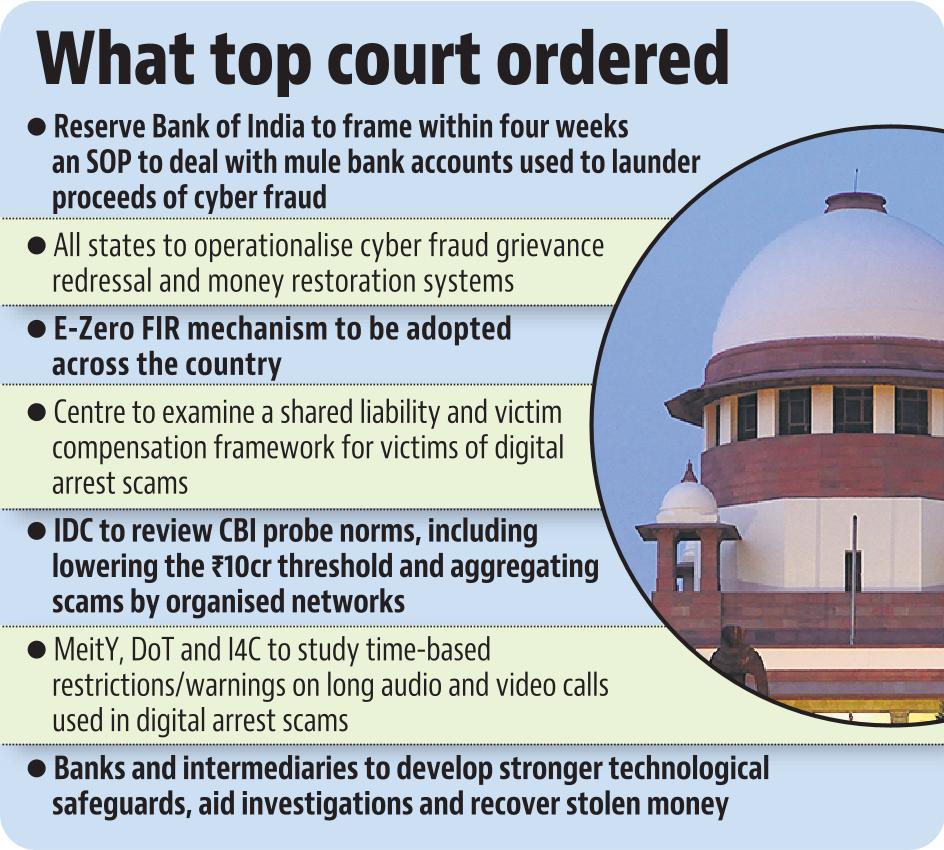
The Supreme Court on Tuesday stepped up its oversight of the country’s battle against the growing menace of “digital arrest” scams, issuing a fresh set of nationwide directions aimed at plugging systemic gaps in cyber fraud investigations, speeding up the restoration of victims’ money and strengthening preventive mechanisms. Among its key directions, the court asked the Reserve Bank of India (RBI) to frame within four weeks a standard operating procedure (SOP) for dealing with mule bank accounts used to launder proceeds of cyber fraud, directed all states to operationalise cyber fraud grievance redressal and money restoration systems, called for the adoption of the e-Zero FIR mechanism across the country, and asked the Centre to examine a shared liability and victim compensation framework for victims of digital arrest scams.

The directions were passed by a bench led by Chief Justice of India Surya Kant hearing a suo motu case initiated to monitor the country’s response to digital arrest frauds, where fraudsters impersonate police officers, CBI officials, judges or other government functionaries to extort money from victims through prolonged video calls and psychological intimidation.
The bench, also comprising justices Joymalya Bagchi and V Mohana, was considering the fourth status report submitted by the Indian Cyber Crime Coordination Centre (I4C) under the Union home ministry, along with notes filed by Attorney General R Venkataramani and senior advocate NS Nappinai, the amicus curiae assisting the court.
ALSO READ | Supreme Court proposes no fuel for uninsured vehicles, seeks Centre's plan
Vigilance remains essential: SC
While noting that the government’s coordinated efforts have led to a significant decline in reported cases, the bench emphasised that sustained vigilance remained essential and that institutional mechanisms had to be further strengthened. “The trend is certainly encouraging…but continued monitoring remains indispensable,” observed the bench while referring to the decline in complaints.
According to the status report, complaints relating to digital arrest scams on the National Cyber Crime Reporting Portal have fallen from 123,672 in 2024 to 58,249 in 2025 and further to 16,377 till June 30 this year. The reported amount lost to such frauds has also reduced substantially.
Venkataramani told the court that the law enforcement response had also improved considerably. Over 36,000 cases have been investigated, while more than ₹18 crore has been restored to victims through the government’s money restoration mechanism. High-value digital arrest cases continue to be investigated by the Central Bureau of Investigation (CBI), while other complaints are handled by state police forces.
A ‘kill switch’
At the same time, the court took note of submissions made by Nappinai that digital arrest frauds continue to evolve despite the fall in numbers. She suggested that the government examine a technological “kill switch” under which messaging platforms such as WhatsApp could automatically terminate unusually long video calls or display warning pop-ups to users where calls continue for six to twelve hours, a common feature in digital arrest scams.
Accepting that the proposal deserved examination, the bench directed the Ministry of Electronics and Information Technology (MeitY), the Department of Telecommunications (DoT) and I4C, in consultation with intermediaries, to study the technical feasibility, safeguards, possible alternatives and use cases of imposing time-based restrictions on audio and video calls, and place a report before the court.
RBI asked to prepare SOPs within four weeks
One of the most significant directions issued on Monday concerned RBI. The central bank has been asked to prepare and circulate, within four weeks, a comprehensive SOP for dealing with mule accounts –– bank accounts opened or used to receive and transfer proceeds of cyber fraud and money laundering. The SOP will also be circulated to the registrar generals of all high courts.
The court also directed all states, Union territories and law enforcement agencies to operationalise without delay the grievance redressal module and the money restoration module developed under the home ministry’s January 2, 2026 SOP for handling cyber fraud complaints through the National Cyber Crime Reporting Portal and Cyber RMS. States have also been directed to create public awareness about these mechanisms so that victims can seek quicker relief.
Recognising that victims frequently approach courts seeking de-freezing of bank accounts or recovery of money, the bench asked the registrar generals of every high court to inform all courts and adjudicating authorities dealing with cyber fraud matters about the grievance redressal mechanism. At the same time, it clarified that using this mechanism would not prevent any person from pursuing statutory or constitutional remedies before courts.
The court also sought greater transparency in measuring the effectiveness of the recovery mechanism. It directed that the next status report should include state-wise and bank-wise data on complaints registered, complaints disposed of, restoration orders issued, successful restorations and the amount restored.
Noting that only 14 states have so far operationalised State Cyber Crime Coordination Centres and that the e-Zero FIR mechanism is functional in only 19 states, the bench directed the remaining states to notify their coordination centres within four weeks and adopt the e-Zero FIR system in consultation with I4C. The central agency has been asked to assist states in implementing these measures.
The bench further directed authorities to ensure expeditious disposal of matters relating to freezing of bank accounts arising from cyber-enabled financial frauds, an issue that frequently delays recovery of funds for victims and businesses alike.
The Inter-Departmental Committee (IDC), which is coordinating the government’s response to digital arrest scams, has also been directed to intensify nationwide awareness campaigns on cyber frauds, the grievance redressal and money restoration mechanisms, cyber security measures and procedures available for recovery of defrauded money. The court also recommended that all State Legal Services Authorities undertake public awareness drives on preventing digital arrest scams.
In another important direction, the bench asked the IDC to consult banks and technology intermediaries on introducing technological safeguards to prevent digital arrest scams, improve recovery of money, facilitate investigations and ensure compliance with legal obligations.
The court also accepted Nappinai’s suggestion that victims require greater institutional support beyond existing legal remedies. It directed the IDC to examine and discuss a proposal for introducing a shared liability and victim compensation framework for digital arrest scams, potentially paving the way for a structured compensation mechanism for victims.
On the investigative front, the court took note of the CBI’s progress in handling organised cyber fraud networks. The status report records that the agency has registered 10 digital arrest cases and several connected matters. In one investigation alone, the CBI identified 238 victims, traced 67 first-layer bank accounts, tracked transactions worth nearly ₹80 crore and carried out searches at 93 locations spread across 16 states.
The bench also asked the IDC to continue examining whether the existing ₹10 crore threshold for mandatory CBI investigation should be lowered and whether multiple frauds committed by the same organised network should be aggregated for determining the threshold for central investigation.
The matter will next be heard on September 16, when the Centre is expected to file a fresh consolidated status report on compliance with the court’s directions.