
 E-Paper



Rahul Gandhi closes popularity gap with PM Modi ahead of 2019 Lok Sabha elections, says CSDS-Lokniti survey
The CSDS-Lokniti survey also shows that an equal number of respondents (43%) like Prime Minister Narendra Modi and Congress president Rahul Gandhi now.

 Prefer HTon Google


Forthcoming assembly elections in the states of Rajasthan and Madhya Pradesh can bring more bad news for the Bhartiya Janata Party (BJP) if the results of a survey by CSDS-Lokniti are to be believed.
The survey shows that the Congress is ahead of the BJP in these two states by 5 percentage points and 15 percentage points, respectively (See Chart 1). Given the fact that these two states witness a bipolar contest, this gap in vote share could translate into an even larger gap in seat share.
These survey findings have been released with the third round of CSDS-Lokniti Mood of the Nation (MOTN) survey which has been conducted among more than fifteen thousand respondents across 19 states between 20 April and 17 May. The previous two rounds were conducted in May 2017 and January 2018, i.e. just after the assembly election results of Uttar Pradesh and Gujarat.
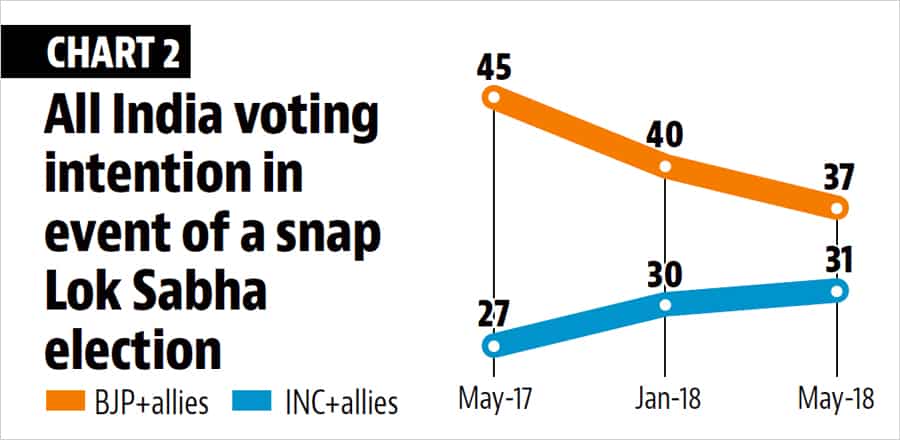
The results show that anti-incumbency has been catching up with the Narendra Modi government and BJP’s lead vis-à-vis the Congress has fallen to less than half in the past one year (See Chart 2).
More than half of India’s religious minorities and Dalits are against giving another chance to the Modi government; the survey says. Majority of Hindu upper castes and lower OBCs however are in favour or giving another chance to the government (See Chart 3).

The survey also shows that an equal number of respondents (43%) like Prime Minister Narendra Modi and Congress president Rahul Gandhi now. While Gandhi seems to be gaining among his adversaries, Modi is losing out among his fans. 25% of the respondents said they did not like Modi earlier but like him now. This number is 29% for Gandhi. In contrast, 35% of the respondents who liked Modi earlier reported to having picked a dislike for him. This number is just 22% for Gandhi. Gandhi’s popularity however does not seem to be translating into support for the Congress or the United Prpgressive Allaince (UPA).
The survey shows that non-UPA parties have gained more among farmers (8 percentage points) in the last one year who have turned against the National Democratic Alliance (NDA) (a swing of 12 percentage points) in a big way.
To be sure, political surveys; including that of the CSDS-Lokniti, have often been way off the mark in the past. However, the broad message from the latest MOTN survey – anti-incumbency is finally catching up with the BJP but the Congress alone cannot claim to be the biggest beneficiary from it – seems to be in congruence with the larger political narrative.


