
 E-Paper



Contemporary epicentre of terror still very much active: Jaishankar at UNSC
Jaishankar said the briefing was part of India’s efforts in the UN Security Council to “re-invigorate the counter-terrorism agenda”.


India on Thursday called for collective action to tackle terror groups such as al-Qaeda, Islamic State, Boko Haram and Al Shabab and the “contemporary epicentre of terrorism”, with external affairs minister S Jaishankar describing terror as an existential threat to global security.
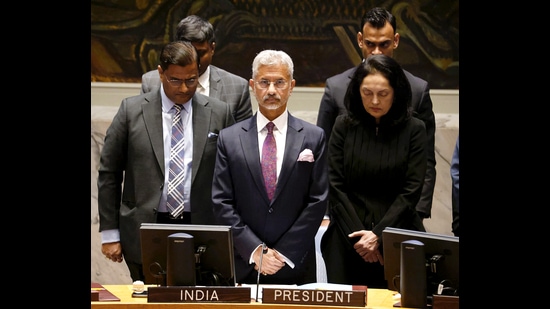
Though Jaishankar did not name any countries while chairing a UN Security Council briefing on the theme of “Global counter-terrorism approach: Challenges and way forward”, it was apparent he was referring to Pakistan.
The briefing, one of two high-level events chaired by the external affairs minister as part of India’s presidency of the UN Security Council during December, was joined by the ministers of Ireland, the UAE, the UK, the US, Kenya and Ghana. There was also a video message from Anjali Kulthe, a nurse at Cama and Albless Hospital and a survivor of the 2008 Mumbai terror attacks carried out by the Pakistan-based Lashkar-e-Taiba (LeT).
Also read | ‘Hosting Osama, attacking Parliament’: Jaishankar slams Pakistan at UNSC
Jaishankar said the briefing was part of India’s efforts in the UN Security Council to “re-invigorate the counter-terrorism agenda”.
He said: “And that is overdue because the threat of terrorism has actually become even more serious. We have seen the expansion of Al-Qaida, Da’esh, Boko Haram and Al Shabab and their affiliates. At the other end of the spectrum are ‘lone wolf’ attacks inspired by online radicalisation and biases.
“But somewhere in all of this, we cannot forget that old habits and established networks are still alive, especially in South Asia. The contemporary epicentre of terrorism remains very much active, whatever gloss may be applied to minimise unpleasant realities.”
Jaishankar said the Security Council is “well aware that terrorism is an existential threat to international peace and security”, and a challenge that the world community must combat collectively. He added that Kulthe’s testimony is a “stark reminder to the Council and the international community that justice is yet to be delivered to the victims of several terrorist incidents, including the 26/11 Mumbai attacks”.
He outlined four challenges confronting the international counter-terrorism architecture — terror financing and state culpability, ensuring the integrity and accountability of counter-terror multilateral mechanisms, addressing double standards in countering terrorism, and countering the threats of the misuse of new technologies by terrorists.
In the context of state culpability, the “question now arises as to the responsibilities of the state from whose soil such actions are planned, supported and perpetrated”, Jaishankar said. He also contended that uniform criteria are not applied to sanctioning and prosecuting terrorists, an apparent reference to China, which has blocked the sanctioning of several Pakistan-based terrorists at the UN Security Council.
In an obvious reference to Pakistan, Jaishankar said: “The response of the sponsors of terrorism is not to give up but to conduct and execute their agenda at an arm’s length. To do this, they create narratives of limitations and difficulties. We buy such explanations at our own peril.”
He also took a swipe at China, which has used the so-called technical hold to block terrorist designations at UN Security Council, saying, “The working methods of relevant mechanisms is also a subject of legitimate concern and debate. At one level, we have seen protections that come close to justification. Then, there are evidence-backed proposals that are put on hold without assigning adequate reason.”
In view of all these challenges, Jaishankar called on the world community to adopt a “comprehensive, contemporary, and result-oriented approach” to counter terrorism.
“When it comes to tackling terrorism, we must overcome political differences and manifest a zero-tolerance approach,” he said.
“Let me conclude by emphasising that we cannot let another ‘9/11 of New York’ or ‘26/11 of Mumbai’ happen again,” he added.


