
 E-Paper



Cop decodes old script to settle ₹10k-cr land cases
Over the course of the next two decades, as Mane slowly made his way from a sub-inspector to assistant police commissioner in Pune, he also kept deciphering the maze of the now-antiquated Modi script, an extraordinary achievement that helped turn him famous not just among the legal and police circles, but also linguists.


In September 1988, Ramakant Mane was training at the Police Training Academy in Nashik, when he received a letter. The letter — from his retired father, who lived in Kolhapur— was a call of distress. His father, then 60years old, had lost his ancestral lands in Kohlapurin a court case because the land records were all in an obscure script of Marathi that had faded from use in the early decades of the 20th century. No one in the area, including Mane’s father Kareba Mane, could decipher what was written on the land documents.
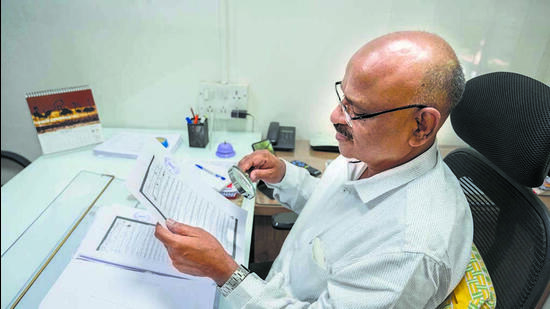
“I decided at that time itself that I would learn the language,” said Mane.
Over the course of the next two decades, as Mane slowly made his way from a sub-inspector to assistant police commissioner in Pune, he also kept deciphering the maze of the now-antiquated Modi script, an extraordinary achievement that helped turn him famous not just among the legal and police circles, but also linguists. Since 2014, officials say, he has helped resolve nearly 50 land title disputes across the state using his mastery of the script that was widely used in official bookkeeping till 1950, when the script was withdrawn from school textbooks.
“To resolve the disputes, we need a list of evidence and in many cases provide documents from the 18th century, scripted in Modi lipi. I learnt the script which helped me to study old documents related to particular properties,” Mane said.
The land parcels involved in the disputes are mainly from the Pune, Jalgaon, Ahmednagar, and Mumbai regions. The cumulative price of the land is worth ₹10,000 crore, although ascertaining the exact figure will be difficult given that land rates keep varying, said senior officials. These cases were pending for decades as the departments had put them on the back burner, given the lack of people who could unlock the secrets of the script.
“We are proud of this achievement. Mane has been able to spare time to help to solve some major issues,” said R Raja, deputy commissioner of police, special branch.
The decline of the script
Various theories abound on Modi script, used for writing Marathi in the 18th century. One of them is that it is believed to be derived from broken Devanagari characters, which supports that etymology. The script, according to experts, is difficult to learn.
Linguist and Maratha history expert, Pandurang Balkawade, said,“In 1957, Modi script was withdrawn from the school textbooks and slowly replaced by the devanagari Marathi. So those who were in school before 1957 know the Modi script very well.”
Balkawade conducts Modi language courses in Bharat Itihas Sanshodhak Mandal in Pune claiming that there are only 200- 250 people in Maharashtra who can write and read Modi script.
In most cases, the land allotted to the police department was under British regime, although its ownership remained with someone else.
A property gets a “clear title” when its ownership is without any dispute and liens. Issued by the local governing authority of a state under revenue department, the title clearance certificate is proof confirming no debt or border encroachment is associated with it and is clear of all kinds of encumbrances. Therefore, Mane’s knowledge of the script proved particularly useful in settling land titles.
The turnaround
The turning point came in 2008, when he was posted at the caste validity department, which validates caste certificate submitted by candidates during elections, in Solapur. Mane faced a roadblock, like his father had, while dealing with a case pertaining to election caste validity certificate, which proves that a person belongs to a certain caste. He joined a three-month professional course in Solapur to better his knowledge of the script at the behest of the department.
“Thereafter, I started visiting the Peshwa Daftar (a Peshwa documents office, in Pune, that houses archival material dating back to the time of Chattrapati Shivaji) and studied many Gaon Namuna Patre (documents pertaining to land records in villages) and related documents in Modi script, which I later used to unravel various land title cases,” Mane said.
Mane studied various revenue and appeal documents, and government resolutions since 1850.
Today, his work has cleared disputes from nearly 200 acres of land, 60% of which is from Pune district, 20% from Mumbai district and the rest from Ahmednagar and Jalgaon. Mane has also helped BJ Medical College, College of Engineering Pune (COEP) and Pune district court to clear their land titles.
“One can get permission for land development only when the land title is clear, failing which, the state government will not provide funds. Many projects have faced roadblocks due to this challenge. When I provided the documents, it became easier for them,” Mane said.
Prominent among these disputes were the title of the Pune Police Commissionerate’s office, which stands on over a two-acre plot, near Pune station, in 2016. The commissionerate’s land — although with the department — was owned by a church. It took the cop two years to straighten it out.
Looking ahead
Peers and seniors have taken note of his contribution. “This is social service. It is commendable that he was able to ace it despite day-to-day difficulties and a hectic work schedule. We are happy to have him on our team and are hopeful that many more officials will similarly come forward,” said R Raja.
Balkawade said,“Work on Modi is the necessity of this era, because there are around 5 crore Modi script documents that are available in Peshwa Daftar (Peshwa-era document office) in Pune and around 25 lakh Modi script documents are available in Bharat Itihas Sanshodhak Mandal in Pune. These documents are related to Peshwa and Maratha history. If we are ignoring towards Modi then how we can know our brave history.”
He has received cash rewards 45 times for his contribution in this field, as recorded in his service book. But he is not keen to rest on his laurels. For now, he has started studying the Raigad fort and Ahmednagar subah (villages, as they were called during Shivaji’s time), collecting documents and studying them in the Modi script.
He recently published a book titled, History of the Nrusinhawadi, on the Duttaguru temple in Sangli district. Mane hopes to do more, encouraging scholarly discourse on Modi lipi. “I am doing this all as a part of my hobby. When you are interested in something, you manage to make time for it. It is not extra work,” he said.


