E-Paper



COP28: Developing nations raise objections to draft text on Global Goal on Adaptation
Developing countries have also raised the issue of common by differentiated responsibilities and respective capabilities (CBDR-RC) being of critical consideration

 Prefer HTon Google


Several developing countries have raised objections to the draft text on the Global Goal on Adaptation (GGA) released on Sunday, with India insisting that the difference in adaptation and mitigation strategies be clearly laid out in the targets that at present are prescriptive and mitigation oriented. A second iteration of the adaptation text was released on Monday evening which was not very different from the first.
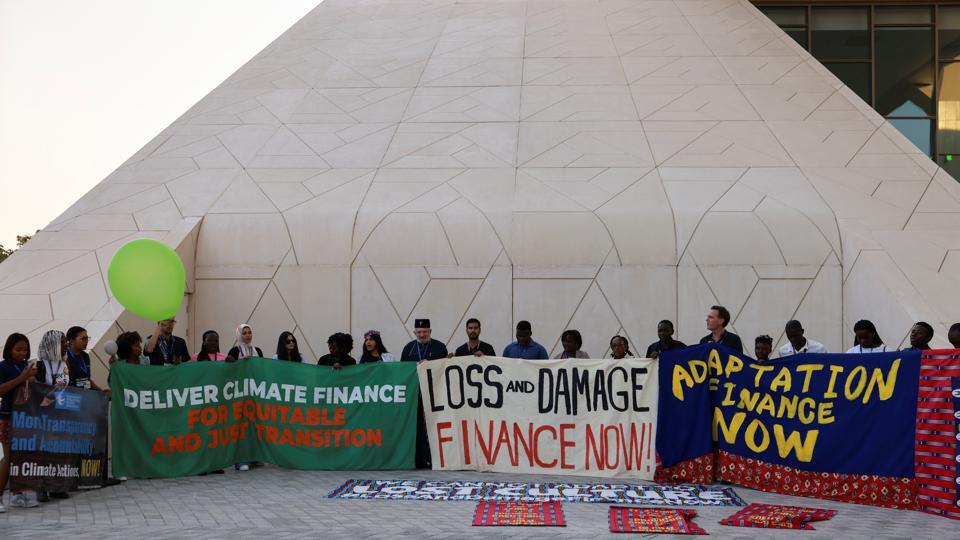
Indian officials said that financial flows for adaptation and mitigation can get muddled if the text is adopted in its current form, while also objecting to terms like “maladaptation” and “transformational adaptation”, an Indian official said requesting anonymity.
“Most targets are mitigation centric. This can muddle financial flows to adaptation and mitigation. All the targets including the one on attaining climate-resilient food and agricultural production and supply; strengthening resilience against climate-related health impacts are mitigation oriented. Terms like maladaptation and transformational adaptation are also not acceptable to us,” the official said.
While mitigation requires measures to address the underlying problem by slowing or stopping the rise in emissions, adaptation is needed to withstand and minimize the impacts of the climate crisis.
According to the United Nations Framework Convention on Climate Change (UNFCCC), maladaptation is “any changes in natural or human systems that inadvertently increase vulnerability to climatic stimuli; an adaptation that does not succeed in reducing vulnerability but increases it instead”.
Experts said that these terms in the draft text indicate that developed countries want to curtail climate finance, adding that the classification of maladaptation is subjective.
“Why is there no mal-mitigation? Is all mitigation good? What about mitigation that puts the burden on the poor? However, there is no such category for mitigation. But there is one for adaptation. It is therefore clearly linked to the fact that developed countries want as many ways to curtail finance as possible. Classification of what is maladaptation and what is not, is virtually impossible. And where it is done is extremely subjective, and sometimes downright wrong,” said an Indian observer who did not wish to be named.
Developing countries have also raised the issue of common by differentiated responsibilities and respective capabilities (CBDR-RC) being of critical consideration.
According to a report by the Third World Network on Monday, China, on behalf of Like-Minded Developing Countries (LMDC), during a heads of delegation meeting on GGA on Sunday said that CBDR-RC should be in the text without any other alternative option and emphasised that strengthening adaptation action must be based on means of implementation and climate finance from developed countries.
It emphasised that the developed countries should provide financial resources to assist adaptation action in developing countries in line with their obligations under the Convention and Article 9.1 of the Paris Agreement (PA).
The US, on the other hand, echoed the call of the Environment Integrity Group (of Switzerland and others) in mainstreaming adaptation into development as an overarching element.
The US also called for targets that are globally relevant and lasting, and sought balance on finance in the text. It also said that discussions on finance for the New Collective Quantified Goal (for the post-2025 period) should not be prejudged.
But what may be sticking point with developing nations, the US has said it will not support any references to CBDR in the text, preferring the “no text” option in this regard.
HT reported on Sunday that a first draft text on the Global Goal on Adaptation, that is expected to be negotiated at COP28, was released on Sunday morning which captured the long-term adaptation efforts that countries are supposed to make towards reducing vulnerability of countries and communities from extreme climate impacts.
In India, public finance covers most of the adaptation-based activities through flagship programmes, schemes etc. Around 40 ministries have adaptation relevant budgetary provisions. The total adaptation relevant expenditure was 5.6% of the GDP in 2021-2022, growing from a share of 3.7% in 2015-16, the communication said. India also informed in its national communication that the large gap to fulfil adaptation needs cannot be met only through government resources.
The text lists out at least seven adaptation targets that countries need to take by 2030. These include attaining climate-resilient food and agricultural production and supply; strengthening resilience against climate-related health impacts, promoting climate-resilient health services, and reducing climate-related morbidity; increasing the resilience of infrastructure and human settlements to climate change impacts to ensure basic and continuous essential services for all and substantially reducing poverty and livelihood vulnerability in areas with high climate risk.