
Sign in

‘Cremating, burying bodies of Covid-19 patients is safe’: Bengal govt

Bengal government’s advisory noted that the main driver of transmission of covid-19 is through droplets. There is no risk of Covid-19 infection from a dead body to health workers, family members or in the locality who follow standard precautions while handling body

Updated on: Apr 3, 2020, 15:24:43 IST
Hindustan Times, New Delhi | By
Share
Share via
  • facebook
  • twitter
  • linkedin
  • whatsapp
Copy link
  • copy link

There is no chance of transmission of coronavirus in crematorium or burial area, Mamata Banerjee’s Bengal government has said in an advisory to state officials and the public.
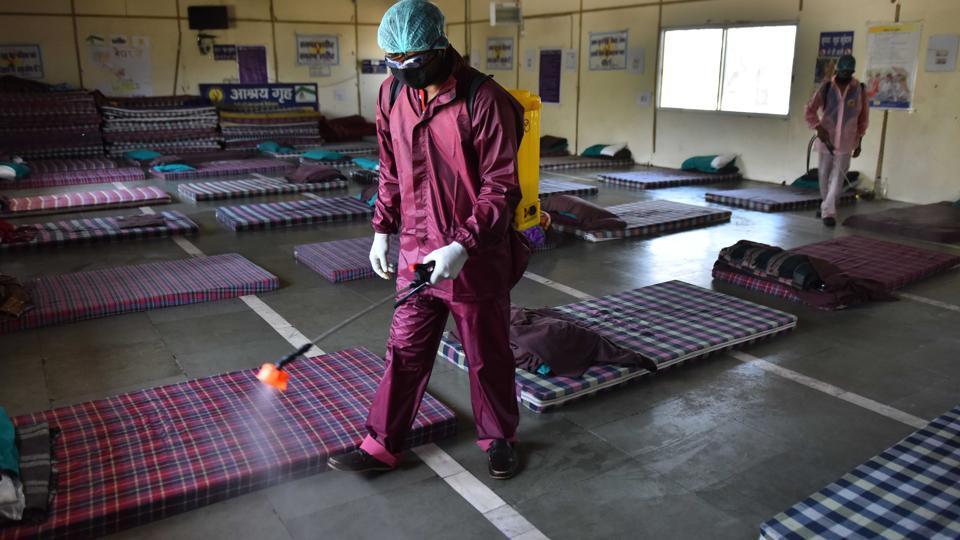
Workers from an NGO spray disinfectant during the sanitization of a night shelter in Delhi on day 9 of the 21-day nationwide lockdown to check the spread of coronavirus. (Sanchit Khanna/HT PHOTO)

The advisory came after instances of protests and chaos by residents living in the vicinity of cremation grounds. In one case, residents had put up road blockade to stop government officials from cremating an elderly man, Bengal’s first casualty. There had been similar protests elsewhere too.

Three people have been confirmed to have died in Bengal due to coronavirus, according to data released by the Union health ministry.

Follow latest updates on coronavirus here

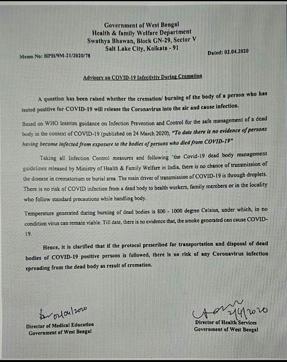
The Bengal health department advisory quoted from the World Health Organisation guidance and the Union health ministry guidelines to underline that there was no evidence of people becoming infected from exposure to bodies of persons who die from Covid-19.

The advisory noted that the main driver of transmission of Covid-19 is through droplets. There is no risk of Covid-19 infection from a dead body to health workers, family members or in the locality who follow standard precautions while handling body

“Temperature generated during burning of bodies is 800-1,000 degree celsius, under which, in no condition, can the virus remain viable,” it said.
Article image

It also emphasised that there was no evidence either that the smoke generated from the pyre can cause Covid-19.

“Hence, it is clarified that if the protocol prescribed for transportation and disposal of dead bodies of Covid-19 positive persons is followed, there is no risk of any coronavirus infection spreading from the dead body as result of cremation,” the notice said.

But Bengal isn’t the only state that has had protests, fueled by the health scare around coronavirus and rumours. There were similar protests in Delhi too when the first death was reported several days earlier. The Union health ministry had soon after issued guidelines on disposal of bodies and placed a restriction on the number of people who can be part of the last journey of the patient.

Click here for complete coronavirus coverage

  • Shishir Gupta
    ABOUT THE AUTHOR
    Shishir Gupta

    Shishir Gupta is Executive Editor at Hindustan Times and one of India's top journalists covering national security, strategic affairs, foreign policy and geopolitics. Over the past three decades, he has extensively reported on India's military, diplomatic and security landscape, covering every major conflict and national security challenge, from the 1999 Kargil War and the 2020 East Ladakh standoff to Operation Sindoor in 2025. He has also covered major terror attacks, including the IC-814 hijacking, the 26/11 Mumbai attacks and the 2025 Pahalgam terror strike, along with numerous Pakistan-backed terrorist incidents in the Kashmir Valley and across India. He has reported on national and state elections for more than three decades. A recognised authority on strategic affairs, Gupta has covered India's nuclear programme since the Pokhran-II (Shakti series) tests in May 1998 and has written extensively on global nuclear issues, Indian diplomacy and the country's expanding global outreach. He has also reported widely on international conflicts and terrorism, with a special focus on the Indian subcontinent. Gupta has interviewed Prime Minister Narendra Modi more than four times, including Modi's first interview with the print media after becoming Prime Minister in May 2014. His other interviews include three with the Dalai Lama, as well as conversations with Benjamin Netanyahu, Amit Shah, Yogi Adityanath, S. Jaishankar, Nirmala Sitharaman and Piyush Goyal. He is the author of Indian Mujahideen: The Enemy Within (Hachette, 2011) and Himalayan Face-off: Chinese Assertion and Indian Riposte (Hachette, 2014). He was awarded the Chevening-Wolfson Joint Scholarship at Wolfson College, University of Cambridge, UK, in 1998 and participated in the International Visitor Leadership Program (IVLP) of the US State Department in 2006. He received the Ben Gurion Prize from Israel in 2011 and the K. Subrahmanyam Prize for Strategic Studies in 2015 from the Manohar Parrikar Institute for Defence Studies and Analyses (MP-IDSA). Since 2024, he has hosted Point Blank, Hindustan Times' weekly YouTube show on global geopolitics.Read More